
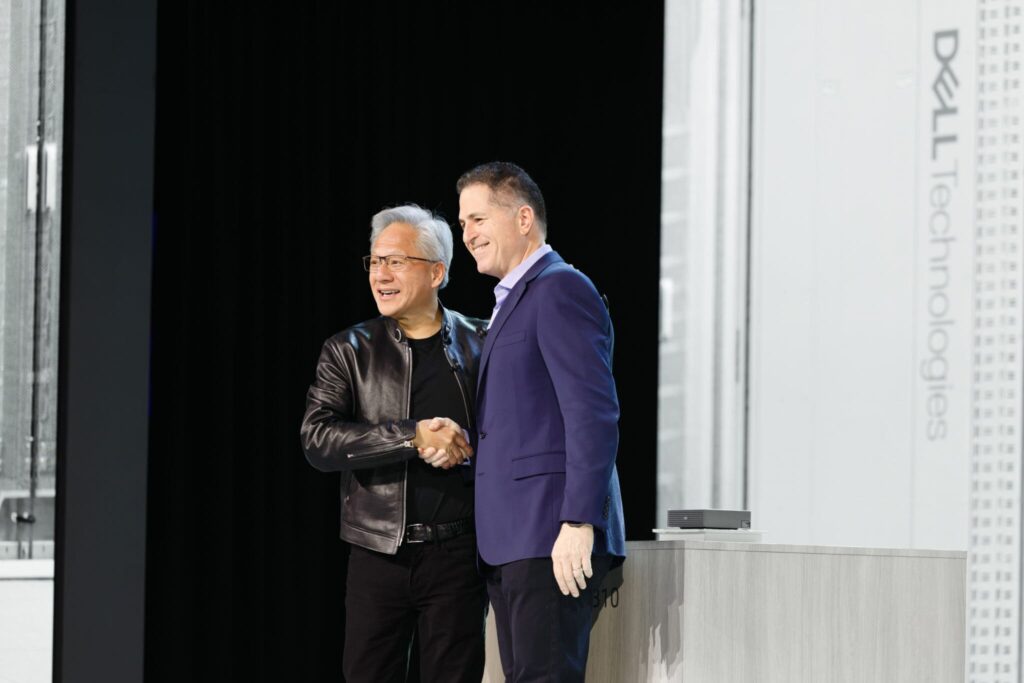
Jensen Huang once again used a powerful image to describe the current state of enterprise artificial intelligence. At Dell Technologies World, NVIDIA’s CEO stated that demand “has become parabolic,” a way to summarize what Dell and NVIDIA aim to sell to the market: AI is no longer just in testing phases but is entering real deployments, with autonomous agents, large-scale inference, and models running within the enterprise itself.
The core message is clear. Companies have shifted from experimenting with chatbots and isolated pilots to questioning how to integrate AI agents into internal processes, databases, code, documentation, industrial operations, and sensitive workflows. This brings up the big debate: what portion of that AI should run in the public cloud and what part should be moved to on-premises infrastructure, whether on-premise, colocation, edge, or advanced workstations.
Dell AI Factory with NVIDIA: From Pilot to Production
The keynote by Michael Dell and Jensen Huang centered around Dell AI Factory with NVIDIA, a solution combining servers, networking, storage, software, services, and models to deploy end-to-end enterprise AI. NVIDIA describes it as a platform for autonomous agents ranging from “deskside” workstations to entire data center racks. Dell emphasizes that enterprise AI requires security, governance, and more predictable costs than strategies based solely on cloud APIs.
The figures presented help illustrate the scale of this commitment. According to Dell, global spending on AI infrastructure could reach between $3 trillion and $4 trillion by 2030, while token consumption would grow by 3,400% in the same period. These are stakeholder projections, but they point to an already-visible reality: as AI moves from demo to production, inference costs, data availability, and infrastructure efficiency are as critical as the chosen model.
| Data Announced by Dell and NVIDIA | Number |
|---|---|
| Number of companies using AI loads with Dell AI Factories with NVIDIA | 5,000 |
| Estimated global AI infrastructure spending through 2030 | $3-4 trillion |
| Projected token consumption growth by 2030 | 3,400% |
| AI workloads already running outside the cloud, according to a Dell survey | 67% |
| Companies surveyed with at least one on-premise AI workload | 88% |
| Estimated savings of Dell Deskside Agentic AI versus cloud APIs over two years | up to 87% |
| Estimated break-even point versus public cloud APIs | from 3 months |
It’s important to interpret these figures with caution. Savings compared to the cloud will depend on usage volume, model type, energy consumption, technical personnel, hardware amortization, and availability needs. Still, the argument is becoming familiar to many companies: if AI agents constantly query internal data, execute code, work with confidential documentation, and generate tokens over hours, purely cloud-based models can become difficult to control.
Vera Rubin, PowerEdge, and the Cost-Per-Token War
The most powerful aspect of the announcement lies in the new generation of accelerated infrastructure. Dell introduced the PowerEdge XE9812 based on NVIDIA Vera Rubin NVL72, a platform that NVIDIA claims can reduce inference costs per token by up to 10 times compared to Blackwell at large-scale agent inference. Additionally, the new servers—PowerEdge XE9880L, XE9885L, and XE9882L—are built on NVIDIA HGX Rubin NVL8, supporting up to 144 GPUs per rack and liquid-cooled compute nodes.
The focus is no longer solely on training ever-larger models. The new front line is in serving inference massively, cheaply, and reliably. AI agents no longer just respond to a single question and stop; they can consult tools, split tasks, generate and review code, access databases, retrieve documents, validate responses, and repeat steps. This multiplies token usage and increases pressure on CPUs, GPUs, memory, networking, and storage.
NVIDIA Vera, the CPU designed for these workloads, is another key piece. Dell will integrate it into PowerEdge M9822 and R9822 servers. According to NVIDIA, Vera provides 1.2 TB/s of memory bandwidth and completes agent inference tasks 50% faster than traditional x86 processors in the scenarios cited by the company. There’s also mention of up to a 3x improvement in analytical queries with Starburst over Vera CPUs for large-scale SQL.
| Product or Technology | Role in Strategy |
|---|---|
| Dell PowerEdge XE9812 with NVIDIA Vera Rubin NVL72 | Large-scale agent inference and cost reduction per token |
| PowerEdge XE9880L, XE9885L, and XE9882L with HGX Rubin NVL8 | Liquid-cooled servers for high GPU density |
| NVIDIA Vera CPU | Sequential agent workloads, analytics, data pipelines, sandboxes |
| Dell PowerSwitch with Quantum-X800 and Spectrum-6 | High-performance network for AI clusters |
| Dell PowerRack | Integrated compute, networking, and storage system for AI and HPC |
| Dell AI Data Platform with NVIDIA | Enterprise data prep, search, analytics, and model integration |
The rack infrastructure is also gaining prominence. Dell PowerRack is presented as an integrated system where computing, networking, storage, cooling, energy management, and software are designed as a single unit. The takeaway is clear: in large-scale AI, just buying GPUs isn’t enough. Real performance depends on networking, liquid cooling, power supply, storage, and operational integration.
Local Agents, Protected Data, and Controlled Models
One of the recurring ideas during the event was the need to bring AI closer to the data. Dell Deskside Agentic AI enables deploying AI agents on local workstations with NVIDIA NemoClaw, NVIDIA OpenShell, and Nemotron models, in addition to Dell Pro Max systems with GB10 and GB300, and Dell Pro Precision stations with Blackwell RTX GPUs. The setup covers models ranging from 30 billion to 1 trillion parameters, depending on configuration.
This approach makes sense for engineering, research, design, finance, public sector, or regulated industries. An agent working with source code, intellectual property, health data, legal documentation, or industrial information can’t always rely solely on external APIs. Dell and NVIDIA’s alternative is running agents locally, testing near the data, and then scaling to the corporate data center when the use case matures.
Security relies on NVIDIA OpenShell, an open-source runtime for developing and deploying agents with privacy controls and corporate policies. NVIDIA Confidential Computing is also part of the strategy, which Dell links with partners like Fortanix, Google, and Red Hat to protect models and data during use. The goal is to enable deployment of advanced models within the enterprise perimeter without exposing model weights or sensitive information.
The model and partner ecosystem has expanded. NVIDIA mentions Nemotron as an open model option for companies wanting to fine-tune weights to their domains. Dell and NVIDIA also discuss Reflection, MiniMax, DeepSeek, GLM, Kimi, Mistral, Gemma, and others available via Dell Enterprise Hub on Hugging Face. OpenAI Codex will connect with Dell AI Data Platform to incorporate company codebases, documentation, and business systems.
The message to CIOs and infrastructure leaders is direct: agent-based AI will not be deployed solely as another SaaS app. Many cases will require a dedicated architecture, with governed data, authorized models, activity logs, execution isolation, secret protection, and a network capable of supporting heavy flows between agents, tools, and internal systems.
There’s also an economic perspective. As agents produce more tokens and perform increasing amounts of background work, the variable API cost can become unpredictable. Building internal infrastructure may not always be cheaper but offers greater control when use is stable, intensive, and sensitive. For sporadic loads, cloud remains reasonable; for daily enterprise data work, the calculus starts to shift.
The Dell-NVIDIA alliance signals where the market is heading: less abstract talk about “using AI” and more emphasis on racks, liquid cooling, specialized CPUs, internal data, security, token costs, and real deployments. Enterprise AI is entering a less glamorous but much more crucial phase: transforming pilots into systems that operate reliably every day.
Frequently Asked Questions
What did NVIDIA announce alongside Dell at Dell Technologies World?
NVIDIA and Dell showcased new components of Dell AI Factory with NVIDIA, including systems with Vera Rubin, PowerEdge servers, Dell PowerRack, Dell Deskside Agentic AI, NVIDIA OpenShell, and new model and partner integrations for enterprise AI.
Why does Jensen Huang say that AI demand is “parabolic”?
Because companies are shifting from isolated testing to inference and AI agents in production. This jump increases token consumption, computing needs, and infrastructure pressure.
What is Dell Deskside Agentic AI?
It’s a solution to run AI agents on local workstations, featuring open models, NVIDIA NemoClaw, and OpenShell, designed for teams that need to work with sensitive data without relying solely on the cloud.
Will enterprise AI move entirely outside the public cloud?
Not entirely. The most likely scenario is hybrid. Some workloads will remain in the cloud, but sensitive data, persistent agents, and certain tailored models can operate on-premises, in colocation, at the edge, or on local workstations.
via: blogs.nvidia
