
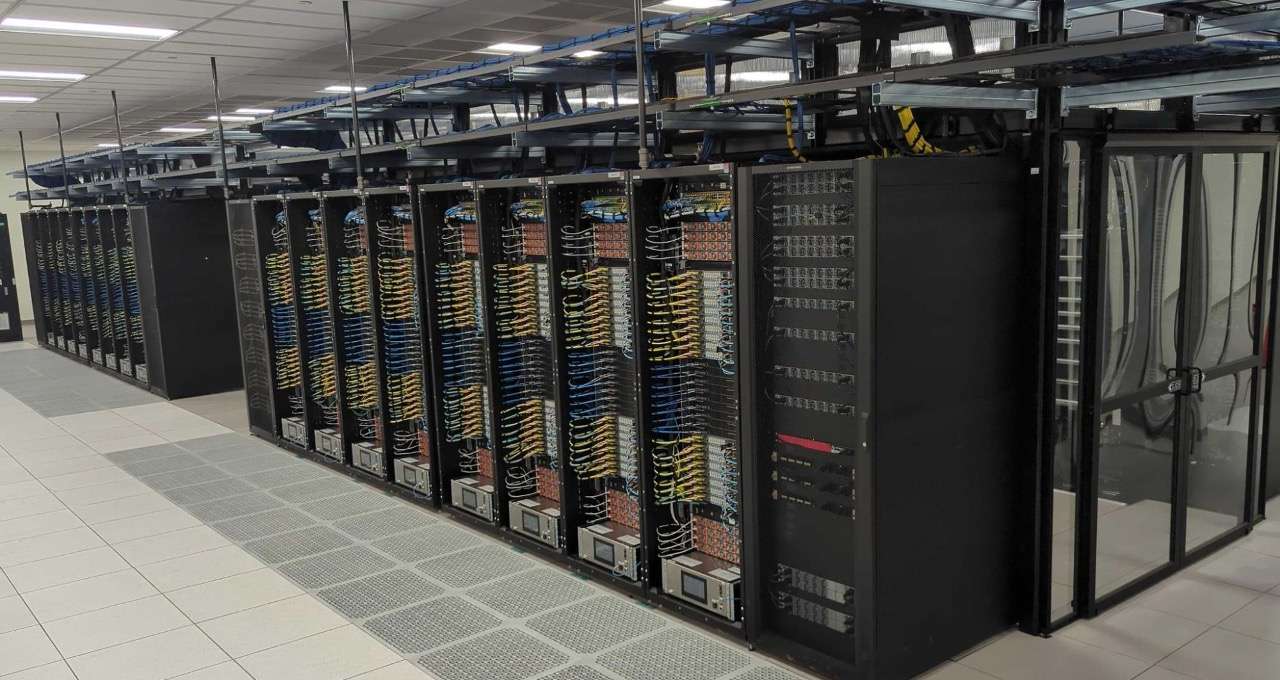
The NVIDIA A100 accelerator, introduced in 2020 and surpassed since then by several generations of GPUs for artificial intelligence, will continue generating revenue for CoreWeave until 2029. The company has confirmed a contract extending the commercial use of these chips for up to nine years after their launch, a fact that challenges one of the main concerns surrounding massive AI infrastructure investments: that hardware becomes economically obsolete in just two or three years.
Key points on AI GPU lifespan in 20 seconds
- CoreWeave has signed a contract to use and lease NVIDIA A100 GPUs until 2029.
- Ampere launched in 2020, so some A100s will still be generating income nine years later.
- Older GPUs find roles in inference, model fine-tuning, and other less demanding workloads.
- Available electricity, cooling, and CUDA also extend their economic utility.
This news goes beyond a second life for a specific model. Over recent years, investors and data center operators have tried to estimate how long an AI GPU can remain profitable as NVIDIA and AMD accelerate their release cycles and introduce new architectures almost annually.
The case of the A100 now provides a real reference. A GPU can stop being the best option for training the largest models on the market and still remain perfectly useful for other tasks.
A 2020 GPU still in the market
NVIDIA introduced the Ampere architecture and the A100 in May 2020. Since then, Hopper, Blackwell, and new platforms that multiply available performance for certain AI workloads have arrived.
This might suggest that an A100 has little place in a modern data center. However, the market demonstrates that the situation is considerably more complex.
During its Q2 2026 earnings presentation, CoreWeave explained it secured A100 capacity through 2029. Its CFO, Nitin Agrawal, also pointed out that previous GPU generations maintain strong prices, while CEO Mike Intrator argued there is demand for these platforms.
Market rental prices support at least part of this thesis. Silicon Data maintains a specific index for the A100, describing it as a GPU still widely used for inference, fine-tuning, and cost-sensitive training. Data shows that an active market persists six years after its launch.
This doesn’t mean the price stays static over its entire lifespan. An analysis by J.P. Morgan published in early 2026 noted that GPU rental rates observed in neoclouds and hyperscalers had fallen between 20% and 25% over the previous year. However, the same report highlighted that A100s continued to achieve high utilization and positive margins beyond the initial two or three years.
Here, an important distinction arises between technological depreciation and economic obsolescence.
An A100 can lose value and cease to be competitive for a specific task without becoming a worthless asset.
Not all AI workloads require Blackwell or Rubin
The evolution of models is also helping to prolong the usefulness of existing hardware.
Quantization, more efficient kernels, memory optimization, compilers, and software improvements enable certain workloads to be run using fewer resources. The CUDA ecosystem also evolves, keeping older hardware within a common software platform.
This results in an infrastructure hierarchy increasingly similar to what has existed in servers for decades.
Newer platforms can be reserved for frontier model training and tasks where performance, memory, bandwidth, or operational power justifies their cost. Older generations can be shifted to inference, data processing, small models, fine-tuning, or enterprise workloads where absolute performance is less critical than cost.
Silicon Data currently positions the A100 as a lower-cost option compared to H100 and B200, precisely for this reason. Their index shows that previous generations maintain steady demand for inference and tuning workloads, while some training shifts toward more recent accelerators.
There’s also a much more physical limitation at play.
Switching from one GPU generation to another isn’t always just about removing an old server and installing a new one.
Modern AI platforms may require much higher power per rack, liquid cooling, new networks, and modifications to the data center’s electrical distribution.
Tom’s Hardware highlights this difference when analyzing CoreWeave: air-cooled DGX A100 systems can function at around 6.5 kW, while modern GB200 and GB300 configurations can raise rack power needs to approximately 120-140 kW.
A data center designed for traditional racks cannot simply increase density twentyfold by buying new GPUs.
This creates an economic space where maintaining older hardware remains viable where upgrading entire electrical and thermal infrastructure isn’t justified.
The A100 tests billions of dollars in GPU depreciation
The commercial lifespan of GPUs has significant financial implications.
Constructing AI infrastructure involves hundreds of billions of dollars. Servers and accelerators are purchased directly, but also financed through debt, leasing, and other structures heavily reliant on the hardware’s future value.
If a $30,000 GPU stops generating income after two years, the financial picture differs markedly from one where the asset can operate for six, eight, or nine years—even if revenues decline gradually.
That’s why NVIDIA advocates for an interpretation of AI infrastructure as a long-term financed asset.
The company collaborates with major financial firms like BlackRock, Blackstone, Brookfield, Goldman Sachs, KKR, and Apollo around mechanisms aimed at mobilizing up to $500 billion for AI infrastructure. The economic lifespan of GPUs is a key variable in making this financing work.
CoreWeave’s contract provides support for this thesis, though it doesn’t guarantee all GPUs will have nine years of commercial life.
Future demand, electricity costs, performance-per-watt improvements, and model evolution can produce very different outcomes depending on each generation.
There’s also a risk that an abundant supply of older accelerators will push prices downward.
From the fastest GPU to a portfolio of generations
The most interesting consequence might be how data centers for AI are designed in the future.
So far, much of the discussion has focused on acquiring the latest GPU. But a large-scale operator could find it more economical to manage multiple generations simultaneously.
Blackwell or Rubin can handle the most demanding workloads. Hopper can stay in high-performance tasks. Ampere can continue in workloads where cost per hour matters more.
This approach allows for longer amortization of the initial investment and avoids replacing servers that are still generating revenue.
It also partially alleviates supply chain pressures, which are still influenced by the availability of advanced memory, packaging, networking, energy, and data center capacity.
The rental market already reflects this segmentation. As of late July, indices published by Silicon Data show different prices for A100, H100, H200, B200, and MI300X, indicating that AI computing is evolving toward a market with varying performance and price levels instead of automatically replacing each previous generation.
The A100 is unlikely to ever be the GPU everyone seeks again. Nor does it need to be.
If CoreWeave manages to keep it contracted until 2029, it will have been nearly a decade since its debut until the end of the contract. For a component born in one of the fastest innovation cycles the industry has seen, that longevity significantly shifts the conversation on how long an AI GPU can really last.
Frequently Asked Questions
Until when will CoreWeave use NVIDIA A100s?
CoreWeave has confirmed a contract maintaining capacity based on NVIDIA A100 until 2029, nine years after the Ampere architecture was launched in 2020.
Why is an NVIDIA A100 still useful in 2026?
Although much faster GPUs exist, the A100 remains suitable for inference, fine-tuning, processing, and other workloads where cost can outweigh the benefits of the latest architecture.
Can an old GPU remain profitable?
Yes, as long as utilization is sufficient and revenues outweigh energy, operational, and maintenance costs. CoreWeave’s contract shows that at least some clients still find long-term economic value in the A100.
Why not replace all A100s with Blackwell or newer GPUs?
Besides hardware costs, newer platforms often require much more power, liquid cooling, and other infrastructure. Upgrading a GPU can also mean transforming large parts of the rack or even the entire data center.
