
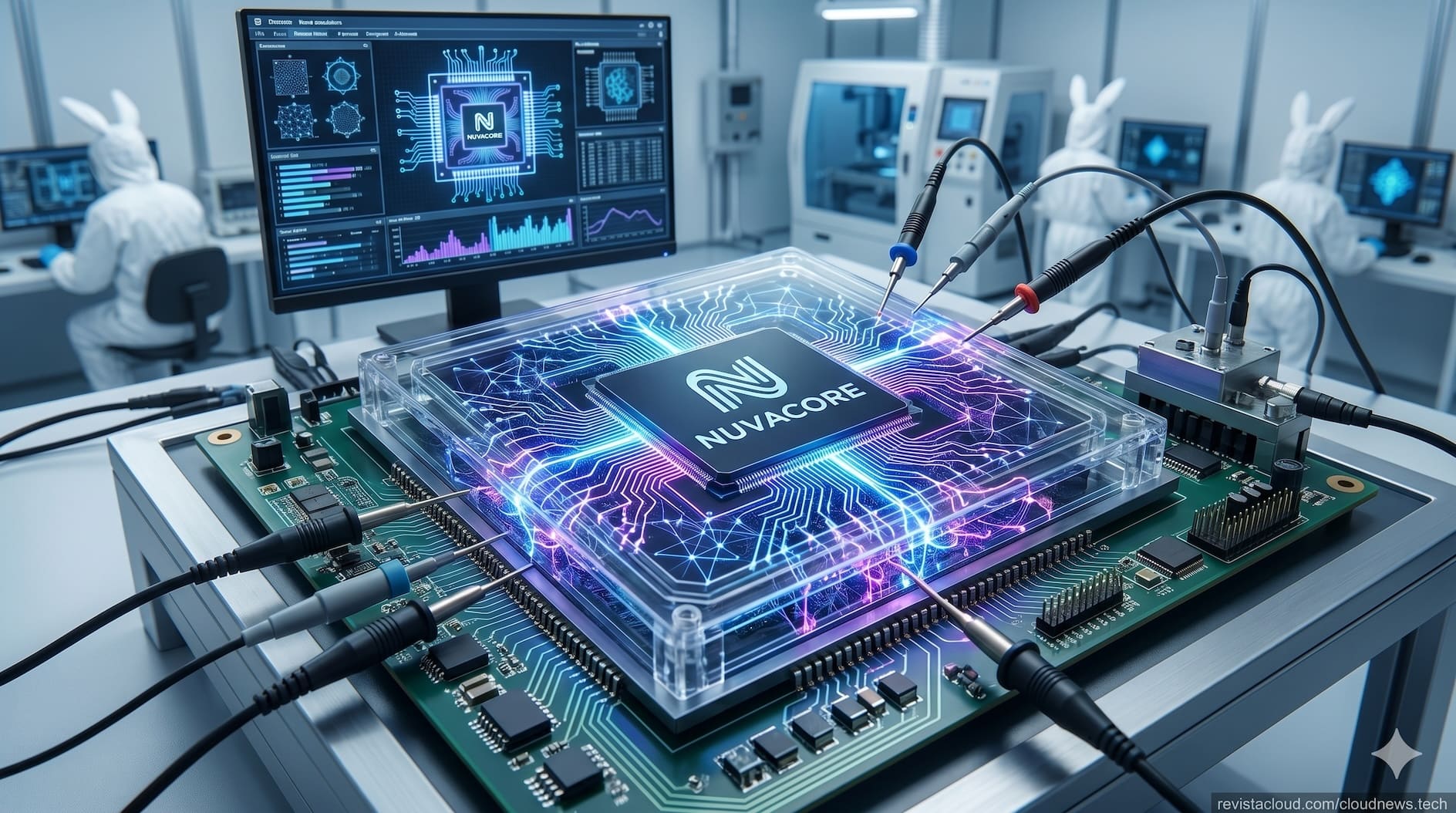
The craze around Artificial Intelligence has sparked increased attention on GPUs, but there’s another piece of the puzzle that remains critical in data centers: the CPU. Now, a new contender has emerged in this space, backed by high-profile names. Gerard Williams, John Bruno, and Ram Srinivasan have launched Nuvacore, a processor startup promising to “rewrite the rules of silicon” with support from Sequoia Capital. The company itself states that it is developing a general-purpose CPU core designed to perform “from basic infrastructure to advanced AI systems,” including continuous workloads associated with agnostic computing.
Nuvacore is not presenting itself as just another firm in the crowded chip market. Its message directly addresses the rise of AI and the mounting pressure on computing infrastructure. On its website, the company claims the industry has spent too long iterating on outdated architectures, and with the explosion of AI and critical infrastructure, “iteration is no longer enough.” Its approach centers around three core ideas: maximum performance, extreme efficiency per silicon area, and a completely new design from scratch.
The move draws attention not only for the message but also because of who is backing it. Sequoia identifies Williams, Bruno, and Srinivasan as the founding team and describes Nuvacore as a company focused on two main pillars: peak performance and absolute area efficiency. It also emphasizes that the project aims not just at traditional data center workloads but specifically at the “intense and continuous” demands of advanced AI systems and agnostic computing.
The founders’ prior histories help explain why this announcement has generated so much anticipation. Qualcomm completed its $1.4 billion acquisition of Nuvia in 2021 and framed that move as a way to strengthen its CPU roadmap and extend its technological reach across markets, from laptops to infrastructure networks. In that official statement, Qualcomm identified Gerard Williams as former CEO of Nuvia and now a senior vice president of engineering at Qualcomm.
What Nuvacore is proposing now is, in essence, a new twist: not a legacy design or an incremental evolution of an existing family, but a general-purpose core conceived specifically for the new AI infrastructure cycle. The startup has not publicly detailed which ISA it will use nor shown specific specifications, tape-out timelines, or manufacturing partners. However, it has opened key positions in firmware, validation, observability, platform software, microarchitecture, performance modeling, and operating systems—clear signals that the project aims to build a complete stack around the processor, not just the logical core design.
The big question is whether there’s still room for a new CPU in a market already occupied by established giants and where public discourse almost exclusively revolves around NVIDIA, AMD, Intel, or specialized AI accelerators. The short answer is yes, because AI isn’t solely dependent on GPUs. Large-scale model deployments also rely heavily on CPUs to coordinate memory, power accelerators, move data, run control services, manage networking, storage, auxiliary inference, and much more. In practice, as AI infrastructure grows, the importance of having efficient, well-balanced, and highly optimized CPUs for sustained workloads continues to increase.
This context explains Nuvacore’s narrative focus. The company talks about “long, intensive, always-on workloads,” language that aligns with many inference platforms and agent systems that no longer operate in bursts but continuously. The core promise is that the CPU of the future for AI should not be a mere auxiliary component but a purpose-built element to coexist seamlessly with accelerators and support saturated infrastructure around the clock.
For now, it remains a promise. The market still doesn’t know whether Nuvacore will lean towards Arm, RISC-V, or another architecture, nor whether it intends to sell IP, manufacture complete processors, or partner with hyperscalers. Customer plans, timelines, and benchmark metrics are also still unclear. However, the very fact that a team with this background is re-entering the scene, now backed by Sequoia, is enough to command industry attention.
In a moment when nearly all hardware discussions revolve around AI acceleration, Nuvacore serves as a reminder of something often forgotten: the CPU has not disappeared from the map. What is at stake now is whether someone can redefine its role within the new architecture of data centers.
What this movement means for AI infrastructure
Ahead of the initial noise, Nuvacore’s appearance points to a broader trend: AI infrastructure is becoming more fragmented and specialized. Simply having more chips is no longer enough; what matters is which type of chip best solves each system layer. In this context, a CPU designed with a focus on sustained performance, area efficiency, and coexistence with accelerators could be valuable to cloud providers, inference platforms, and companies developing custom silicon.
It also signals that the battle for AI isn’t decided solely in models or data centers but also at the fundamental computing architecture level. If Nuvacore succeeds in translating its vision into a real product, the startup could become one of those small players that don’t instantly disrupt the entire market but force the giants to respond.
Frequently Asked Questions
What exactly is Nuvacore?
It’s a new processor startup founded by Gerard Williams, John Bruno, and Ram Srinivasan. The company states it is developing a general-purpose CPU core from scratch for data center infrastructure and AI.
Who is funding the project?
Sequoia Capital is listed as a partner in the company’s public profile within its portfolio.
Is it related to Nuvia?
Yes, at least in terms of the founders’ history. Qualcomm acquired Nuvia in 2021 for $1.4 billion.
Has Nuvacore revealed what architecture it will use?
Not yet. In its current public presentation, the company hasn’t disclosed the ISA or shared detailed technical specs of the core.
Image generated by AI.
