
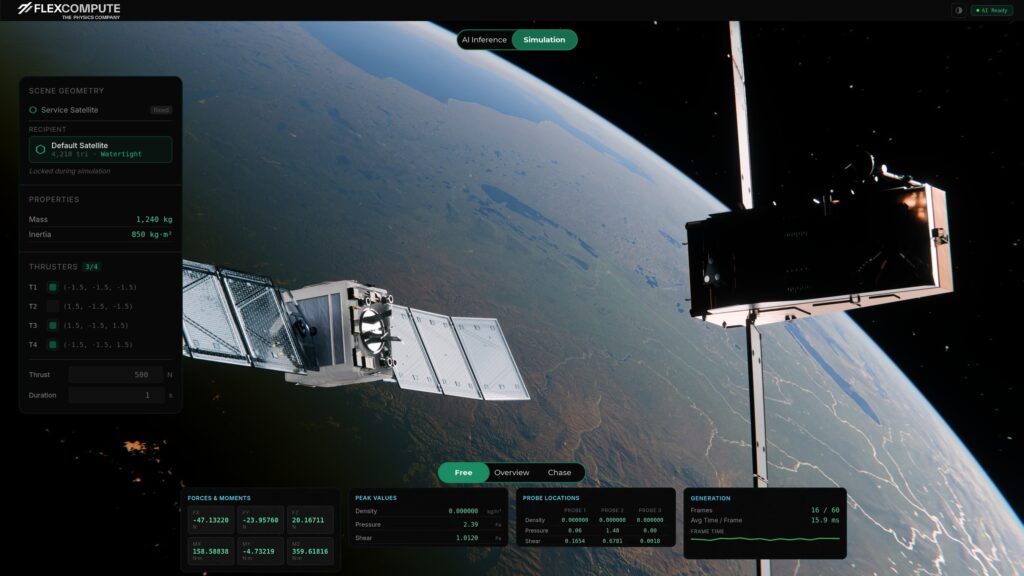
Artificial Intelligence continues to penetrate areas traditionally dominated by complex numerical simulation codes. The latest development comes from the aerospace sector: Flexcompute and Northrop Grumman claim to have developed, using NVIDIA technology, a physical AI infrastructure capable of fully automating a simulation workflow to predict in real time the effects of propulsion plume impacts during space docking maneuvers. According to both companies, this approach could reduce the preparation time for certain missions by up to 100 times.
The figure is striking, but it’s important to interpret it precisely. It’s not presented as a general reduction across all phases of a space mission, but as an improvement in a very specific and critical part of the process: modeling complex interactions between a thruster’s jet and nearby structures of a spacecraft or other orbital vehicle. In the announcement, the companies state that the new model can provide predictions within seconds, compared to traditional workflows that require months of preparation and large volumes of high-fidelity simulations.
Why “plume impingement” remains a serious issue in space
The challenge they aim to address is significant. NASA maintains specialized tools to analyze plume impingement, the effect produced by gases expelled from a thruster impacting nearby surfaces during proximity and docking operations. The agency explains that its EMPIRE software is used to calculate loads, mass flow, impact heating, and surface temperatures in complex geometries during maneuvers affecting systems like the ISS, Orion, HLS, and Gateway components.
Understanding this context helps clarify the announcement. In the vacuum of space, gases expand rapidly, creating thermal and mechanical effects that are difficult to reproduce on Earth and costly to simulate with conventional methods. NASA also reminds us that for such rarefied gas environments, specialized tools based on methods like DSMC are employed, because classical computational fluid dynamics (CFD) is insufficient to accurately model these phenomena.
The operational importance is clear. Insufficient calculations in this domain can impact orbital maintenance maneuvers, approaches, vehicle rendezvous, docking, or even robotic operations. The flexible automation of modeling these effects, coupled with reliable uncertainty estimates, is especially critical when making decisions that affect vehicle control and safety. The announcement emphasizes that the models include explicit uncertainty estimation, a vital feature when critical operational decisions depend on prediction accuracy.
What does physical AI truly add over traditional simulation?
The technological foundation of this project is NVIDIA PhysicsNeMo, an open framework designed to build, train, and deploy AI models tailored to physics and engineering problems. NVIDIA describes it as an open, scalable platform for developing models that combine physical knowledge with data, enabling near real-time inference. It also features optimized architectures and pipelines for training and inference at scale.
Building on this, Flexcompute claims to have added proprietary architectures, physics-guided constraints, and specialized training strategies for modeling nozzle plumes and space robotics interactions. The core message is that the system does not replace high-fidelity simulation outright but leverages it to generate a faster surrogate model capable of real-time responses without losing physical consistency. In engineering, this balance between speed and rigor is key to the value of these tools.
The industrial promise is clear. If a team can move from extensive simulation campaigns to nearly instantaneous predictions with quantified uncertainty, the impact extends beyond software to operational efficiency. Preparation times shorten, scenario testing becomes faster, control strategies can be adjusted on the fly, and resources like fuel and structural margins can be optimized — potentially extending mission lifespans. The announcement highlights that these improvements aim for more reliable control, lighter structural margins, and more efficient fuel usage.
An important advance, but open questions remain
Nevertheless, caution is warranted when interpreting this announcement. The available information comes from the corporate press release, and publicly, detailed validation metrics, comparisons with other methods, exact training set sizes, or peer-reviewed technical publications are not provided. These would be necessary to adequately assess whether the claimed 100-fold reduction is fully justified. While the progress is promising, it’s important to distinguish between a technological demonstration and a mature, industry-wide reference standard.
That said, the direction is meaningful. The space industry has long sought to narrow the gap between advanced simulation and real operations. If physics-based AI models can shorten this trajectory without sacrificing traceability or safety, they could transform system design and complex maneuver planning. In this context, the collaboration between Flexcompute and Northrop Grumman contributes to a broader trend: leveraging physics-informed models not only to accelerate calculations but to turn simulation into an operational tool that operates more in near-real-time and supports decision-making.
What’s truly exciting is not just faster simulations, but the potential for the aerospace sector to reconsider certain traditionally accepted engineering bottlenecks. If hybrid models combining data, physics, and accelerated inference can significantly compress these bottlenecks, it could impact orbital docking procedures, propulsion system design, advanced robotics, and new mission architectures. For now, the key takeaway is that physical AI is transitioning from a laboratory promise to becoming a practical component in the chain of critical space operations.
Frequently Asked Questions
What is plume impingement in a space mission?
It refers to the effect of expelled gases from a thruster impacting nearby surfaces of another spacecraft, the structure itself, or orbital systems during proximity operations, rendezvous, or docking maneuvers. NASA uses specialized tools to calculate the loads, heating, and mass flux associated with this phenomenon.
What exactly have Flexcompute and Northrop Grumman announced?
They have introduced an automated simulation flow based on physics-enabled AI, supported by NVIDIA technology, to predict in real time the effects of propulsion plumes during space docking. The system includes uncertainty estimation and could reduce certain mission preparation times by up to 100 times.
What is NVIDIA PhysicsNeMo and what is it used for?
It is an open framework by NVIDIA for developing, training, and deploying AI models applied to physics and engineering challenges. It aims to combine data with physical knowledge to enable rapid inferences in areas like fluid dynamics, thermal analysis, and other scientific and industrial applications.
Does this mean traditional simulation is no longer needed in the space sector?
Not necessarily. The approach relies on high-fidelity physics simulations to train the models. The key innovation is using these trained models to generate nearly instant responses during operations or design phases, without replacing the need for detailed physics-based simulations entirely.
via: prnewswire
