
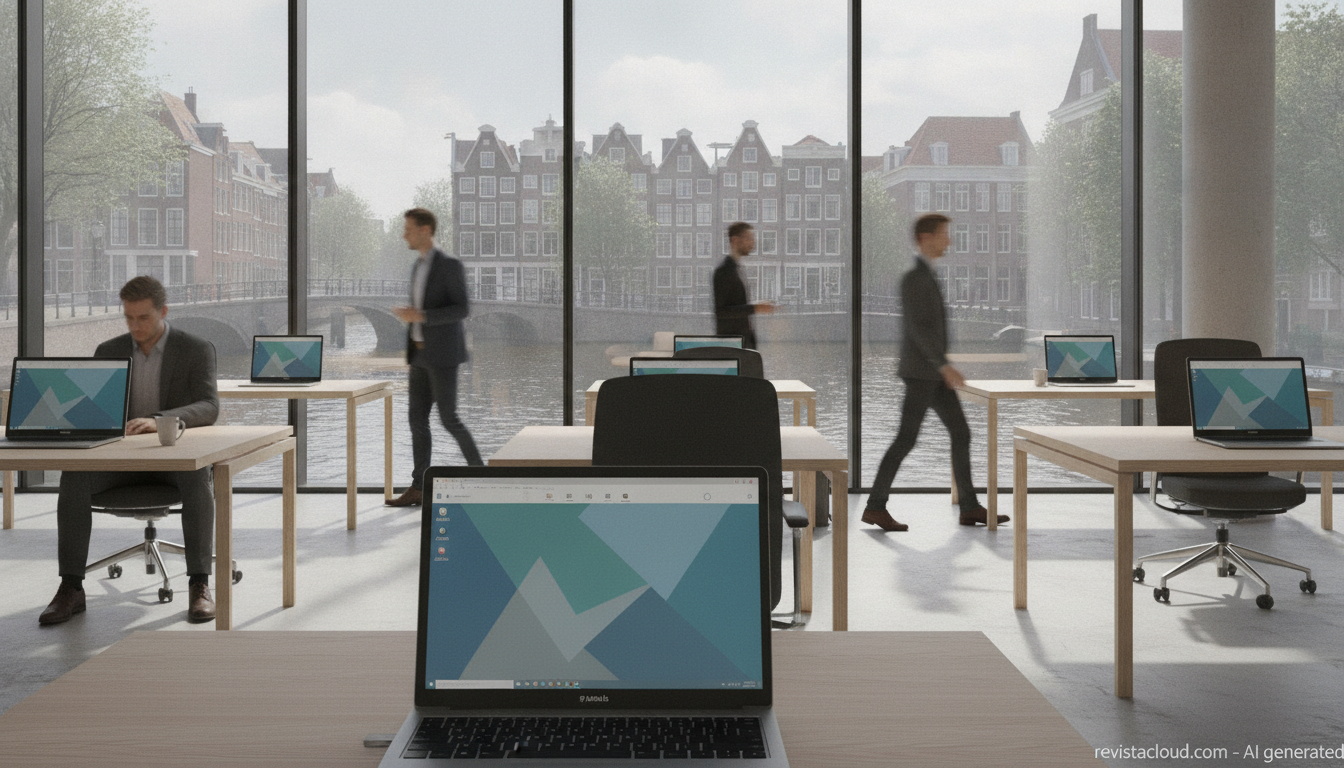
The Netherlands is joining France and Germany in the search for alternatives to Microsoft in government: the Ministry of the Interior and Kingdom Relations is developing DAWO, a sovereign digital workspace for civil servants built on the NixOS Linux distribution, already being piloted by eight municipalities. The project, reported by TechSpot, The Next Web, and Tweakers, remains in pilot phase, and its team expects to release version 1.0 next year.
DAWO, the Dutch government’s Linux, in 30 seconds
- DAWO (Digitaal Autonome Werkomgeving Overheid) is a sovereign workspace based on NixOS for the Dutch administration.
- It’s developed by the Ministry of the Interior, and piloted by eight municipalities, including Amsterdam, Zaanstad, Ede, and ‘s-Hertogenbosch.
- It includes an operating system, office software, collaboration tools, cloud services, and management tools.
- There’s no formal timeline; version 1.0 is expected next year.
- France and the German state of Schleswig-Holstein already have similar migrations underway.
The move fits a trend that’s accelerated through 2026. Several European governments have begun reviewing their dependence on U.S. software, in a political climate where Washington’s sanctions against the International Criminal Court, based in The Hague, served as a warning about what can happen when critical infrastructure depends on a foreign provider.
What DAWO Is, and Why NixOS
According to The Next Web, the project started in early 2025, following the U.S. sanctions against the ICC, and in July the Interdepartmental Committee on Government Operations made it an official task. It tasked IT service centers SSC-ICT, DICTU, and DUO-ICT with building a standard, more sovereign workspace. The plan covers an operating system, an office suite, collaboration apps, cloud services, and management tools, and the client code is published in the government’s public repository at code.overheid.nl/MinBZK/DAWO-NixOS, with a mirror on Codeberg.
The team — Victor Gevers, Rutger Putter, and Bram Buijs — had previously tried openSUSE and Fedora. They settled on NixOS for several reasons: it has Dutch roots, no single company controls it, and its package system keeps each component in its own immutable path, which makes it possible to reproduce the same setup across different organizations. Putter estimated to Tweakers that 80% to 90% of the Nix code can be reused. So administrators used to Windows don’t have to learn the command line from day one, Buijs has built a graphical management tool.
The pilots run on old laptops the government had already decommissioned, and DAWO also runs on machines that don’t meet Windows 11’s requirements. The developers, though, warn against expecting quick savings. Putter summed it up plainly: open source doesn’t cost less, it costs differently.
France and Germany Are Already Ahead
France took a more explicit political step. On April 8, 2026, the Interministerial Digital Directorate (DINUM) announced it would migrate its own Windows workstations to Linux and asked every ministry for a plan to reduce extra-European digital dependencies before autumn 2026. The French government is also pushing La Suite numérique, a set of homegrown tools that includes the Tchap messaging app, the Visio video-conferencing tool, and collaborative document editing, meant to replace Teams and Zoom for 2.5 million civil servants by 2027. The Gendarmerie has run GendBuntu, its Ubuntu-based distribution, on more than 100,000 machines for almost two decades.
In Germany, the state of Schleswig-Holstein is the most advanced case. According to BornCity, the regional chancellery already has more than 200 employees working on Linux, with only about 20 workstations still on Windows for specific technical applications. The regional government canceled nearly 80% of its Microsoft licenses last year, saving around €15 million, and has already migrated more than 40,000 mailboxes. The full project aims to cover about 30,000 workstations across the Land’s administration. CloudNews covered the debate in Should Europe Replace Windows With Linux Across Part of Its Public Administration? and in Schleswig-Holstein Takes Historic Step and Eliminates Microsoft, as well as Switzerland’s move away from Microsoft 365.
What the Rest of the Ecosystem Stands to Gain
Beyond the political motives, a migration of this size has an effect that reaches beyond the government itself. When large organizations spend time, money, and staff bringing Linux to the desktop, they end up polishing the experience for non-technical users, building infrastructure like mail servers or domain controllers, and pushing software vendors not to limit themselves to Windows. If the problems they solve get shared — as is happening with DAWO’s code — the benefit reaches businesses and users across Europe.
The challenges are well known too. Many specialized applications, in healthcare, defense, or finance, only run on Windows, and the cloud layer remains largely in the hands of U.S. providers, which according to Synergy Research Group control around 85% of the European market. Replacing the desktop is only one part of digital sovereignty; the other is where data is hosted and who operates the infrastructure — a front where companies like Telefónica and Indra are studying a sovereign cloud.
Frequently Asked Questions
What is DAWO?
It’s the Digitaal Autonome Werkomgeving Overheid, a sovereign workspace for the Dutch government based on the NixOS Linux distribution, developed by the Ministry of the Interior.
Has the Netherlands abandoned Windows?
Not yet. DAWO is in pilot phase across eight municipalities, and its team expects to launch version 1.0 next year, with no formal migration timeline.
Why did they choose NixOS?
Because it has Dutch roots, no single company controls it, and it lets them reproduce the same setup across different organizations. They previously tried openSUSE and Fedora.
What other European countries are migrating to Linux?
France has asked its ministries for plans to cut extra-European dependencies and DINUM is moving to Linux, while the German state of Schleswig-Holstein has already migrated much of its administration.
Sources:
- TechSpot: The Netherlands is building its own Linux OS to break free from Microsoft
- The Next Web: The Dutch government is building its own Linux desktop on NixOS
- Code.overheid.nl: DAWO NixOS repository
- The Next Web: France orders all government ministries to ditch Windows for Linux
- BornCity: Schleswig-Holstein chancellery moves more than 200 jobs to Linux
