
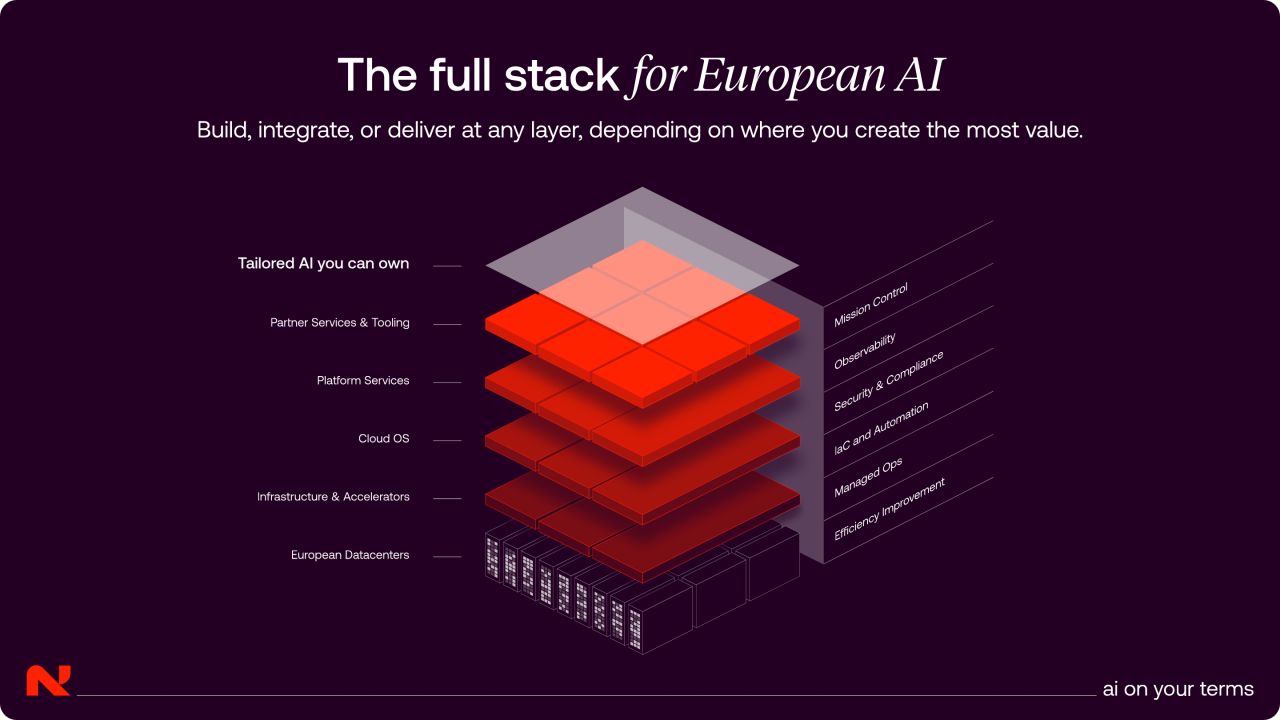
Dutch company Nebul is strengthening its sovereign AI infrastructure proposition with a model that spans everything from direct GPU access to training, fine-tuning, and inference. The company runs its platform from European data centers and is an NVIDIA Elite Partner, with infrastructure built on accelerators such as the H200, B200, and the new B300. Its argument is that intensive AI workloads require a different architecture than the generalist cloud.
Nebul’s strategy in 30 seconds
- Nebul is a Dutch company specializing in cloud infrastructure for AI and accelerated computing.
- Its platform lets customers procure everything from dedicated GPUs and clusters to training, fine-tuning, and managed inference.
- It operates data centers in Europe and positions European jurisdiction as part of its sovereignty pitch.
- It is an NVIDIA Elite Partner and works with Hopper and Blackwell architectures.
- The company wants to differentiate itself from the generalist cloud through infrastructure designed specifically for sustained AI workloads.
The proposition addresses a problem that is emerging as AI projects move beyond initial testing. An application that makes a few calls to a model through an API has very different needs from a company that trains models, keeps agents running continuously, or needs to serve inference to thousands of users.
In that second scenario, GPUs, memory, storage, and networking stop being independent resources. Performance depends on how the whole system works together and, in particular, on keeping accelerators busy as much of the time as possible.
From Renting a GPU to Running a Full AI Platform
Nebul structures its offering in different layers so companies don’t necessarily have to buy into the entire platform.
At the bottom sits accelerated infrastructure. The company offers access to GPUs and clusters for training, fine-tuning, and inference, along with CPUs, storage, and conventional cloud services.
For organizations that want to work directly on the hardware, this tier lets them deploy workloads on NVIDIA infrastructure without necessarily adopting all of the provider’s higher-level services.
Above that sits what the company calls its European NeoCloud, which includes compute services, Kubernetes, databases, storage, and developer tools.
The next layer is aimed directly at models. Its AI Engine offers training, fine-tuning, dedicated inference, and on-demand inference services. Finally, AI Studio adds features related to customization, observability, enterprise information retrieval through RAG (Retrieval-Augmented Generation), security, and model governance controls.
The difference from a conventional cloud, according to the company, lies in designing the infrastructure from the ground up with sustained GPU workloads in mind.
Nebul states that its clusters follow NVIDIA reference architectures to deliver predictable performance during sustained workloads, as opposed to shared-infrastructure models where performance can depend more heavily on resource availability. This is a commercial claim made by the company itself, and its actual advantage will depend on the workload and on whatever alternative it’s compared against.
The available hardware spans several NVIDIA generations.
In April 2025, Nebul deployed a supercluster based on Supermicro HGX B200 systems, which it presented as the largest deployment of its kind in the Benelux region. The systems use Blackwell B200 GPUs, NVLink 5.0, and NVIDIA BlueField-3. The company also offers Hopper-based H200 and H100 GPUs, plus L40S and L4 accelerators for other workloads.
Its current lineup also includes liquid-cooled NVIDIA B300 NVL8 systems, aimed at agentic AI workloads and models with heavy memory and compute requirements.
European Sovereignty Means More Than Just Storing Data in Europe
The second element Nebul uses to differentiate its offering is sovereignty.
Physically keeping data within the European Union is only part of the issue. It also matters who controls the company providing the service and under what jurisdiction it operates.
Nebul presents itself as a company founded and funded in Europe, with European data centers and a platform developed and operated on the continent. The company also states that it does not rely on US hyperscalers to deliver its sovereign infrastructure.
That approach is aimed especially at public administrations, regulated companies, and organizations that handle intellectual property or sensitive information.
The concern isn’t just about where the server is physically located.
A European company can store information in a data center located in the EU while contracting the service from a provider whose parent company falls under a different jurisdiction. This distinction has gained weight within the European debate on digital sovereignty.
Nebul uses precisely that argument to position its platform as an alternative to the large US providers, an approach similar to the one behind Mistral’s push to build sovereign AI infrastructure in Europe. The company states that its infrastructure is designed around the General Data Protection Regulation (GDPR), the EU AI Act, and other European requirements. Actual compliance with each regulation, however, also depends on how each customer configures and uses the service.
Sovereignty also doesn’t necessarily mean developing every technology component in Europe.
There’s an important nuance here. Nebul’s infrastructure relies heavily on NVIDIA technology, a US company. Its sovereignty proposition focuses mainly on the ownership and operation of the cloud provider, the location of the infrastructure, how data is handled, and the control customers retain over their models and information.
Nebul is an NVIDIA Elite Partner, DGX Cloud Partner, and DGX Solution Provider.
This is, therefore, sovereignty over infrastructure and data rather than an exclusively European technology chain running from the semiconductor up to the application.
Inference Is Becoming the Next Infrastructure Challenge
Nebul’s strategy also reflects a shift within the AI market.
Training large models was initially the workload that drew most of the attention. As those models reach production, inference is accounting for a growing share of total infrastructure consumption.
Every question sent to an assistant, every document processed, and every task carried out by an agent requires running the model again.
When that process repeats millions of times, small differences in GPU, memory, or storage utilization can have a major impact on cost per token.
Nebul is working precisely on that front alongside DDN and NVIDIA. The three companies announced a collaboration in July focused on accelerating the KV cache, a memory store used during inference to retain information the model has previously generated and avoid certain repeated computations.
The goal is to increase effective GPU utilization, reduce time to first token, and lower the cost of inference.
It’s an example of why running AI at scale is starting to require more than simply having accelerators available.
A cluster can include extremely powerful GPUs and still use them inefficiently if the processors are left waiting for data coming from storage, memory, or the network.
That’s why specialized providers are trying to differentiate themselves through the full architecture.
Nebul sums up that strategy by letting customers choose their entry point: GPU infrastructure for those who want to manage their workloads directly, cloud and Kubernetes services for building platforms, or higher-level tools for deploying and customizing models, a similar layered logic to the inference infrastructure IBM and Together AI are building around the NVIDIA B300.
It also offers open models and lets customers bring their own. Its platform covers training, fine-tuning, and deployment while letting customers retain control over the models and data used.
Offerings like this are expanding the European AI infrastructure market beyond the hyperscalers.
That doesn’t mean the generalist cloud has stopped being suitable. AWS, Microsoft Azure, Google Cloud, and other major providers also offer extensive GPU catalogs and infrastructure specifically for AI. Their global scale, service catalog, and geographic availability remain important advantages.
The difference lies in the model that companies like Nebul are trying to offer: specialized infrastructure, operated in Europe, with different levels of control so an organization can decide how much it wants to manage directly.
As AI moves from experimental projects to permanent workloads, that choice can become an architectural decision. It’s no longer just about finding an available GPU, but about deciding where models will run, who will manage the infrastructure, which jurisdiction will have access to the data, and how much control the company wants to retain over its own technology.
Frequently Asked Questions
What is Nebul?
Nebul is a Dutch company specializing in cloud infrastructure and private platforms for artificial intelligence. It offers GPUs, clusters, cloud services, training, fine-tuning, and inference from European infrastructure.
What GPUs does Nebul offer for artificial intelligence?
Its lineup includes several NVIDIA generations, including the H100, H200, B200, and B300, plus accelerators such as the L40S and L4 for other workloads.
Is Nebul a European sovereign cloud provider?
The company is founded and operated in Europe, and it states that it uses exclusively European data centers for its sovereign platform. Its infrastructure relies, among other technologies, on NVIDIA accelerators, so sovereignty here mainly refers to the platform’s ownership, operation, jurisdiction, data handling, and control.
What is a specialized AI cloud used for?
It lets organizations run training and inference on infrastructure designed specifically for GPU workloads. It can also provide tools for Kubernetes, model deployment, observability, RAG, model fine-tuning, and AI agents, without the company having to build the entire platform from scratch.
