
For years, MPLS was one of the standard technologies for connecting sites, offices, and data centers with service conditions controlled by the carrier. The growth of the cloud, SaaS applications, and high-capacity Internet connections has changed that picture. SD-WAN now makes it possible to manage several transports at once and decide which path each application uses, but that doesn’t necessarily mean MPLS has become obsolete.
MPLS and SD-WAN: the key points in 30 seconds
- MPLS provides carrier-managed connectivity, while SD-WAN controls how different WAN links are used.
- An SD-WAN can combine Internet, MPLS, dedicated fiber, and 4G/5G connections.
- MPLS still has advantages when contracted specs and defined SLAs are required.
- SD-WAN allows routes to be selected based on applications and link conditions.
- The growth of SaaS and the cloud favors direct Internet breakouts.
- Many companies may evolve toward hybrid models in which MPLS becomes just one more transport within SD-WAN.
This shift matters because, for a long time, corporate networks had a relatively predictable topology. Branches connected to one or more private data centers, and most enterprise applications lived there.
Now traffic is far more spread out.
A company may have applications in its data center, email and collaboration as a service, infrastructure across different clouds, and employees connecting from locations that aren’t even part of the traditional WAN.
The network has to decide how to reach all of those destinations without turning every connection into a standalone project.
MPLS and SD-WAN Aren’t Exactly Rival Technologies
Although they’re often pitted against each other, comparing MPLS directly with SD-WAN can lead to the wrong conclusions.
MPLS (Multiprotocol Label Switching) is a technology widely used by carriers to provide private, managed WAN services. The customer contracts connectivity between locations along with certain service characteristics.
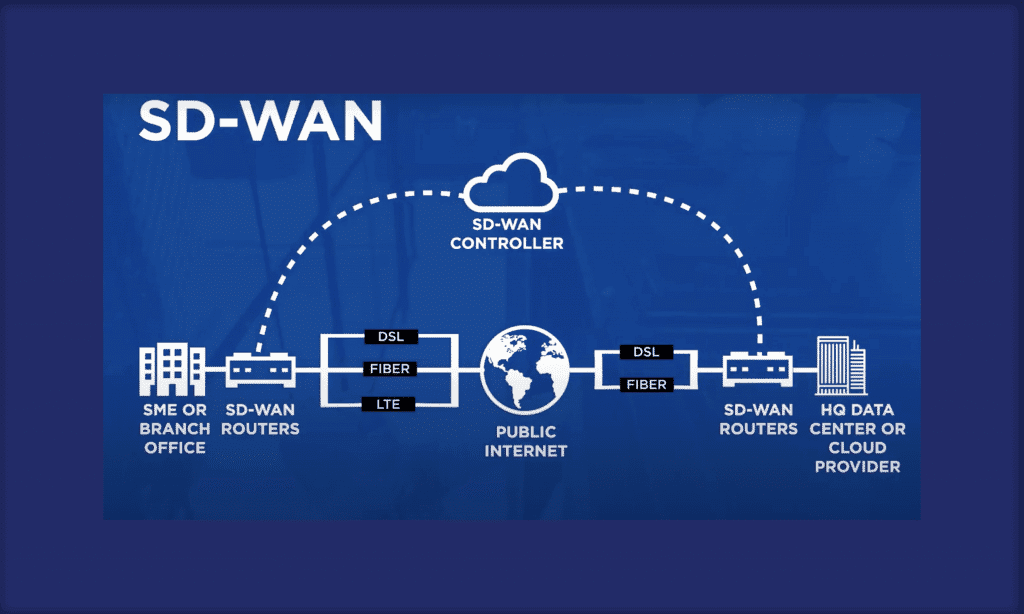
SD-WAN (Software-Defined Wide Area Network) works at a different layer. Its job is to manage available connectivity and apply policies to decide how traffic should flow.
That’s why an SD-WAN can run over MPLS.
It can also use two Internet connections, dedicated fiber, 4G/5G, or different combinations depending on what’s available at each site.
| Aspect | MPLS | SD-WAN |
|---|---|---|
| Main function | Managed WAN transport | Intelligent management of different transports |
| Infrastructure | Carrier network | Internet, MPLS, 4G/5G, and other access types |
| Performance | Contracted, predictable characteristics | Depends on the links used |
| SLA | Tied to the contracted service | Depends on the design and transports used |
| Per-application routing | Limited compared to SD-WAN | One of its main capabilities |
| Management | Closely tied to the carrier | Usually centralized |
| Redundancy | Depends on contracted circuits and service | Can combine multiple links and carriers |
| Cloud and SaaS | Depends on network design | Enables direct breakouts and specific policies |
| Site scalability | Requires service provisioning | Can take advantage of different available access types |
| Encryption | MPLS doesn’t imply end-to-end encryption | Usually uses encrypted tunnels, depending on the solution |
This difference explains why saying SD-WAN is replacing MPLS is only partly correct.
What SD-WAN can really replace is dependence on MPLS as the WAN’s only transport.
The Cloud Broke the Model of Routing Everything Through the Data Center
One of the reasons behind SD-WAN’s growth lies outside the network itself: applications moved.
In a traditional architecture, a branch could send practically all of its traffic to the corporate data center. From there it accessed the ERP, file servers, email, and other applications.
That design made sense when almost everything was hosted there.
With software as a service (SaaS), the situation is different.
If a user needs to access an application hosted directly on the Internet, routing the connection through the corporate data center first can add an extra hop that doesn’t always add value.
SD-WAN makes it possible to set different policies.
Traffic bound for a SaaS application can break out directly to the Internet. An application hosted in a private data center can use MPLS. A video call can pick whichever link offers the best conditions at that moment.
This way, the network stops making decisions based solely on IP addresses and static routes, and can factor in information about applications and link quality.
This is especially useful when multiple access links exist.
A site might have two Internet connections from different carriers plus a mobile backup connection. SD-WAN can monitor them and shift traffic when it detects degradation, within the limits of whatever platform is being used.
But there’s an important limit: SD-WAN can’t improve a connection’s physical characteristics.
If every available transport suffers an outage at the same time, no software decision can fix the problem. The quality of the access links and genuine diversity of carriers and routes remain essential.
Latency, Jitter, and Packet Loss Still Matter
The growth of business-grade Internet has narrowed some of the gaps that historically favored private networks, but certain applications remain sensitive to network conditions.
Voice over IP is a good example.
A connection can have plenty of bandwidth and still deliver a poor experience if it has too much jitter, latency, or packet loss.
Something similar happens with certain transactional applications, remote desktops, or industrial systems.
MPLS lets organizations contract services with parameters and service levels defined by the carrier. That predictability remains valuable for organizations that need specific conditions between certain locations.
SD-WAN introduces a different strategy: having several paths available and picking the most appropriate one.
Instead of requiring every packet to always use the same connection, it can apply different policies depending on the application and the state of the links.
This lets business Internet absorb a much larger share of traffic without necessarily forcing MPLS out.
The Case for Hybrid Architecture
A modern corporate network can combine both approaches.
An organization might keep MPLS between its main offices and data centers while using the Internet for SaaS and browsing. Smaller sites could use two Internet connections plus 5G as backup.
SD-WAN would provide a common layer for managing these combinations.
The result might look like this:
| Traffic type | Possible transport |
|---|---|
| Critical applications in a private data center | MPLS or private link |
| Microsoft 365 and other SaaS | Direct Internet |
| Web browsing | Internet |
| Corporate voice | Best link based on policy and quality |
| Public cloud access | Internet or private connectivity as needed |
| Site backup | Second carrier or 4G/5G |
There’s no universal assignment. Each organization will have to decide based on its own applications, risks, and requirements.
This ability to separate network policy from the physical transport is one of the key differences SD-WAN introduces.
The company can gradually change its connections without having to rethink the entire logical architecture every time.
Private MPLS Doesn’t Mean Encrypted Traffic
There’s also a common point of confusion related to security.
An MPLS network provides private connectivity and logical separation between customers within the carrier’s infrastructure, but MPLS by itself doesn’t equal end-to-end encryption.
If traffic confidentiality requires encryption, it has to be explicitly built into the architecture.
SD-WAN solutions typically set up encrypted tunnels between their different points, although the exact characteristics depend on the vendor, product, and configuration.
Security doesn’t stop there, either.
Today’s enterprise networks combine SD-WAN with firewalls, segmentation, identity systems, and, increasingly, SASE (Secure Access Service Edge) and Zero Trust architectures.
This shift matters because a user’s physical location matters less and less.
An employee can access a SaaS application from an office, home, or anywhere else. Always forcing traffic through the corporate data center to apply security controls can be inefficient.
SASE shifts part of those controls to distributed services and brings security and connectivity closer together.
SD-WAN fits into that evolution, though it shouldn’t be confused with a full SASE platform.
Is SD-WAN Really Cheaper?
One of the main promises associated with SD-WAN has been cutting connectivity costs by replacing MPLS circuits with the Internet.
That can happen, but it shouldn’t be assumed.
Comparing only the monthly price of an MPLS circuit with a fiber connection gives an incomplete picture.
An SD-WAN architecture may need two carriers for redundancy, hardware at each site, licenses, a management platform, support, and additional security services.
There’s also an operational cost.
The more connections, policies, and providers get added, the greater the complexity can become if the platform isn’t properly designed and managed.
That’s why the calculation should be based on the total cost of the WAN, not just the price per Mbps.
In companies with many branches and a large share of traffic heading to the Internet and SaaS, SD-WAN can offer significant cost advantages. In other organizations, keeping certain MPLS circuits in place can still make sense.
MPLS Is Changing Roles, Not Necessarily Disappearing
The question of MPLS’s death probably starts from the wrong premise.
MPLS doesn’t need to disappear for SD-WAN to keep growing.
What’s changing is its position within the architecture.
For years it could function as practically the entire corporate network. Now it can become just one of several available transports.
A company can reserve it for the links where it really needs those characteristics and use the Internet for everything else.
SD-WAN provides the layer that makes managing that combination possible.
The result is a WAN that depends less on a single technology and can adapt better to an infrastructure where applications are spread across private data centers, SaaS, and different clouds.
That’s why the technology debate is evolving from MPLS versus SD-WAN toward a more useful question: which combination of transports each application actually needs.
MPLS may lose some prominence in that scenario.
But losing its monopoly on the enterprise WAN is quite different from being dead.
Frequently Asked Questions
What’s the main difference between MPLS and SD-WAN?
MPLS provides a transport mechanism carriers use to offer managed WAN networks. SD-WAN is a control layer that can manage different connections, including MPLS, the Internet, and 4G/5G.
Can SD-WAN run over MPLS?
Yes. An SD-WAN network can use MPLS as one of its transports and combine it with the Internet or other access types. That’s why the two technologies aren’t necessarily mutually exclusive.
Is SD-WAN always cheaper than MPLS?
Not necessarily. The Internet can lower transport costs, but redundancy, licenses, hardware, security, operations, and support all need to be factored in to compare the total cost.
Will MPLS disappear as SD-WAN grows?
There’s no basis for saying it will disappear. Its use may decline on certain networks, especially for SaaS and Internet traffic, while it continues to make sense for connections that require specific specs and SLAs.
