
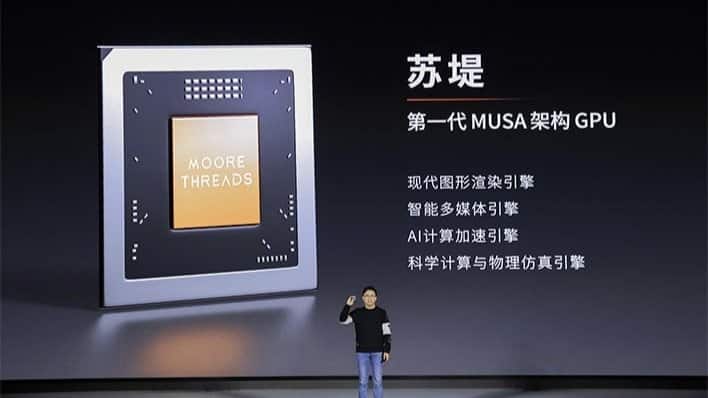
Moore Threads, one of the Chinese manufacturers attempting to break into a market dominated by NVIDIA and AMD, has announced a new generation of GPUs within its MUSA ecosystem, featuring two key models: Lushan, aimed at gaming and content creation, and Huashan, designed for AI workloads and data center deployments. The company accompanies the announcement with ambitious figures—up to “15 times” improvements in gaming and “up to 50 times” in ray tracing, among others—and a message directly addressing its longstanding Achilles’ heel: compatibility with modern APIs like DirectX 12 Ultimate.
The move comes amid a broader context where the Chinese market has been striving for years to reduce reliance on foreign technology in critical components (hardware and software), with the local industry seeking alternatives to meet domestic needs in both consumer electronics and infrastructure. In this landscape, Moore Threads aims to position itself as more than just “another domestic GPU”: its roadmap includes new architecture designs, low-precision compute formats for inference, and large-scale interconnection through its proprietary network.
“Flower Harbor” Architecture and the Effort to Bridge the Gap with the West
According to details shared around the event, Flower Harbor (Huagang) is the foundational architecture that will power the Lushan and Huashan families. The company claims to have redesigned its compute blocks to increase density and improve energy efficiency, emphasizing compatibility with a broad range of formats (from FP64 to FP4), as well as proprietary formats for mixed low-precision workloads.
Beyond marketing hype about performance, the most critical detail for developers is another: the promise to align with real-world market software. Compatibility with DirectX 12 Ultimate is seen as a clear statement of intent to leave behind the perception of platforms that, due to immature drivers or incomplete support, are often excluded from many current titles and engines.
Lushan, the “Gaming” GPU with a Clear Objective: Stop Being Irrelevant in AAA Titles
Lushan is presented as the natural successor to Moore Threads’ previous consumer GPUs. While the company has not released a final model with full specifications, it has hinted at significant performance improvements in AAA gaming, a major leap in ray tracing capabilities, and a notable increase in memory compared to earlier generations.
It’s important to note: these figures and multipliers are provided directly by the company. Without independent, controlled, and repeatable benchmarks, the industry generally treats these numbers as rough estimates, not guarantees. However, if Moore Threads successfully combines better drivers, true compatibility, and consistent performance, Lushan could serve a strategic role in the Chinese market: providing a viable local alternative for desktops and institutional or educational environments.
Huashan, the AI GPU Targeting Large Clusters and HBM Memory
Meanwhile, Huashan is described as a GPU for compute and training/inference, with a design aimed at chiplet configurations and high-bandwidth HBM memory. Moore Threads conceptually compares it to NVIDIA’s Hopper and Blackwell generations in terms of compute power, bandwidth, and memory access, but the sector will continue to demand what it always does: verifiable figures, efficiency, stability, and availability.
The discourse here is also important because Moore Threads emphasizes massive scalability, supporting it with its own interconnect (MTLink) for very large clusters. In practice, the viability of this approach depends not only on the GPU itself but also on the software ecosystem—tools, communications, libraries, and operational day-to-day support.
Quick Table: What Each Family Promises (No Hype)
| Key Point | Lushan (gaming/content creation) | Huashan (AI/data center) |
|---|---|---|
| Focus | AAA gaming, content creation, API support | Training/inference, clusters, sustained performance |
| Main message | “Generational leap” and modern support (DX12 Ultimate) | Memory/bandwidth and infrastructure scalability |
| Typical risks | Driver compatibility and real support in titles and engines | Software ecosystem, stability, performance per watt |
| What’s needed to believe | Independent reviews and real game benchmarks | Public benchmarks, availability, and production testing |
Why This Announcement Matters, Even if the Figures Are Optimistic
Even though Moore Threads is not yet operating at the global level of NVIDIA, AMD, or Intel, its announcements do matter for three main reasons:
- Local competitive pressure: China needs internal alternatives to avoid bottlenecks in consumer markets and, especially, data centers.
- Accelerated learning: each generation improves drivers, toolchains, and compatibility; software (not silicon) often remains the bottleneck.
- Huge “bottom-up” market: even as a mostly domestic story, the potential volume within China is enough to fund rapid iterations.
Frequently Asked Questions
What does it mean for a GPU to support DirectX 12 Ultimate?
It implies compatibility with a set of modern features within the DirectX ecosystem (very relevant for current games), but it does not guarantee high performance on its own—drivers, game optimization, and stability are also essential factors.
Are the “15x” or “50x” figures comparable to those of NVIDIA or AMD?
Not necessarily. These multipliers often depend on the testing scenario and baseline. Without public methodologies and independent benchmarks, they should be interpreted as manufacturer claims.
Can Huashan compete in AI against Western GPUs in large clusters?
The key is not just hardware: software (libraries, compilers, frameworks), networking/interconnection, efficiency, and operational usability are equally important. In AI, the entire “stack” weighs almost as much as the chip itself.
When can these GPUs hit the market?
The information shared points toward launches during 2026, but real availability and independent testing will be crucial to confirm.