
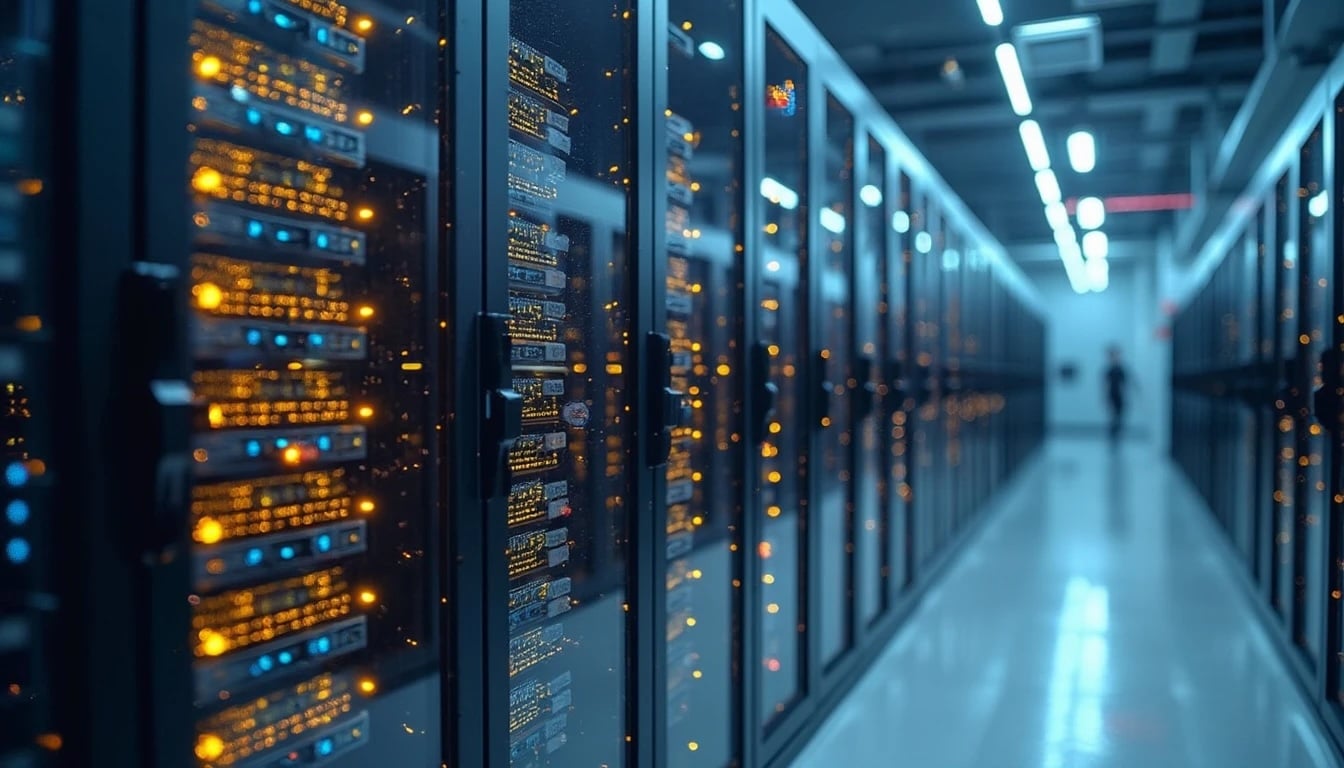
The craze for Artificial Intelligence is transforming data centers into the new critical infrastructure of the 21st century. According to Moody’s Ratings, the world faces a colossal bill to keep pace: at least $3 trillion in global investment in data centers over the next five years. This figure is not presented as an optimistic scenario but as the minimum threshold to prevent capacity shortfalls as AI computing expands, driven by hyper-scale spending.
The estimate comes at a time when the market is accelerating visibly. Moody’s focuses on the push from a small group of tech giants, whose infrastructure investments have become decisive. The agency calculates that spending by six U.S. hyper-scalers — Microsoft, Amazon, Alphabet, Oracle, Meta, and CoreWeave — approached $400 billion in 2025 and suggests that the figure could rise to $500 billion in 2026 and $600 billion in 2027 as capacity, network, energy, and cooling needs multiply.
It’s not just about building: financing is also changing
Moody’s assessment isn’t limited to investment volume but to how it’s being financed. The scale and speed of this effort are pushing markets to “reinvent” development capital. In practice, banks remain primary players, but increasingly institutional investors and new debt structures are joining, partly to cover risk and mainly to sustain pipelines that no longer fit traditional tech real estate cycles.
In fact, the demand boom is facilitating a phenomenon considered exceptional just a few years ago: much of the new capacity is pre-leased even before becoming operational. For developers, such pre-sales reduce the risk of building vacant facilities. But they also introduce a different vulnerability: counterparty risk concentration. If a significant portion of occupancy depends on a handful of global clients, the business may become more fragile to strategic shifts, budget cuts, or regulatory tensions.
Speed changes the rules: more risk during construction
Moody’s also warns of a major shift in the relationship between developers and large tenants: clients are accepting more risk during the delivery phase to buy time. In a market where energy availability or grid connection timelines can delay projects, clauses and conditions previously considered untouchable are being reviewed. The logic is clear: if AI doesn’t wait, schedules rule.
However, this rush has a cost. The agency foresees that as the number of installations increases and younger or less experienced operators enter the sector, more operational issues will emerge. Not necessarily due to malpractice but purely statistically: more data centers, more complexity, more potential failure points, and a supply chain stretched to its limits.
Electricity, water, and neighborhoods: local conflicts intensify
Another element turning into political and social friction is local impact. Moody’s highlights the growing community opposition to new data centers, especially due to electrical and water consumption, as well as the impact on distribution grids, which are already under strain in many areas. In certain markets, grid limitations are acting as a real growth brake, prompting companies to seek locations with more favorable regulatory frameworks or greater administrative agility.
Meanwhile, some regions are competing to attract this investment through clearer rules, urban planning incentives, or energy subsidies. The result is an uneven map: some territories seeing a surge in data centers, others where projects stall due to lack of power, wait times, or local resistance.
Rising costs: building is more expensive… and AI pays for it
In this context, the market faces a paradox: the more urgent the construction, the more costly it becomes. Moody’s points to cost pressures linked to equipment, materials, and especially AI-related components like GPUs, which continue to drive up project costs and, by extension, rents and contracts paid by tenants.
Nevertheless, the analysts’ overall outlook remains positive: despite delays or higher costs, clients are accepting available assets, prioritizing capacity access over strict contractual penalties. The agency suggests this balance could shift when supply and demand normalize, but does not expect that happening “within several years” in most markets.
JLL agrees on the figure and speaks of a “supercycle” of infrastructure
Moody’s thesis aligns with forecasts from other industry players. JLL, for example, has pointed to a similar scale and projects nearly 100 GW of new global capacity by 2030, which would double the world’s current data center capacity. In this view, the phenomenon isn’t described as just a bubble but as a supercycle comparable to the large migration to the cloud, with AI as the dominant driver.
In other words: data centers are no longer “hidden machinery rooms” but are becoming strategic pieces in national competitiveness, economic security, and technological sovereignty. And as Moody’s reminds us, this change isn’t paid for with promises — it’s paid for with concrete: concrete, copper, transformers, energy contracts, and billions in financing.
Frequently Asked Questions
What does it mean that $3 trillion in investment is needed in data centers?
According to Moody’s, this is the minimum amount required to expand capacity at the pace demanded by AI, including construction, critical equipment, energy, and operational upgrades.
Why are hyper-scalers so influential in the data center market?
Because they concentrate a large part of AI compute demand and sign massive long-term capacity contracts, which drive new construction but also increase dependence on a few clients.
What is the biggest bottleneck to building new data centers in 2026?
The availability of electrical power and network limitations in many areas, along with local opposition over energy and water consumption.
What risks does Moody’s see in this accelerated expansion?
Among others, risk concentration among few tenants, increased construction risks due to aggressive schedules, and more operational failures with less experienced operators.
Source:
- Moody’s (summaries and media coverage).