
Microsoft has introduced a new initiative to build and operate AI data centers with an approach aimed at reducing friction with local communities. The program, called Community-First AI Infrastructure, comes at a time when AI infrastructure deployment accelerates investment in land, civil works, electricity, cooling, and connectivity, but also multiplies neighborhood objections: from impacts on electricity and water prices to pressure on permits, construction traffic, and municipal services.
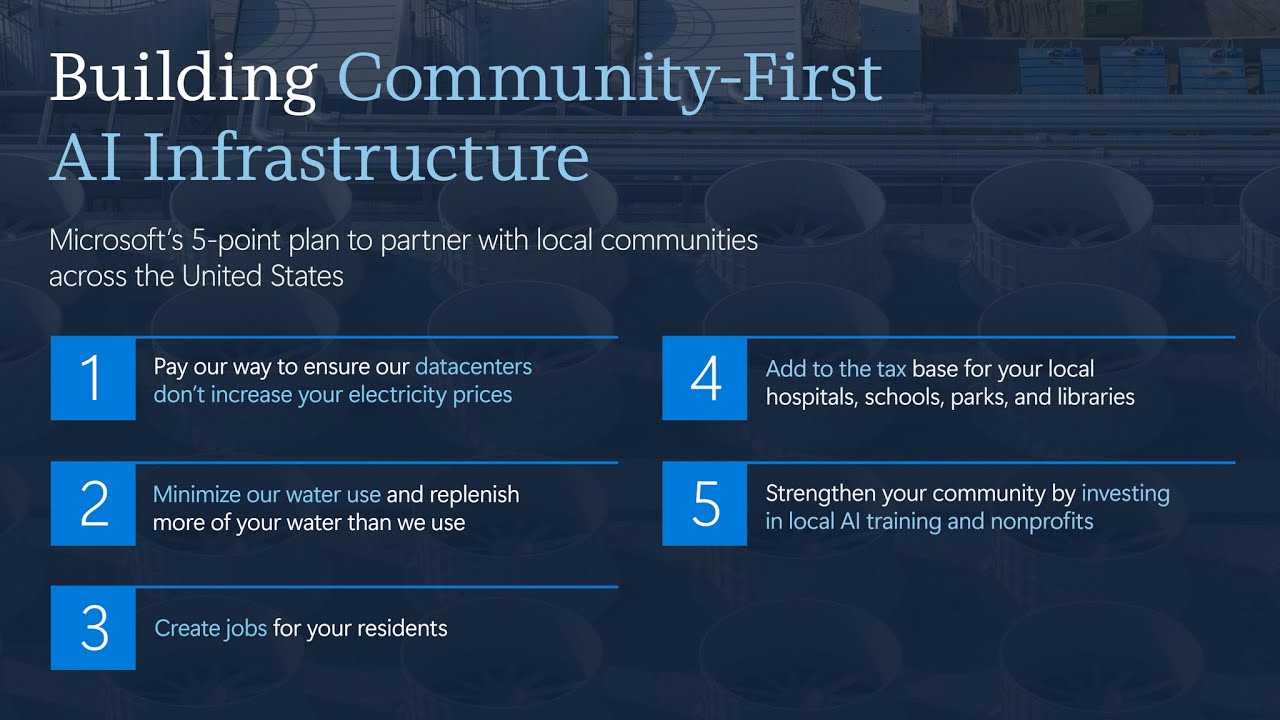
Microsoft’s proposal is structured around five commitments that, in practice, intend to turn conversations with the community into a more predictable “contract”: if the data center arrives, the company commits to spending more out of its own pocket, to reduce and compensate critical resources, and to leave measurable benefits in employment, taxes, and training.
Five commitments to “unblock” social acceptance
The plan rests on five main promises:
- Pay their part to prevent data centers from raising residential electricity costs.
- Minimize water use and replenish more than they consume.
- Create jobs for local residents.
- Increase local tax base (hospitals, schools, parks, libraries).
- Strengthen the community with local AI training and support for nonprofits.

The core idea behind this is: the growth of AI depends on large-scale infrastructure, but that infrastructure only moves forward if communities feel that the benefits outweigh the costs.
Electricity: the number one friction point
Microsoft openly acknowledges that AI consumes large amounts of energy and that the country (the United States, in this case) faces an additional challenge: aging transmission networks, lack of transformers, and expansion timelines that can exceed 7–10 years for new transmission projects.
Their approach is based on four strategies:
- Rates and pricing structures: collaborating with utilities and regulators so that data centers pay rates reflecting the necessary infrastructure costs, preventing those costs from being passed onto residential customers.
- Early planning with utilities: greater visibility on electrical demand beforehand and funding for substations or necessary upgrades as growth requires.
- Efficiency and optimization: employing new design and operational techniques, including AI-driven optimization, to reduce energy intensity and improve performance.
- Public policy: supporting measures to accelerate permits and interconnections and modernize the grid, as well as redesigning rates for large consumers.
Additionally, Microsoft mentions contracts to add new generation capacity in wholesale markets as part of a strategy to prevent data center growth from directly competing with other local uses.
Water: lower consumption, closed-loop cooling, and returning more than withdrawn
The second major local issue is water, especially in regions under water stress or with old municipal networks. Microsoft commits to two measurable goals:
- Improve water use efficiency by 40% in their own data centers by 2030.
- Extend closed-loop cooling designs aiming to drastically reduce water consumption and, in some deployments, eliminate the need for potable water for cooling.
The plan also emphasizes a local “water positive” approach: replenishing more water than is used within the same water district through reuse projects, leak reduction, or environmental restoration. A prominent example is the reuse and recirculation approach in Quincy (Washington) to avoid pressure on potable water, along with funding improvements in water and sewer systems where municipal infrastructure could be strained by new data center campuses.
Jobs: construction, operations, and a qualified labor bottleneck
Regarding employment, Microsoft focuses on both the construction phase (thousands of temporary jobs) and operational phase (hundreds of permanent positions), but highlights a structural problem: the shortage of skilled professionals in trades.
Their response combines:
- Training in trades and apprenticeships in partnership with unions and sector organizations.
- Data Center Academy: collaborating with community colleges and technical centers for roles in infrastructure, operations, and maintenance.
- Promoting certifications and practical labs with real data center equipment.
The core message: without a local “pipeline,” the employment benefits risk being captured outside the communities that host the impact of the project.
Taxes and public services: the “invisible benefit” that should be visible
Microsoft advocates that data centers can significantly contribute to a community’s tax base but commits not to seek local tax discounts, instead paying their “fair share.” Examples cited include small communities where fiscal revenues and economic activity have notably increased after years of investment in data centers, helping fund public services and community infrastructure.
AI training and social support: ensuring the community not only hosts AI but uses it
The fifth pillar aims to prevent a common scenario where the community “provides the land and energy” but the value is captured elsewhere. Microsoft proposes:
- AI literacy programs for schools, training centers, and universities in markets with data centers.
- Learning hubs in libraries for adults.
- Supporting small businesses through chambers of commerce and training organizations.
- Enhancing the local nonprofit ecosystem via donation programs and corporate volunteering.
Overall, the plan seeks to standardize what many communities demand case by case: transparency, impact mitigation, measurable benefits, and verifiable commitments.
Frequently Asked Questions
What is “Community-First AI Infrastructure,” and why is Microsoft launching it now?
It is a framework of five commitments to build and operate AI data centers while minimizing impacts (electricity, water) and maximizing local benefits (employment, taxes, training). It is launched amid rapid growth of data centers and increasing local opposition.
How can a data center “not increase residents’ electricity bills”?
The key is in specific rates for large consumers, funding for electrical infrastructure by the operator, and early planning with utilities to prevent network expansion costs from being passed onto residential bills.
What does it mean to “replenish more water than used” in data centers?
This involves measuring consumption and funding projects within the same water basin or district (reuse, leak repair, wetland restoration) to ensure the net balance returns more water to the community than is used for operations.
Which job profiles grow with AI data center expansion?
Beyond IT technicians, there is growth in industrial and installation trades: electricians, HVAC technicians, critical infrastructure operators, cabling, electromechanical maintenance, security, and operations personnel, with increasing demand for certifications and practical training.
via: blogs.microsoft