
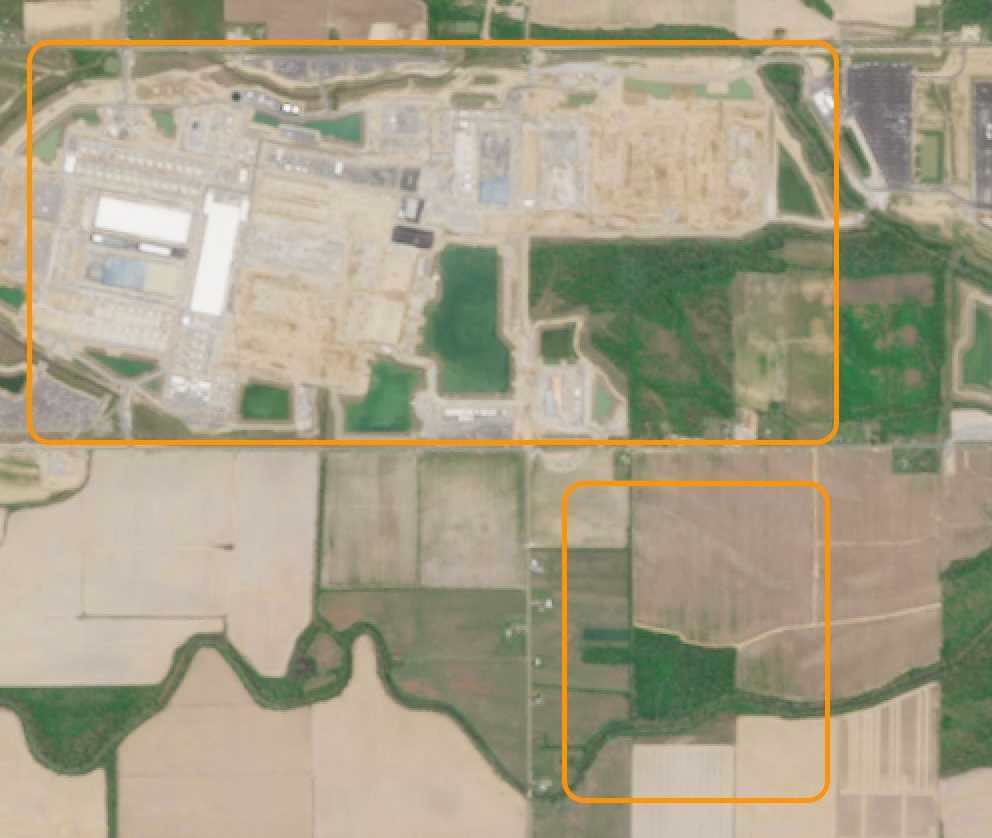
Microsoft closed the July-to-September 2026 quarter — the first of its fiscal year 2027 — with capital expenditures (capex) of $45.2 billion, roughly $5 billion below what it had forecast, because some of the data-center capacity it planned to lease from third parties wasn’t ready on time. According to The Information, one of those providers is IREN, which is building Microsoft’s Childress campus in Texas.
Microsoft’s lower data-center spending in 30 seconds
- Microsoft invested $45.2 billion between July and September 2026, the first quarter of its fiscal year 2027, versus its own forecast of more than $50 billion.
- CFO Amy Hood attributed it to delayed third-party capacity deliveries and lowered the full-year forecast to around $170 billion.
- The Information points to IREN and its Childress campus (Texas), tied to a $9.7 billion contract with Microsoft.
- IREN’s shares fell 11.4% on November 4.
Microsoft hasn’t named any provider. The link to IREN was reported on November 4 by The Information, which cites unnamed sources, and Stocktwits’ own analysis of that scoop admits it isn’t clear how much of the gap Childress explains. The headline that’s circulated these past few days also calls it a “third fiscal quarter,” which isn’t correct: Microsoft’s fiscal year starts on July 1, so the July-to-September period is the first fiscal quarter of 2027. It’s only the third if counted by calendar year, which is how The Information refers to it.
Nor is this a deliberate budget cut. Hood explained on the October 28 analyst call that capital expenditures “were $45.2 billion, as some third-party capacity deliveries we expected in Q1 were delayed.” The company expects that spending to shift into later quarters.
What Microsoft said, and what its capex includes
The $45.2 billion figure includes finance leases, which Microsoft books at their full value the moment each lease contract starts. That’s why delays from a partner like IREN hit capex directly: if a building isn’t delivered, the lease doesn’t start, and its amount isn’t recorded that quarter. According to the conference call’s automated transcript, as compiled by FourWeekMBA, finance leases added up to about $7.4 billion, though the 10-Q form filed with the SEC (Securities and Exchange Commission) records $5.2 billion in new assets under this heading, and the filing doesn’t reconcile the two figures.
| Item | Amount | Source |
|---|---|---|
| Capex, July–September 2026 (Q1 FY2027) | $45.2 billion | Microsoft |
| Microsoft’s forecast for that quarter | More than $50 billion | Microsoft |
| Analyst consensus | $50.7 billion | StreetAccount |
| Forecast for October–December 2026 | More than $50 billion | Microsoft |
| Updated full-year forecast | About $170 billion | Microsoft (10/28/2026) |
The comparison against StreetAccount’s consensus leaves a gap of about $5.5 billion, so the “$5 billion” figure making the rounds these days is a rounded number relative to the company’s own forecast. For the October-to-December quarter, Hood projected capex of more than $50 billion, and for the full year she lowered the estimate to about $170 billion “due to third-party capacity delays.” In July the figure stood at about $175 billion, and in April it was around $190 billion; July’s drop was mainly because part of the leases shifted from finance leases to operating leases, which don’t count as capex. Some outlets place that target in calendar year 2026, others in fiscal year 2027.
That accounting shift also shows up in the 10-Q. New operating leases added up to $6.523 billion for the quarter, versus $1.417 billion a year earlier, and leases signed but not yet started — mostly for data centers — reached $364.6 billion as of September 30, with start dates expected between fiscal years 2027 and 2034.
Childress, Horizon 4, and what the satellite images show
On November 3, 2025, IREN announced a roughly $9.7 billion, five-year contract with Microsoft to provide compute capacity using NVIDIA GB300 GPUs (graphics processing units). The deal includes a 20% prepayment and rests on four liquid-cooled buildings, Horizon 1 through 4, with 200 MW of IT load in total within Childress’s 750 MW campus. IREN also agreed to buy roughly $5.8 billion in equipment from Dell and set a phased rollout through 2026.
Horizon 1 was delivered and accepted by Microsoft in August 2026. Daniel Roberts, IREN’s co-founder and co-CEO, said at the time that they expected to keep making progress with Microsoft while working “to deliver Horizon 2 through 4 by the end of this year.” According to Blockspace, the company’s latest earnings call placed those three deliveries within the current quarter.
The doubts stem from a satellite-imagery analysis by the firm Aterio, published by Business Insider and dated as of October 21. According to that analysis, Horizon 4 still lacked backup generators and cooling equipment, putting its delivery before year-end at risk. Aterio also spotted unfinished work at Nebius’s project in Vineland, New Jersey, where about 140 MW could slip into 2027. IREN and DataOne, the New Jersey project’s partner, declined to comment, and a Microsoft spokesperson said only that its infrastructure strategy “remains flexible.”
Some accounts don’t quite line up. On October 20, Blockspace reported observations from investor Franz Bacher according to which Horizon 4 already had three generator buildings installed. That same analysis added that the contract includes grace periods for Horizon 2 through 4, running from mid-Q4 2026 to the start of Q2 2027 — a detail that doesn’t appear in the IREN documents consulted for this article. Neither IREN nor Microsoft has confirmed delays, and the company reports its first fiscal-quarter results on November 5 after market close.
A stock-market hit to neoclouds, and the power bottleneck
The market reacted in two waves. Following Microsoft’s results, in after-hours trading on October 28, Nebius slid 6.3%, CoreWeave 5.8%, IREN 5.3%, and Applied Digital 4.3%, according to Stocktwits. After The Information’s scoop on November 4, IREN dropped 11.4%, while Nebius and Applied Digital fell 7% and CoreWeave 10%. The same source notes that fears of stricter data-center regulation after the midterm elections also weighed on that session, so not all of the decline is explained by Childress. IREN is down 45% for the year.
Nebius has its own $17.4 billion agreement with Microsoft, extendable to $19.4 billion, and the Vineland site is part of that relationship — a project already facing its own pushback over gas generators. Investors read Microsoft’s lower capex as a signal of how much capacity these providers can actually place, and at what pace, even though Microsoft expects to recover that spending in coming quarters.
These delays aren’t unique to these two providers. In Texas, the large-load queue at grid operator ERCOT (Electric Reliability Council of Texas) grew from 63 GW at the end of 2024 to 226 GW in November 2025, with data centers accounting for 77%, according to Latitude Media, and stood at around 438 GW by the end of May 2026, according to ERCOT’s own presentation as reported by New Project Media. In April, the Financial Times cited a SynMax analysis estimating that around 40% of major AI data-center projects planned in the United States face schedule disruptions. On top of the power connection, there’s a shortage of electricians and local permitting hurdles — as shown by a Sunbury, Ohio, vote against large data centers that complicates AWS’s plans in the state.
Frequently asked questions
How much did Microsoft invest last quarter?
Microsoft reported capital expenditures of $45.2 billion between July and September 2026, the first quarter of its fiscal year 2027. The figure includes finance leases and came in below the more than $50 billion the company itself had forecast.
Has Microsoft cut its data-center investment?
Not exactly. The company spent less than planned because some third-party capacity arrived late, and it expects that spending to shift into the second half of the fiscal year. It did lower its full-year estimate to about $170 billion because of those delays.
What does IREN have to do with Microsoft’s lower spending?
Microsoft hasn’t named any provider. It was The Information, citing unnamed sources, that pointed to IREN’s delays in Childress, Texas, and it isn’t clear how much of the gap that explains.
When does IREN need to deliver the Horizon 2 through 4 buildings?
IREN expects to deliver them throughout 2026. According to Blockspace, the contract includes grace periods running from mid-Q4 2026 to the start of Q2 2027, a detail that doesn’t appear in the public documents reviewed.
Sources:
- The Information: Microsoft Lowered Data Center Spending Following Delays By Cloud Firm Iren
- IREN: IREN Secures $9.7bn AI Cloud Contract with Microsoft
- Stocktwits / Yahoo Finance: IREN Stock Drops After Report Says It’s Behind Microsoft’s AI Spending Delay
- Stocktwits: CRWV, NBIS, IREN, APLD Stocks Drop After Microsoft Capex Falls Short
- FourWeekMBA: Microsoft’s New Operating Leases Up 4.6x as Capex Fell Short
- FourWeekMBA: Microsoft Lowers 2026 Capex View to $170B
- PANews (on Business Insider and Aterio): Satellite imagery shows possible delays at IREN and Nebius projects
- Blockspace / Yahoo Finance: IREN’s Childress delivery for Microsoft on track for Q4 despite delay rumors
- US Data Center Projects: IREN delivers the first module to Microsoft in Texas
- Latitude Media: ERCOT’s large load queue has nearly quadrupled in a single year
- New Project Media: ERCOT large-load requests climb to 438 GW
This article is also available in Spanish: «Microsoft invirtió 5.000 millones menos de lo previsto y el foco apunta a IREN», on revistacloud.com.
