
Microsoft has unveiled Majorana 2, a new version of its topological quantum processor, claiming to have increased the stability of its qubits by a factor of 1,000 compared to its previous chip. The company states that this breakthrough, supported by a new materials design developed with the help of artificial intelligence, allows it to cut its roadmap in half and now targets 2029 to have a scalable, fault-tolerant quantum computer.
The announcement comes at a time of intense competition among big tech companies, public labs, and startups to demonstrate which quantum architecture can become a practical machine outside the laboratory. IBM, Google, Amazon, Quantinuum, PsiQuantum, and various Chinese groups are pursuing different paths. Microsoft, instead, maintains a particularly unique approach: topological qubits based on Majorana zero modes, which promise lower error rates and greater scalability, though this approach has also been surrounded by scientific debate.
Lead instead of aluminum to achieve more stable qubits
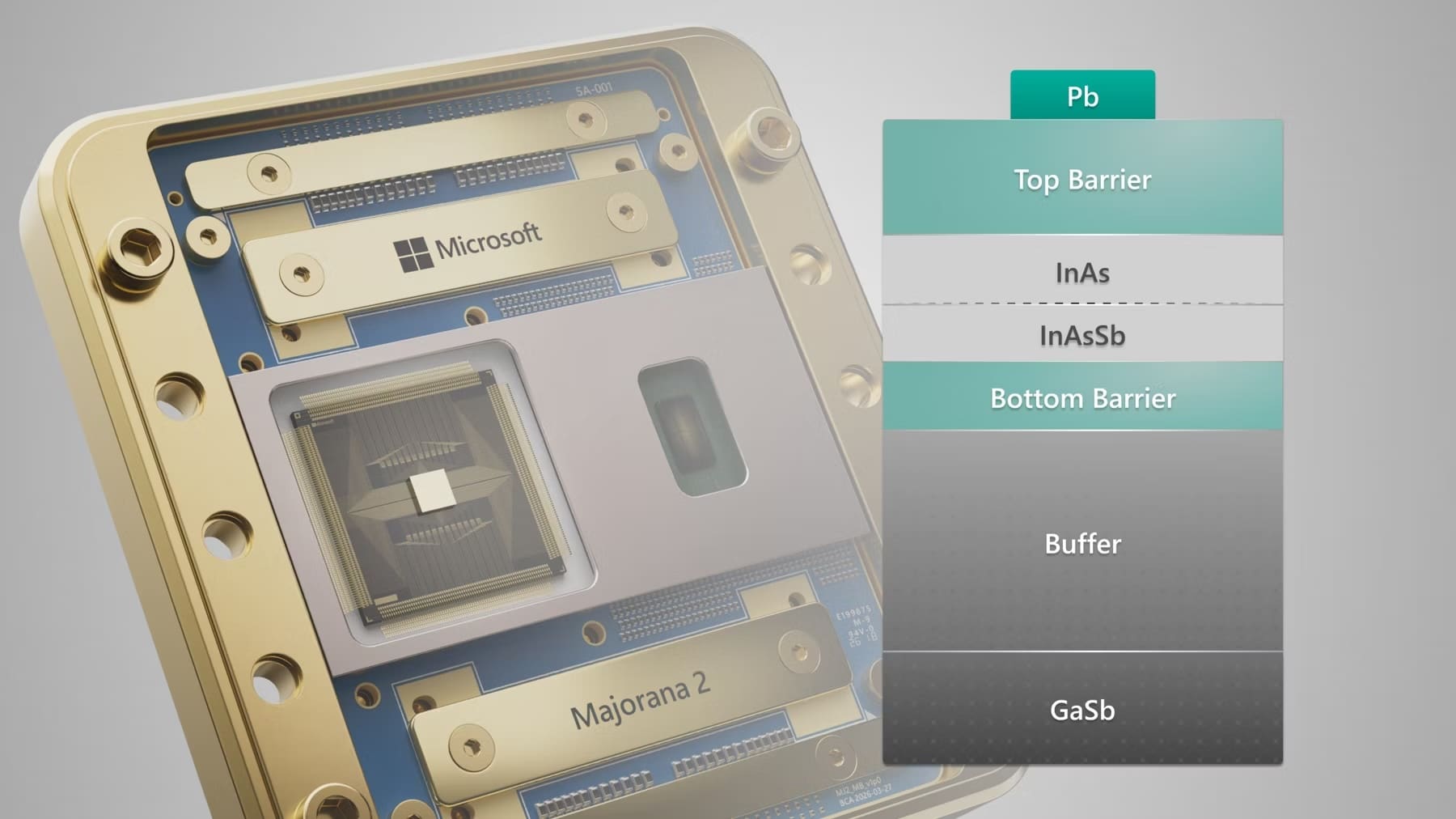
The main innovation in Majorana 2 lies in its materials stack. Microsoft replaced the aluminum used in Majorana 1 with lead as the superconductor and updated the active semiconductor region with a combination of indium arsenide and indium arsenide-antimonide. According to the company, this change more than doubles the topological gap, a key property that protects the qubit against environmental noise and errors.
As Microsoft reports, the result is a significant leap in qubit lifespan. In Majorana 1, durations ranged from 1 to 12 milliseconds. In Majorana 2, the mean lifetime exceeds 20 seconds, and in some cases, surpasses one minute. For quantum technology, where the fragility of states is one of the biggest hurdles, this difference could be transformative if independently verified.
Majorana 2 is built using tetrons, a type of topological qubit composed of two superconducting nanowires with Majorana zero modes at their ends. Quantum information is stored via parity, i.e., whether the number of electrons in the topological superconductor is even or odd. Operations are performed through measurements, activated and deactivated by digital pulses that connect or disconnect quantum dots in the nanowires.
This measurement-based control approach is significant because, according to Microsoft, it enables reading the qubit in a single operation and measuring the joint parity of two qubits. This capability is essential for implementing quantum error correction, a key ingredient that differentiates current experiments from a truly fault-tolerant machine.
| Element | Majorana 1 | Majorana 2 |
|---|---|---|
| Main superconductor | Aluminum | Lead |
| Semiconductor region | Microsoft’s previous material | InAs / InAsSb |
| Qubit lifespan | 1–12 milliseconds | Average over 20 seconds |
| Maximum reported cases | Milliseconds | Over one minute |
| Declared improvement | — | More than 1,000 times |
| Roadmap goal | Longer-term | Scalable computer by 2029 |
AI also enters the design of quantum materials
One of the most striking aspects of the announcement is the role of artificial intelligence. Microsoft claims that the advancement in Majorana 2 was achieved with the help of AI applied to the design and fabrication of the new materials stack. The company presents this use as a demonstration of how models can accelerate complex physical research, not just code writing or text generation.
The idea makes sense. Topological quantum computing depends on extremely delicate materials, clean interfaces, and challenging electronic properties adjustments. Finding a combination that yields a stable topological phase requires exploring many variables: composition, growth process, geometry, layer contact, electrical control, temperature, and noise. If AI helps reduce this search space, it could accelerate cycles that previously took years of trial and error.
Microsoft also links Majorana 2 to DARPA. The U.S. agency previously selected Microsoft and PsiQuantum to advance to the final phase of its US2QC program, part of the Quantum Benchmarking Initiative, aimed at evaluating whether any architecture can achieve useful quantum computing before 2033. For Microsoft, remaining in this process provides external validation of its engineering roadmap, though it alone doesn’t close the scientific debate about its qubits.
The company states it aims to build a fault-tolerant prototype based on topological qubits within “years, not decades.” This is an ambitious promise. Demonstrating better small-qubit devices is one thing; scaling to systems with enough physical qubits, control, error correction, cryogenics, repeatable manufacturing, and software for solving useful problems is another.
The scientific debate remains open
The Majorana 2 announcement should be viewed with caution. Microsoft has been arguing for years that its topological approach could shorten the path to a practical quantum computer. However, its claims about Majoranas and topological qubits have faced skepticism from the scientific community, especially after past controversies and difficulties in openly reproducing results.
Back in 2025, Nature reported doubts from physicists regarding Microsoft’s evidence for Majorana 1. Some experts find the approach promising but call for more public data, independent reproducibility, and stronger proof that the devices truly behave as protected topological qubits. Reuters also noted criticisms from researchers demanding greater transparency, while Microsoft maintains it has shared sufficient data with organizations like DARPA.
This tension is normal in a field where promises are significant and experimental results can be hard to interpret. If topological qubits work as hoped, they could notably reduce the burden of error correction compared to other architectures. But for that to happen, the evidence must be especially rigorous.
Microsoft competes not only against other companies but also against a fundamental physical question: can its architecture be reproducibly manufactured, scaled, and error-corrected enough to perform useful calculations? Extending qubit lifespan is promising if it withstands scrutiny, but large-scale integration remains to be demonstrated.
Why it matters for the tech industry
Fault-tolerant quantum computing could revolutionize fields such as computational chemistry, materials science, optimization, post-quantum cryptography, molecular simulation, and certain scientific challenges impossible for classical computers. It won’t replace traditional data centers or generative AI overnight, but it could solve very specific problem classes with enormous industrial impact.
That’s why the 2029 date is significant. Microsoft isn’t announcing a mass-market product tomorrow but accelerating its timeline. Approaching a fault-tolerant prototype by the end of the decade would pressure competitors and reinforce the idea that the quantum race is shifting from basic research to system engineering.
It’s also a strategic move for Microsoft itself. The company aims to avoid being limited to cloud services and AI alone. Azure Quantum, its materials research, lab collaborations, and participation in programs like DARPA’s enable it to stake a claim on a future layer of advanced computing. In an industry where AI already consumes vast amounts of classical computing, having a useful quantum platform would be a long-term advantage.
Majorana 2 doesn’t close the quantum race nor eliminate all doubts. But it marks a significant step forward for Microsoft: increased stability, new materials, measurement-based control, AI assistance, and a concrete timeline for scaling. The real test will come as the community evaluates the data, reproducibility, and the path toward functional error-corrected systems in more detail.
Frequently Asked Questions
What is Majorana 2?
Majorana 2 is Microsoft’s new topological quantum processor. The company claims its qubits are 1,000 times more reliable than those in its previous processor, with an average lifetime of about 20 seconds.
What changes compared to Majorana 1?
The main change involves materials. Microsoft replaces aluminum with lead as the superconductor and employs a new semiconductor region based on indium arsenide and indium arsenide-antimonide.
Why are topological qubits important?
Because, in theory, they could be more resistant to noise and errors than other qubit types. This might reduce the complexity needed to build fault-tolerant quantum computers.
Is it proven that Microsoft will have a useful quantum computer by 2029?
No. Microsoft has set 2029 as a target, but it still needs to demonstrate that its architecture can be scaled, error-corrected, and reliably reproduced. Some in the scientific community continue to call for greater transparency and independent validation.
