
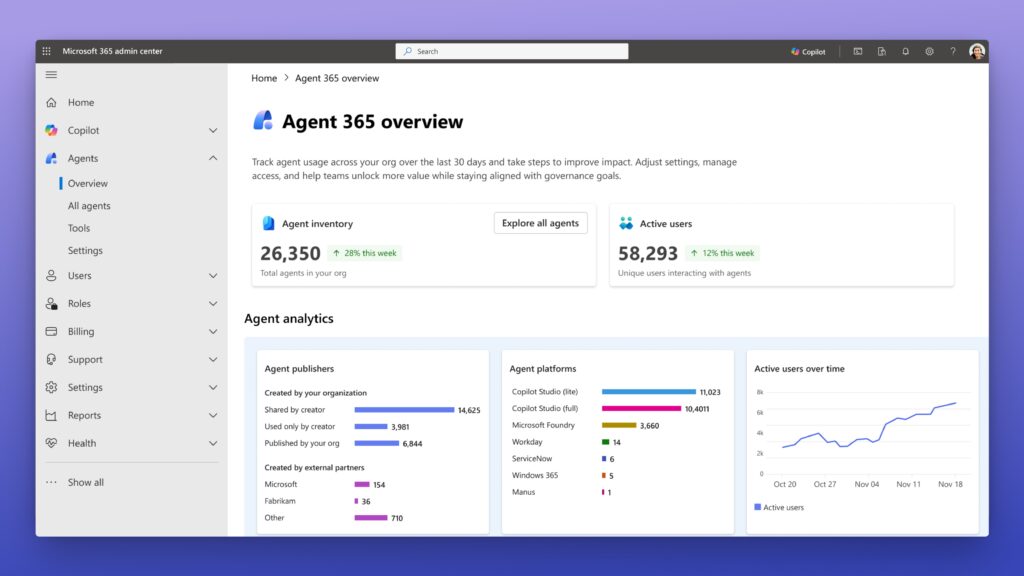
Microsoft has introduced Agent 365, a new platform designed to become the “control tower” for artificial intelligence agents that companies are starting to deploy en masse within their systems. The goal: prevent chaos as agents proliferate, and manage them with the same rules, infrastructures, and controls already applied to people and corporate applications.
Industry forecasts point to an immediate future with up to 1.3 billion AI agents operating worldwide by 2028. In this context, Microsoft presents Agent 365 as the natural evolution of its identity, security, and management tools within Microsoft 365, adapted to the new AI-agent landscape.
A unified registry to know which agents exist and what they do
The first pillar of Agent 365 is a centralized registry. Through Microsoft Entra, organizations obtain a complete inventory of all agents in use, under development, or incorporated from third parties within the company.
Each agent has its own identifier, just like an employee has their corporate account. This allows:
- Detecting all active agents, including those created outside the official channels.
- Flagging as “unauthorized” those that do not comply with internal policies and placing them in quarantine.
- Preventing unauthorized agents from accessing data or connecting with other agents and services.
Additionally, a new “Agent Store,” integrated into Microsoft 365 Copilot and Teams, makes it easier for employees to discover and use approved agents for their daily tasks.
Policies and access: agents with minimal privileges
The growth in the number of agents makes access control a critical point. Microsoft proposes that no agent operates without its own identity or clear boundaries about what it can see and do.
With specific policy templates, IT teams can define:
- Who can create, register, and manage agents.
- What data, applications, and APIs each agent can access.
- What conditions are required for connecting to sensitive resources.
Microsoft Entra enforces adaptive access policies based on real-time risk and context. If an agent exhibits anomalous behavior or is suspected of being compromised, it can be immediately blocked before reaching critical information.
Visibility and metrics: from monitoring to return on investment
Agent 365 features a unified dashboard with telemetry, charts, alerts, and advanced analytics that help understand how agents, users, and resources interact within the organization.
From this dashboard, IT, security, and business leaders can:
- View all active agents, their level of activity, and potential risks.
- Measure performance, speed, and quality of tasks performed by agents.
- Assess the actual impact on productivity and ROI to decide which agents to scale, adjust, or decommission.
The platform also offers detailed logs of interactions, e-discovery, and policies to detect and preserve evidence in case of misuse, strengthening compliance and audit readiness.
Interoperability: agents working with the same data as people
For AI agents to be effective, they need access to the same context as employees. Agent 365 is designed so that, always under control, agents can work with:
- Documents and content in Word, Excel, Outlook, SharePoint, or OneDrive.
- Business data in applications like Dynamics 365.
- The “Work IQ” context: internal relationships, histories, flows, and organizational processes.
The platform is also open: it supports agents created with Microsoft tools—such as Copilot Studio, Microsoft Foundry, or the new Microsoft Agent Framework—as well as agents developed with open-source frameworks or third-party platforms, integrated via the Agent 365 SDK.
Depth security for agents and data
Microsoft applies the same security approach to agents as to other critical systems. Agent 365 relies on multiple layers:
- Microsoft Defender, to detect threats directed at agents, investigate incidents, and respond to attacks with a comprehensive view of the intrusion chain.
- Microsoft Entra, to block high-risk access in real time and strengthen authentication.
- Microsoft Purview, to monitor exposure of sensitive data, prevent information leaks, and detect risky behaviors in agent interactions.
Furthermore, companies can audit agent conversations and actions, assess potential policy violations, and adapt controls to meet new regulatory requirements regarding AI usage.
From isolated tests to large-scale deployment
With Agent 365, Microsoft aims to facilitate the transition from pilots and experiments to systematic, governed use of AI agents across the organization. The idea is for humans and agents to function as hybrid teams, under a unified layer of identity, security, and management.
Organizations can start testing Agent 365 through the Microsoft 365 admin center within the early access program called Frontier. From there, IT and security departments can define use cases, evaluate real impact, and prepare policies before a broad rollout.
Microsoft presents Agent 365 as the missing piece that ensures the next generation of AI agents not only boost productivity but do so in an organized, traceable manner, aligned with security and compliance obligations already in place in large enterprises.
Source: Noticias inteligencia artificial