
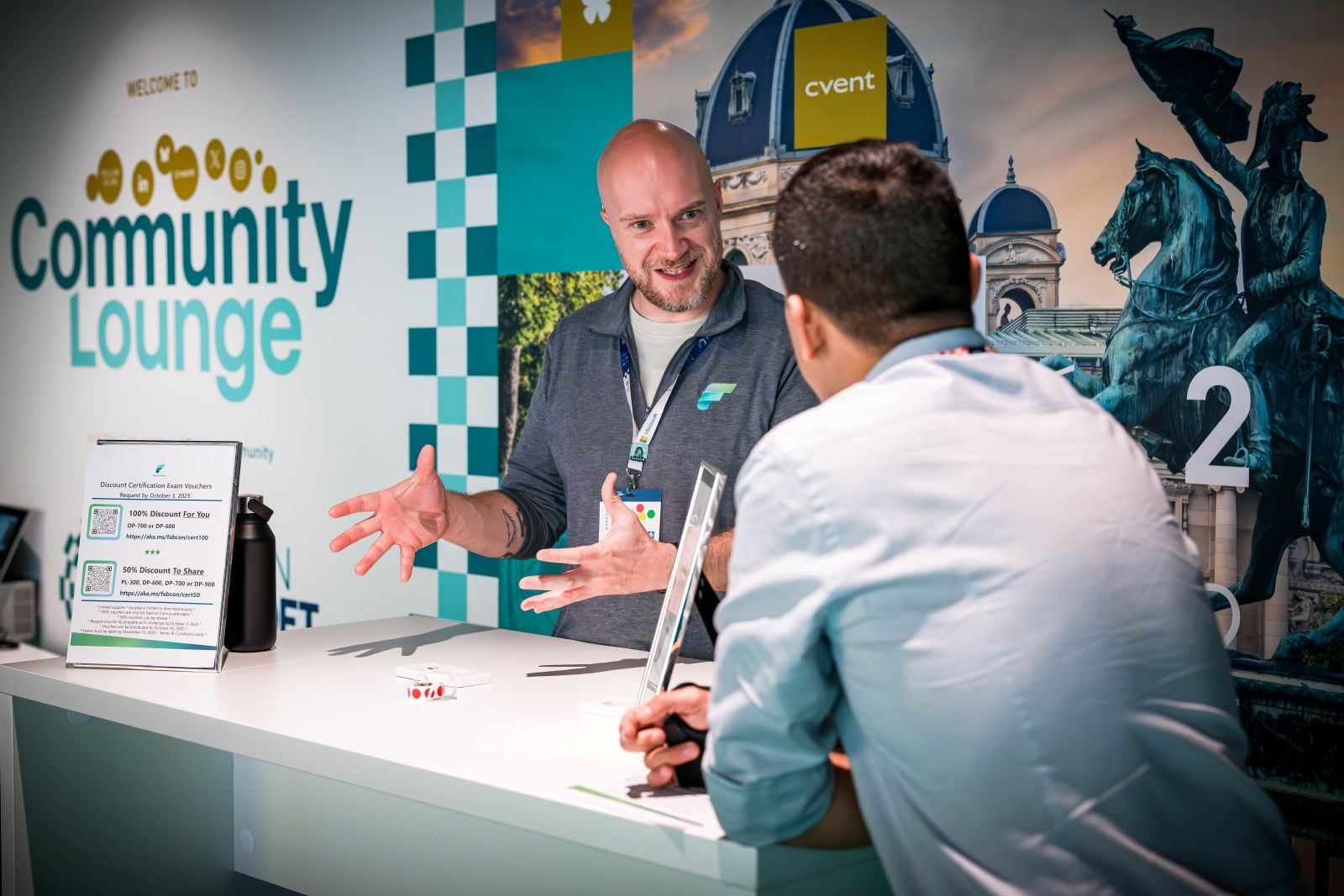
Microsoft has brought Fabric IQ to Copilot Chat and Cowork, so the assistant answers business questions using the same Power BI semantic models that power the company’s official reports. That’s the centerpiece of the package Microsoft unveiled on September 28, 2026, at the European Microsoft Fabric + SQL Community Conference (FabCon and SQLCon) in Barcelona. It also includes new data-sharing, observability, data-engineering-agent, and on-premises SQL Server features, many of them still in preview.
Microsoft Fabric news: the key points in 20 seconds
- Fabric IQ is now available in Copilot Chat and Cowork, turned on by default.
- IQ Sharing, observability, Database Hub, and data-engineering agents are arriving in preview.
- SQL Server on Azure Local reaches general availability.
- Microsoft hasn’t detailed pricing for the new features.
The announcement is signed by Jessica Hawk, corporate vice president of Azure product marketing, and is rounded out by a more technical post from Arun Ulag, executive vice president of Azure Data. Both repeat the same idea: AI models are becoming increasingly interchangeable, and the real difference will come down to each company’s own data and context. According to Microsoft, Fabric has more than 40,000 customers and Power BI has more than 425,000.
Fabric IQ: Copilot answers with the official numbers
The problem Microsoft wants to solve is familiar from any earnings meeting: two people show up with two different figures for the same metric. Fabric IQ connects Copilot to Power BI’s semantic models — that is, to the metrics, relationships, and business definitions the organization has already validated. If someone asks for the latest sales forecast, the answer comes from the same model that feeds the official reports and respects existing access permissions.
The feature is already generally available in Copilot Chat and in Cowork, which can use that data as part of multi-step tasks. For Fabric and Power BI customers it comes turned on by default, a detail that IT and data-governance leads will want to review. Integration with Copilot’s Code experience will arrive later through the Frontier program. This move follows the recent expansion of Copilot Cowork and Copilot Studio to build AI applications.
Meanwhile, IQ Sharing, in preview, lets customers and partners share data and its business context without losing control over the original assets. Microsoft cites EY, S&P Global, and TomTom, among others, as early adopters, and pairs it with OneLake mirroring and shortcuts. Ulag has also announced general availability of Google BigQuery mirroring and a two-way integration with Salesforce Data Cloud in preview.
Agents for data engineering and databases
Another part of the announcement aims to automate the work of data teams. The new agent-based data-engineering features, in preview, let engineers define the outcome and the boundaries while the agent plans and executes the work, validates the results, and adjusts its approach. It’s a continuation of the bet Microsoft placed in January with its acquisition of Osmos, a company specializing in autonomous data engineering.
For day-to-day management, Fabric is getting new observability features in preview, with cross-workspace monitoring and an expanded Monitor Hub that unifies jobs, capacities, and workloads, backed by Operations Agents and Activator to investigate incidents and automate responses. Database Hub, first shown at FabCon Atlanta, moves to public preview as a central dashboard for SQL Server, Azure SQL, PostgreSQL, Cosmos DB, and Fabric SQL databases. Specialized SQL and PostgreSQL agents for Database Hub and Visual Studio Code are coming soon in preview.
Fabric Apps, meanwhile, brings application development closer to Fabric’s governed data, with connectivity, transactional workloads, server-side logic, storage, and policy-controlled access. According to Ulag, Power BI Pro and Premium per-user customers will get up to 1 GB per Fabric database application at no extra cost, with the preview expected in the coming weeks.
SQL Server on Azure Local, offline too
The announcement with the most relevance for regulated environments is SQL Server on Azure Local, now generally available. It brings SQL Server and Azure services to a company’s on-premises infrastructure, so workloads can run close to applications and operations. The disconnected-operations variant, designed for places where cloud connectivity is restricted, intermittent, or unavailable, is listed as preview on Hawk’s blog, though Ulag’s summary includes it among the features that are already available; Microsoft hasn’t clarified the discrepancy.
Microsoft frames the whole package around one promise: taking advantage of the best models without depending on a single provider. The flip side is that context, permissions, and governance become increasingly tied to Fabric, OneLake, and Power BI. The company has said it will expand on this approach at its Ignite conference, covering agents, applications, and infrastructure.
Frequently asked questions
What is Fabric IQ?
It’s the layer of Microsoft Fabric that brings a company’s business context to Copilot, based on Power BI’s semantic models, metrics, and definitions, while respecting existing permissions.
Is Fabric IQ turned on by default in Copilot?
Yes. According to Microsoft, it comes turned on by default in Copilot Chat and Cowork for Fabric and Power BI customers.
Which Fabric features are already available?
Fabric IQ in Copilot Chat and Cowork, and SQL Server on Azure Local. IQ Sharing, observability, Database Hub, and agent-based data engineering are in preview.
How much do the new Microsoft Fabric features cost?
Microsoft hasn’t published specific pricing. It has only said that Power BI Pro and Premium per-user applications will include up to 1 GB of Fabric database storage at no extra cost.
Sources:
