
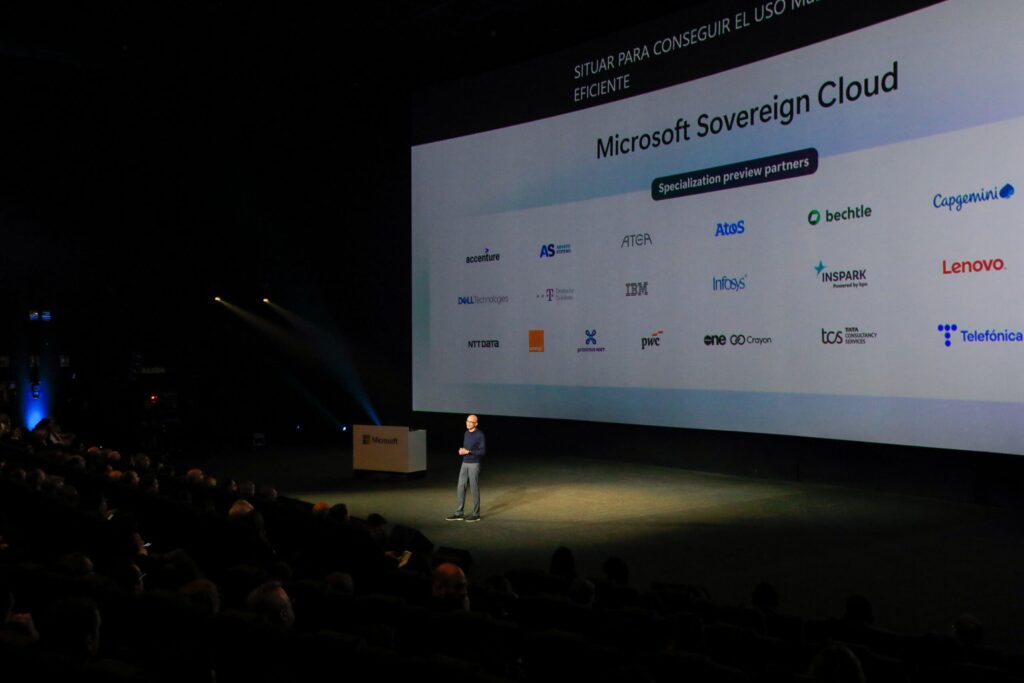
The Microsoft AI Tour Madrid, held on February 26, 2026 at Kinépolis Ciudad de la Imagen, served as a thermometer for two obsessions already ruling boardrooms and architecture teams in Spain: how to scale AI agents without losing control, and how to do so within a realistic digital sovereignty framework. Microsoft brought to the stage Satya Nadella and Charles Lamanna to push a clear narrative: AI is no longer an experimental layer but is becoming the operating model, with direct implications for data, security, resilience, and business continuity.
In the plenary session, Nadella positioned enterprise AI adoption as a process that’s “moving at high speed” and highlighted a profile of organizations, according to Microsoft, already demonstrating competitive advantages: the Frontier Firms — pioneers that place AI at the core of their strategy and operations. In this context, he cited Factorial, Ferrovial, Ilunion, Repsol, and Sanitas as examples of deployments impacting productivity, customer experience, internal optimization, and new business models.
The most relevant innovation for IT: sovereignty as “disconnected mode”
The most technical announcement of the day centered on Microsoft Sovereign Cloud and its proposal to operate critical workloads offline, on-premises, which until recently sounded like an exception and is now presented as a requirement in regulated sectors, classified environments, or isolated infrastructures.
Microsoft highlighted three components:
- Azure Local in disconnected mode (already available): enables governing critical infrastructure with Azure policies without needing connectivity to the public cloud.
- Microsoft 365 Local in disconnected mode (already available): maintains services like Exchange Server, SharePoint Server, and Skype for Business Server within the customer’s sovereign perimeter on Azure Local.
- Foundry Local supporting large models: opens the door to running multimodal models on own hardware within sovereign, isolated environments, with local inference and no external connection.
For technical profiles, the key shift is in focus: sovereignty is no longer just about where data resides, but how the entire stack is operated when connectivity isn’t an option. In corporate communications related to these capabilities, Microsoft describes a unified “full stack” (infrastructure + productivity + models) within the customer perimeter with consistent governance, precisely to prevent compliance requirements from turning into a fragmented architecture.
Agents: from individual copilots to human-AI “hybrid teams”
Charles Lamanna emphasized the second major theme: agents as a lever to redesign processes, not just to accelerate tasks. His message, as summarized by the event, was to encourage organizations to facilitate the creation of “agents at all levels,” with the underlying idea that if agents are to operate across multiple areas (sales, operations, customer service, finance), companies need a solid foundation of data, security, sovereignty, and impact measurement to scale without improvisation.
At the AI Tour, there was a focus on transitioning from “tools” to “business models”: integrating Microsoft 365 Copilot across the board and evolving toward teams where humans and agents share work, with governance and resilience conditions to prevent operational risks from this coexistence.
EU Data Boundary: data residency as a prerequisite for scaling AI
Digital sovereignty also took shape through European initiatives like EU Data Boundary, which Microsoft presents as a commitment to store and process European customer data within a defined geographic perimeter, reinforcing control and compliance in online enterprise services (including Azure, Microsoft 365, Dynamics 365, and Power Platform).
In a market like Spain, where regulated sectors (banking, energy, health, administration) measure each deployment against compliance footprints, this layer of residency and processing becomes a “permission to innovate”: if data isn’t properly governed, agents won’t move beyond pilot stage.
Real-world case studies and ecosystem: over 30 sessions and operational partners
The format of the AI Tour made it clear that the priority is moving from talk to action. There were more than 30 sessions across four tracks, with companies such as Bankinter, BBVA, Damm, Ferrovial, Iberdrola, Iberostar, Indra, Mapfre, Mutua Madrileña, Naturgy, OHLA, SEGITTUR, and W2M, among others, as well as nearly 40 Microsoft specialists. The recurring themes: AI, agents, data management, and cybersecurity.
The exhibition area (Connection Hub) and sponsorships also provided insights into the “operational how”: partners like Accenture, Avanade, Capgemini, Devoteam, Equinix, EY, IBM, KPMG, NTT DATA, Snowflake, Rubrik, Telefónica Tech, and GitHub adopt an approach where AI is deployed with services, integration, data governance, and security — not just as an add-on.
Quantifiable impact: Spain accelerates, and data pressure mounts
Microsoft supported its narrative with metrics. In the Work Trend Index, the company highlights that 71% of leaders from Frontier Firms claim their company is growing, compared to 39% of others. Locally, the event cited that 89% of Spanish executives plan to adopt AI agents within the next 12 months to boost productivity and competitiveness.
Additionally, Microsoft linked the rise of AI to the broader debate on the digital gap and adoption: it recalled surpassing its commitment to extend internet access to 250 million people before 2025, reaching over 299 million (including more than 124 million in Africa). At the same time, it highlighted skills development challenges: out of a global population of over 8.1 billion, approximately 52% would have basic digital skills, and only a 15% actively use AI tools.
Within this context, Spain is emerging as a “leader” in adoption, with 42% of the working-age population expected to use AI tools in the second half of 2025, a 2.1-point increase from the previous semester, according to the AI Diffusion 2025 report by the Microsoft AI Economy Institute.
Why this AI Tour matters to a tech media outlet
The message from Madrid is less about marketing and more about architecture: if the era of agents is serious, the debate shifts toward operation, governance, and “implementable” sovereignty. The move toward disconnected modes (infrastructure + productivity + models) sketches a scenario where AI can be deployed even in environments without cloud connectivity, while EU Data Boundary and the focus on impact measurement aim to address the classic barriers to adoption: compliance and risk.
In 2026, the question isn’t whether there will be agents, but who is ready to operate them.
Frequently Asked Questions
What does Azure Local in disconnected mode mean, and in which cases is it being considered?
It allows running and managing critical infrastructure with Azure policies without connection to the public cloud, designed for sovereign, classified, or isolated environments with strict operational continuity requirements.
What can Microsoft 365 Local disconnected offer organizations with a sovereign perimeter?
It enables maintaining productivity services like Exchange Server, SharePoint Server, and Skype for Business Server within the customer’s controlled environment, with local operation even without connectivity.
How does Foundry Local fit into sovereign AI projects with large, multimodal models?
It’s aimed at running large models on own hardware within sovereign, isolated perimeters, enabling local inference without external connectivity requirements.
What is the relationship between EU Data Boundary, regulatory compliance, and agent adoption in Europe?
Housing and processing data within the European perimeter aims to reduce compliance friction, allowing regulated organizations to scale AI agents and workflows with greater data control.