
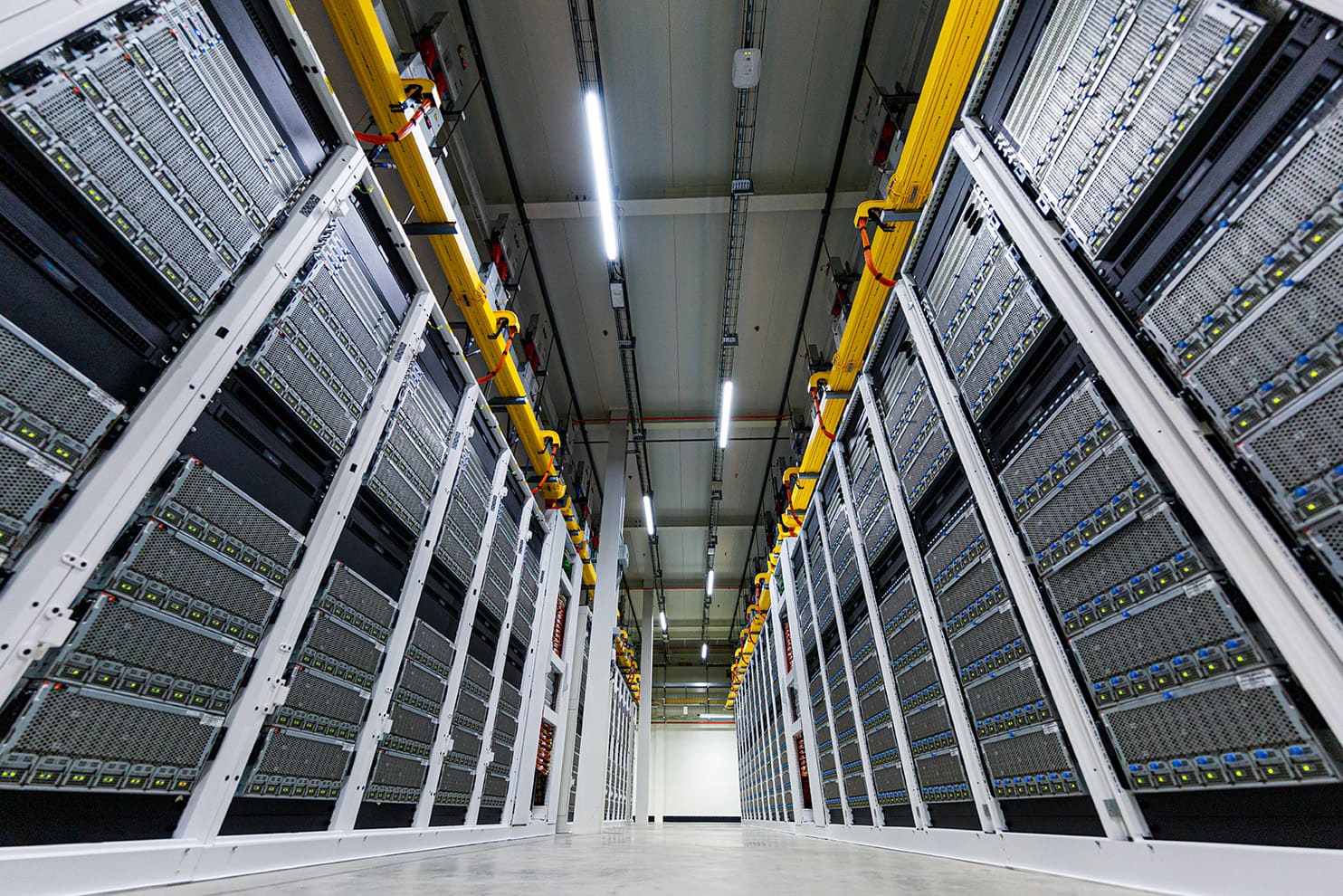
Microsoft has put two new “data halls” into operation in the state of São Paulo (Brazil), a step further in its investment plan to expand capacity for cloud and artificial intelligence in the country. The announcement was made during the Microsoft AI Tour held in Brazil, where Microsoft Brazil president Priscyla Laham confirmed that the first two halls are already operational and that the construction of additional units is progressing “as planned.” However, the company has not disclosed the exact location or the size and capacity of these facilities, nor whether they are new buildings or expansions within existing campuses.
In industry terms, a data hall generally refers to a room or operational module within a data center (the “usable” part where racks, power, and cooling are housed). The mention of “two data halls in operation” is significant because it indicates an incremental capacity increase: more IT space ready for production workloads, especially at a time when demand for AI infrastructure —training, inference, and data services— is stressing the expansion plans of major providers.
A long-term investment through 2027
This activation of modules is part of a commitment announced by the company to invest 14.7 billion reais (approximately $2.7 billion USD) in cloud and AI infrastructure in Brazil by the end of 2027. The figure positions the country as a strategic piece in Microsoft’s regional map, partly due to market size and partly due to pressure from companies and governments to have local capacity, lower latency, and business continuity options.
During her speech, Laham emphasized Brazil’s competitive potential if AI adoption accelerates: Microsoft views artificial intelligence as a lever to enhance productivity and innovation, with Brazil aiming for a more prominent role in the global digital economy. This message aligns with the dominant narrative among hyperscalers: infrastructure is not just “more cloud” but a requirement for AI to become a tangible asset across industry, finance, retail, and the public sector.
Redata and the new regulatory environment: incentives to attract data centers
The announcement also comes at a time of political and fiscal movement in Brazil. During the AI Tour, Laham was asked about Bill 278, related to the creation of a special fiscal regime for data center services, known as Redata. According to her response, the progression of this measure does not alter the commitments already made by Microsoft to the country.
The goal of Redata is to attract investments in data centers and the associated industrial chain, with tax exemptions on equipment purchases, including federal levies like PIS/Pasep, Cofins, and IPI, aimed at technology infrastructure used in such deployments. Simultaneously, the debate reveals a practical reality: Brazil wants to capture part of the value from the AI and cloud economy, and to do so, it needs computing and storage capacity within its borders, along with attractive conditions to accelerate projects.
Existing Azure regions and a more modular approach
Microsoft already has two Azure regions in the country: Brazil South, in São Paulo state (launched in 2014), and Brazil Southeast, in Rio de Janeiro. In the case of Brazil South, the company expanded the region to operate with three availability zones in 2021, a key detail because zones allow designing architectures with fault tolerance within the same region (zone redundancy). Additionally, recent reports have indicated work on additional facilities in areas like Hortolândia and Sumares, within São Paulo state, as part of the regional campus growth.
Meanwhile, the Rio region currently has restricted access for specific scenarios — for example, disaster recovery within a designated geographic area — suggesting a more selective capacity or availability strategy based on client type and use case.
Overall, the “data halls” approach aligns with an industrial logic: growth through modules and capacity activation in stages, which is common in environments where civil works, permits, power, cooling, and equipment (servers, networks, storage) schedules rarely align perfectly.
Implications for the market: AI, latency, and operational sovereignty
Although Microsoft has not disclosed the installed capacity of these new modules, the movement reinforces a trend: Brazil is establishing itself as one of Latin America’s digital infrastructure hubs, with projects designed to serve both local companies and multinationals that require data residency, low latency, and robust continuity options. For customers, more local capacity can translate into operational improvements (less regional saturation, new deployment options, expansion of services) and, in certain sectors, an added argument to meet internal policies on risks and regulations.
There is also a competitive element: when a hyperscaler activates capacity, it pressures the entire ecosystem — data center operators, integrators, energy providers, telecoms, and talent — to accelerate their own roadmaps. When combined with incentives like Redata, the conversation shifts from purely technological to industrial policy.
Frequently Asked Questions
What exactly is a “data hall” in a data center?
It is typically a room or operational module housing racks and systems for power and cooling. Activating “two data halls” usually means more IT capacity ready for production, though it does not always imply a completely new data center.
How much does Microsoft plan to invest in Brazil and until when?
The announced investment amounts to 14.7 billion reais (about $2.7 billion USD) in cloud and AI infrastructure by the end of 2027.
What is Redata and why is it important for data centers in Brazil?
Redata is a fiscal incentive framework aimed at attracting data centers and their supply chain, including exemptions on levies like PIS/Pasep, Cofins, and IPI for equipment purchases, to accelerate new deployments and expansion.
Which Azure regions are in Brazil and what does this mean for businesses?
Microsoft operates Brazil South (São Paulo, since 2014) and Brazil Southeast (Rio). For companies, having local regions facilitates lower latency, data residency options, and strategies for high availability and disaster recovery as needed.