
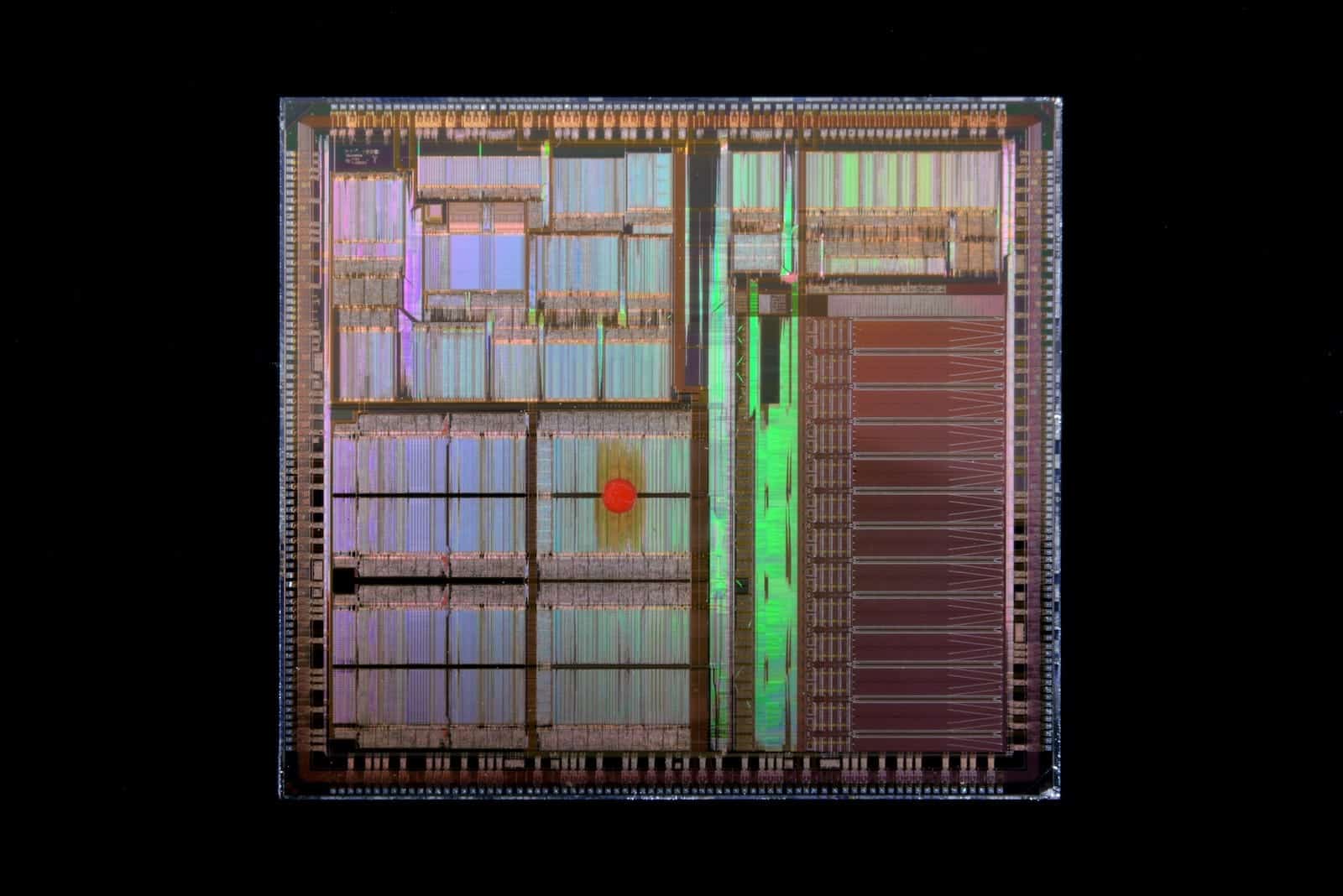
The microprocessor didn’t emerge into the world with the appearance of a great revolution. It was created to solve a very specific problem: simplifying the design of a Japanese calculator. But that little silicon piece ended up changing the history of electronics, computing, and much of daily life. Every mobile phone, car, router, smartwatch, appliance, server, or industrial system today contains a direct descendant of that idea: placing the central processing unit of a computer inside a chip.
Before that leap, computers were enormous machines. They occupied entire rooms, consumed large amounts of energy, and cost amounts beyond the reach of most companies. Computing was an infrastructure reserved for governments, universities, banks, and large corporations. The microprocessor changed that scale. It didn’t do so suddenly or by magic, but by transforming programmable calculation into something small, mass-producible, and adaptable to many uses.
The Intel 4004 and the industry-changing order
The story begins in the late 1960s when Intel was still a young company focused on semiconductor memory. Its initial goal wasn’t to invent the microprocessor but to replace magnetic core memories with silicon chips. The opportunity came from Japan, through Busicom, a calculator manufacturer that needed a new family of circuits for their desktop printing machines.
Busicom proposed to Intel the design of a set of twelve specialized chips. Each would have a specific function: input and output, memory, control, and arithmetic logic. This was a common solution in electronics of the time but also expensive, complex, and poorly reusable. Each new product could require a different family of circuits, increasing design costs and complicating manufacturing.
Marcian E. “Ted” Hoff, an Intel engineer, saw the problem differently. Instead of manufacturing many chips dedicated to a single calculator, he proposed a more general architecture: a chip capable of executing instructions, accompanied by memory and other support circuits. The idea shifted part of the hardware complexity into software. The same circuit could be adapted for various uses through programming.
Stanley Mazor, Masatoshi Shima, and Federico Faggin also contributed to this process. Faggin’s expertise in silicon gate technology was crucial in enabling the chip to be manufactured with the right size and cost. The result was the Intel 4004, commercially introduced in 1971. It featured 2,300 transistors, 10-micrometer technology, a maximum frequency of 740 kHz, and a 4-bit architecture. Its dimensions were just 4 by 3 millimeters.
Looking from 2026, those numbers seem minimal. Modern processors contain billions of transistors and operate at frequencies millions of times higher. But the 4004 achieved something that hadn’t been successfully commercialized until then: a complete CPU on a single integrated circuit. Intel’s advertisement phrase, “Announcing a new era of integrated electronics,” wasn’t an exaggeration. It opened a new era.
From calculator to personal computer
The 4004 was not an isolated piece. It was part of the 4000 family of chips, which included ROM and RAM memories, as well as shift registers. Its first use was in the Busicom 141-PF calculator, but Intel eventually bought back the rights to sell the technology to other customers and uses. That commercial decision was as important as the technical advance; had the 4004 been confined to a calculator, its impact would have been much smaller.
Later came the Intel 8008, the company’s first 8-bit microprocessor, developed from another project related to programmable terminals. In 1974, the Intel 8080 appeared, overcoming many limitations of its predecessors and giving a decisive boost to the market. The microprocessor ceased to be a curiosity and became a platform.
From then on, the story accelerated. Microprocessors made the personal computer, game consoles, embedded systems, industrial controllers, early portable devices, and later, mobile phones possible. Computing shifted from being confined to a control room to being distributed across increasingly smaller objects.
This change had a profound consequence: electronic products stopped being defined solely by their physical circuits. They became programmable. The same hardware could change behavior with software. This separation between machine and program is one of the key aspects of the digital economy.
RISC, ARM, and efficiency as an advantage
During the 1980s, another decisive debate emerged: CISC versus RISC. CISC architectures, like x86, favored complex instruction sets. RISC aimed for simpler, more efficient instructions with cleaner designs suited for specific workloads.
From this culture, ARM was born at Acorn Computers. The ARM architecture was simple, 32-bit, and highly efficient for its time. For years, it appeared as a minor alternative compared to x86 dominance in personal computers, but it eventually conquered the mobile world. Its low power consumption and ease of integration made it ideal for phones, tablets, embedded devices, and over time, next-generation servers and personal computers.
The lesson was important: the biggest or most power-hungry chip does not always win. Many markets favor the one that offers the best balance of performance, cost, power consumption, and ease of integration. This idea explains much of modern electronics.
From clock frequency to system-on-a-chip
In the 1990s and early 2000s, the race focused heavily on frequency—more megahertz, then more gigahertz. It was a straightforward way to sell performance and a metric easy to understand. But physics imposed limits. Increasing frequency raised power consumption and heat. Processors encountered a thermal barrier.
The response was strategy change. Multi-core designs, integrating more functions into the same package, and the rise of SoCs—system-on-a-chip—became prominent. An SoC doesn’t just include the CPU; it can also feature GPU, memory controllers, connectivity, AI accelerators, signal processors, security, and power management. In a modern smartphone, much of the “computer” exists within a single chip.
This integration has been crucial for mobile devices, wearables, IoT, and industrial systems. It enables reductions in size, power consumption, and cost at large volumes. It also transforms product design: instead of assembling many discrete circuits, developers now work from increasingly complete platforms.
AI brings silicon back into the spotlight
Cloud computing and artificial intelligence have taken the microprocessor into a new phase. Modern data centers no longer depend solely on general-purpose CPUs. They use GPUs, TPUs, NPUs, FPGAs, ASICs, and specialized accelerators to train models, run inference, process video, analyze language, or move data at high speeds.
This doesn’t replace the microprocessor; it expands its family. Computation has become heterogeneous. Each task seeks the most suitable chip type: CPU for control and versatility, GPU for parallelism, NPU for edge AI, FPGA for adaptable logic, and specialized accelerators for very specific loads.
At the same time, billions of connected devices embed small microcontrollers and SoCs that make decisions close to the data. Industrial sensors, cameras, cars, robots, appliances, energy meters, and medical devices process information locally, not always relying on the cloud. Intelligence becomes distributed.
The journey that began with the Intel 4004 hasn’t ended with the personal computer but has evolved into an invisible computing infrastructure. The microprocessor is everywhere precisely because it no longer calls attention to itself.
The great paradox of this technology is: the more indispensable it becomes, the less we notice it. The chip born for calculators ended up being the silent engine of the digital age.
Frequently Asked Questions
What was the first commercially available microprocessor?
The Intel 4004, introduced in 1971, is considered the first commercial microprocessor. It integrated a 4-bit CPU on a single chip.
What was the original purpose of the Intel 4004?
It was created as part of a project for Busicom, a Japanese company making desktop printers with calculators.
What is the difference between a microprocessor and an SoC?
A microprocessor focuses on executing instructions like a CPU. An SoC integrates additional functions such as memory, graphics, connectivity, controllers, and accelerators within a single chip.
Why did ARM end up dominating the mobile world?
Because it offered an efficient architecture suitable for devices with constraints on power, battery life, and size.
What role do microprocessors play in AI?
AI utilizes many types of chips: CPUs, GPUs, NPUs, FPGAs, and specialized accelerators. All are part of the evolution initiated by the microprocessor.
