
The hype around Artificial Intelligence accelerators is often counted from GPUs, data centers, and the energy required to power them. But there’s another less visible piece that’s starting to shape the entire supply chain: memory. Without sufficient DRAM, NAND, and HBM, models can’t train or respond at the pace promised by their manufacturers.
Micron has just made this clear with record-breaking results and an even more powerful message: the current demand for AI memory is just the beginning. Sanjay Mehrotra, the company’s President and CEO, described this phase as the “first innings” of a transformation that, in his view, will require more capacity, higher bandwidth, and greater efficiency in every new generation of servers and accelerators.
A Record Quarter for Micron
Micron closed its fiscal Q2 2026, ending February 26, with revenues of $23.86 billion, compared to $13.64 billion the previous quarter and $8.05 billion a year earlier. GAAP net profit was $13.79 billion, or $12.07 per diluted share, while non-GAAP net profit reached $14.02 billion, or $12.20 per share.
The company also posted an operating cash flow of $11.9 billion and an adjusted free cash flow of $6.9 billion. These are uncommon figures even for a memory manufacturer in a favorable cycle. Non-GAAP gross margin hit 74.9%, well above the 37.9% from the same period last year.
| Fiscal Metrics Q2 2026 | Results | Fiscal Q2 2025 |
|---|---|---|
| Revenues | $23.86 billion | $8.05 billion |
| GAAP Net Income | $13.79 billion | $1.58 billion |
| GAAP Diluted EPS | $12.07 | $1.41 |
| Non-GAAP Gross Margin | 74.9% | 37.9% |
| Operating Cash Flow | $11.9 billion | $3.94 billion |
| Adjusted Free Cash Flow | $6.9 billion | $857 million |
The surge doesn’t originate from just one business line. The Cloud Memory unit generated $7.75 billion; Core Data Center, $5.69 billion; Mobile and Client, $7.71 billion; and Automotive and Embedded, $2.71 billion. All these reflect a broad cycle improvement, though data centers and AI are the factors reshaping the industry narrative.
For the third fiscal quarter, Micron expects revenues around $33.5 billion, with a gross margin near 81% and a non-GAAP EPS of $19.15, with a range of $0.40. This outlook confirms that the company doesn’t see the record quarter as an isolated peak but as part of sustained demand.
AI Turns Memory into a Strategic Asset
For years, the memory market has been seen as one of the most cyclical segments in the tech industry. When supply exceeded demand, prices plummeted; when production was tight, margins soared. Now, the difference is that Artificial Intelligence is changing the nature of that demand.
Micron asserts that demand for DRAM and NAND for AI-driven data centers will surpass 50% of the industry’s total addressable bit market for the first time in 2026. The company also claims that both traditional server and AI server demand are constrained by a lack of adequate DRAM and NAND supply.
The reason is straightforward. Training and running advanced models require not just computational capacity but also moving large amounts of data with low latency. High Bandwidth Memory (HBM) has become essential for GPUs and AI accelerators because it offers high bandwidth in a very close-to-the-chip format. However, it’s expensive, complex to manufacture, and consumes industrial capacity that could be used for other DRAM products.
The issue extends beyond HBM. Inference—daily execution of models to respond to users, generate code, analyze documents, or coordinate agents—also raises memory demands. The more tokens models process, the greater the pressure on DRAM, LPDDR, data center SSDs, and NAND for workloads like vector databases or cache offloading.
Micron claims that the rapid growth of inference is driving new architectures optimized for token economy. This phrase encapsulates the change: it’s no longer just about training large models occasionally, but about serving them continuously, with millions of requests, long contexts, and multi-step agents.
HBM4, LPDDR, and SSDs: AI’s New Memory
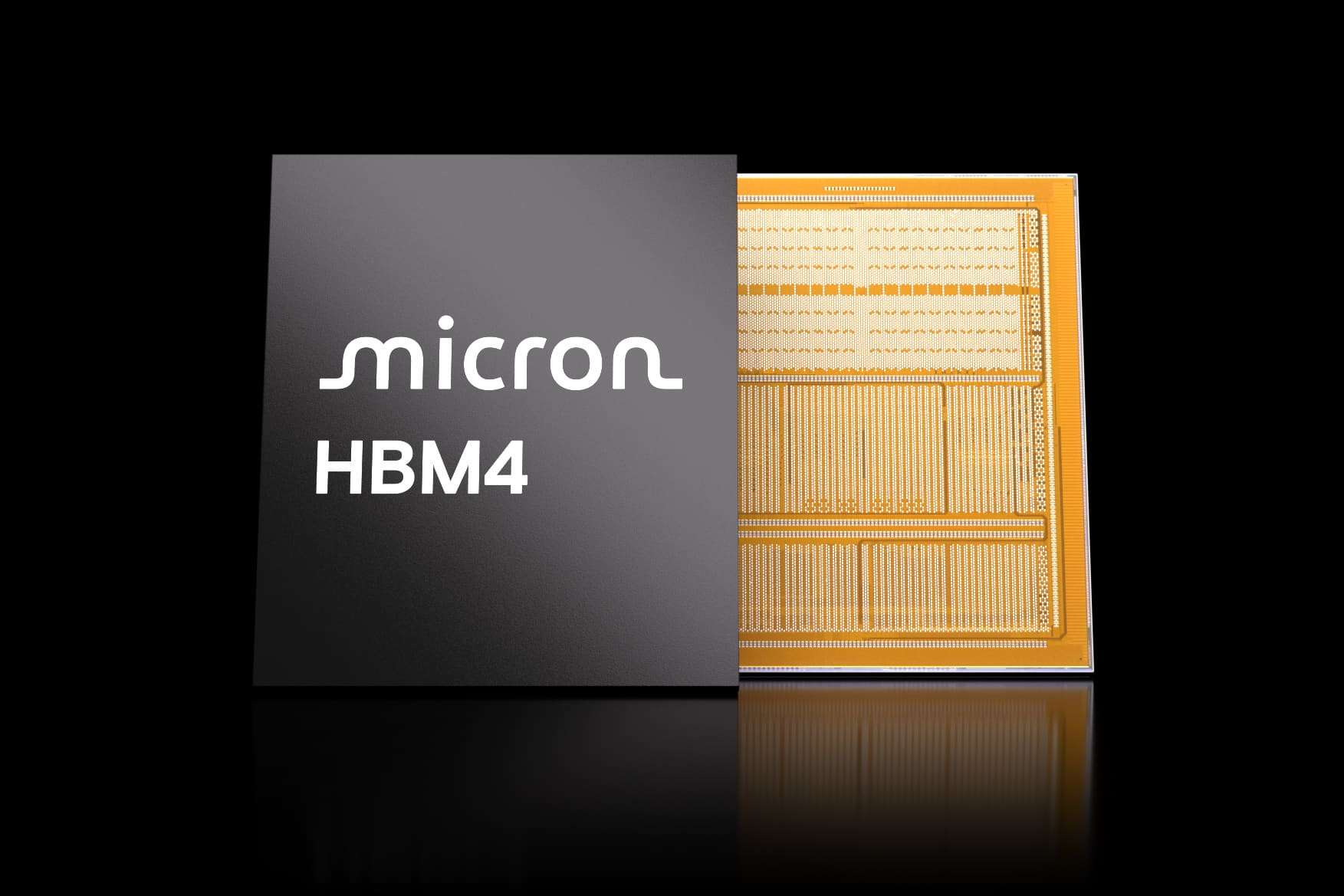
Micron’s product roadmap also indicates where the industry is heading. The company has begun volume shipments of its HBM4 with 36 GB and 12 layers, designed for NVIDIA’s Vera Rubin platform. It has also sampled an HBM4 version with 16 layers and 48 GB per stack, a 33% capacity increase over the 12-layer HBM4.
The next step will be HBM4E, with volume production expected in 2027. Micron anticipates this generation will leverage its 1γ DRAM node and deliver more performance improvements for AI platforms. In practice, HBM has become one of the components defining a modern GPU’s ability to train and run large models.
But the company is also looking beyond HBM. For LPDDR memory in data centers, Micron has presented samples of its 256 GB SoC_MM2, based on LPDDR, capable of supporting up to 2 TB per CPU. The promise of LPDDR in servers is improved energy efficiency: lower power consumption per bit moved, especially relevant as data centers begin to face limits in energy, cooling, and space.
In storage, NAND also enters the AI conversation. Vector databases, layered SSD storage, and cache offloading workloads are boosting data center demand. Micron reports that NAND revenues for data centers more than doubled sequentially during the quarter and that demand clearly exceeds available supply for the foreseeable future.
| Technology | Role in AI |
|---|---|
| HBM | Feeds GPUs and accelerators with very high bandwidth |
| DDR DRAM | Supports traditional servers, CPUs, and complementary AI workloads |
| LPDDR / SoC_MM | Reduces energy consumption in more efficient server architectures |
| NAND / SSD | Supports vector databases, data storage, and cache offloading |
| HBM4E | Next-generation for more demanding AI platforms |
Supply Shortages May Last Longer Than Expected
The concerning part of Micron’s message is that increasing supply isn’t quick. Building factories, expanding clean rooms, installing lithography equipment, qualifying processes, and reaching mature yields take years. The company expects DRAM and NAND supply constraints to persist into 2026, with tight conditions possibly extending beyond that.
Micron is responding with increased investment. The company projects a fiscal capex above $25 billion for 2026 and anticipates further growth in 2027 to support HBM and DRAM investments. Plans include expanding global manufacturing footprints, projects in Idaho and New York, the acquisition of land in Tongluo, Taiwan, expansions in Japan, and a new NAND fab in Singapore with first wafers expected in the second half of 2028.
This explains why the memory market may remain tight. Although manufacturers want to produce more, additional capacity won’t materialize overnight. Additionally, HBM requires a higher “interchange ratio”: it demands more manufacturing capacity to produce a given amount of usable memory compared to conventional DRAM products. If manufacturers prioritize HBM due to profitability and demand, other segments might become more constrained.
The impact is already evident in PCs and mobiles. Micron warns that in 2026, various factors—including DRAM and NAND shortages—could lead to low-double-digit declines in PC and smartphone unit sales. Meanwhile, AI features integrated into devices could increase memory content per device. In PCs, 32 GB configurations are gaining momentum in local AI workflows, pushing beyond many users’ minimum standards.
Memory Cycle Enters a New Phase
The key question is whether the current boom is just another cycle with rising prices followed by corrections, or if AI is creating a more structural demand base. Micron leans toward the latter. Not because cyclicality will disappear, but because data centers, inference, AI agents, robotics, electronic vehicles, and edge AI all drive up memory consumption simultaneously across many fronts.
This thesis makes sense, though it’s important not to overstate it. Memory remains a business exposed to excessive investment, price fluctuations, and inventory adjustments. If customers delay deployments, models become more efficient, or supply grows too rapidly at some point, the cycle can turn. The difference today is that demand isn’t just driven by smartphones and PCs but also by a new layer of global infrastructure needing high-performance memory to operate.
For cloud providers and model developers, the takeaway is clear: memory availability can be as critical as access to GPUs. For data centers, this adds additional pressure on energy, cooling, and system design. For PC and mobile manufacturers, it introduces a tension between higher prices and the need for systems with more RAM to run local AI.
Micron’s results reflect an extraordinary moment. But the most important takeaway isn’t just the quarter—it’s the underlying message: AI is starting to make memory a strategic component of technological infrastructure. As inference and AI agents grow as industry expects, the question won’t be only how many GPUs a business can buy, but also how much fast memory they can obtain, at what cost, and under what supply guarantees.
Frequently Asked Questions
Why does AI need so much memory?
Because models must move and store enormous amounts of data during training and inference. The larger the models and the longer the contexts, the greater the pressure on HBM, DRAM, and fast storage.
What is HBM and why does it matter?
HBM is high-bandwidth memory located very close to the accelerator. It’s essential for AI GPUs because it enables feeding the chip with data at high speed.
What results did Micron report for its fiscal Q2 2026?
Micron achieved revenues of $23.86 billion, with GAAP net profit of $13.79 billion and operating cash flow of $11.9 billion.
Can memory shortages impact PCs and mobiles?
Yes. Micron warns that DRAM and NAND constraints could pressure the PC and smartphone markets in 2026, although local AI features will also increase memory content per device.
