
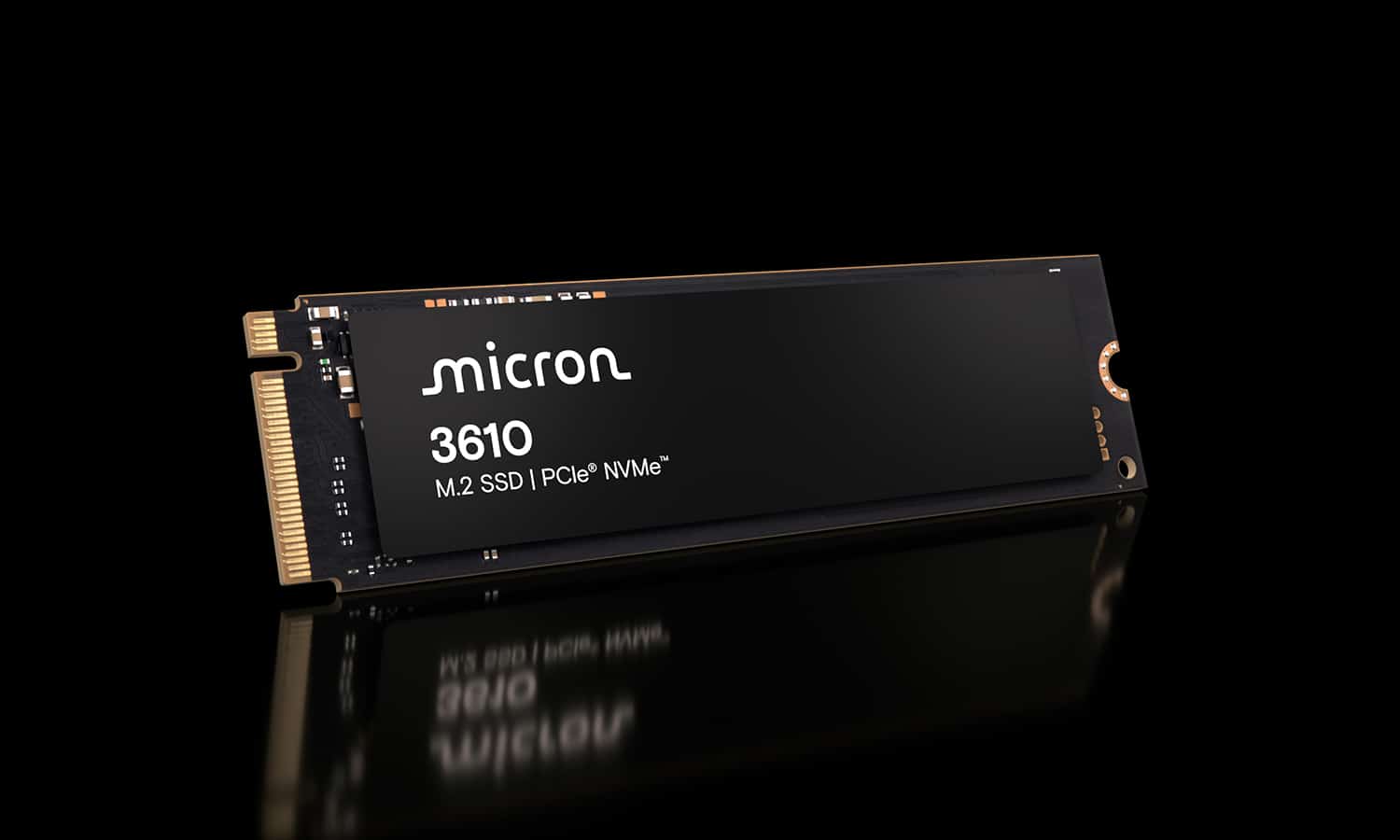
Micron Technology has announced the launch of the Micron 3610 NVMe SSD, a move aimed at bringing next-generation performance to consumer computing (laptops and mainstream PCs) without increasing power consumption or cost. The company describes it as the first PCIe Gen5 SSD with NAND QLC G9 designed for client systems, a combination built to “democratize” high-end speeds in increasingly compact formats, just as the market shifts toward AI PCs and more data-intensive workloads.
In practice, Micron seeks to address a very specific tension: users want thin, silent devices with good battery life, but also demand instant responses, multitasking capabilities, and — increasingly — the ability to run AI models locally. In this scenario, storage stops being just a “wildcard” component and becomes a critical bottleneck. The 3610’s approach hinges on three ideas: more bandwidth (PCIe 5.0), higher capacity (up to 4 TB), and improved efficiency.
A performance leap in a slim device-focused SSD
Micron estimates the 3610’s maximum performance at up to 11,000 MB/s sequential read and 9,300 MB/s sequential write, along with 1.5 million IOPS in random read and 1.6 million IOPS in random write (based on internal configurations and testing). The message is clear for users: faster application launches, smoother context switching, and fewer “pauses” when multitasking.
But the most eye-catching detail isn’t just the MB/s figures. Micron guarantees 4 TB in a single-sided M.2 2230 format, which is especially relevant for ultrathin laptops and devices where physical space — and thermal margins — are highly limited. In other words: more capacity in less volume, without resorting to longer modules that don’t fit certain designs.
Efficiency: DRAM-less, HMB, and low-power states
To avoid paying the typical energy cost of “more performance,” Micron has opted for a DRAM-less design supported by Host Memory Buffer (HMB) and low-power states like DEVSLP. The company claims this architecture improves power efficiency by 43% compared to Gen4 TLC units in lab tests, aiming to deliver high performance without sacrificing portability or battery life in laptops.
This approach aligns with a key concern of manufacturers: in thin chassis, sustained performance isn’t just about being “fast,” but about preventing overheating and avoiding excessive power draw during load spikes. That’s why Micron also highlights a thermal management scheme controlled by the host, allowing OEMs to set thresholds and prioritize stability in even “fanless” designs.
“AI-ready”: loading large models in seconds
The announcement is accompanied by a promise closely aligned with AI PC marketing: Micron claims that the 3610 can load AI models of 20 billion parameters in less than three seconds, targeting on-device AI experiences and real-time analysis in conventional devices, not just workstations.
Whether this figure can be replicated in real-world scenarios remains to be seen, but it highlights the product’s goal: enabling AI tools (local assistants, classification, transcription, semantic search, etc.) to run without “waiting for disk” and providing immediate experience even with large models.
Security and product positioning
In a market where PCs are increasingly emphasizing hardware-level security, Micron includes features like Data Object Exchange (DOE) and Device Identifier Composition Engine (DICE), aimed — according to the company — at enhancing data protection and device identity.
Micron also positions the 3610 between its premium Gen5 4600 series and more value-oriented Gen4 options, seeking that middle ground where Gen5 speeds make sense for volume deployments, especially for integrators and large manufacturers.
Regarding availability, the company states that the Micron 3610 is already in sampling with select OEM partners and will be available in capacities ranging from 1 TB to 4 TB, in multiple form factors.
Frequently Asked Questions
What is the real advantage of a PCIe 5.0 SSD in an ultrathin laptop compared to Gen4?
Beyond higher peak speeds, the benefit is noticeable in sustained loads and mixed tasks (app launches, large files, caches, swapping, indexing). In thin devices, it’s crucial to balance performance with thermal control and power consumption so that improvements don’t translate into “spikes” that are quickly cut back.
What does it mean that the SSD is QLC, and who benefits from this?
QLC (quad-level cell) prioritizes capacity and cost per GB over endurance, making it well-suited for laptops requiring high storage in limited space. For heavy, continuous writing workloads (intensive editing, constant scratch space, server-like loads), it’s important to review specific endurance ratings of the particular model.
What is the significance of the M.2 2230 format and why does “single-sided” matter?
The M.2 2230 is shorter than the typical 2280 and is used in devices with space constraints. Being “single-sided” simplifies physical and thermal integration in compact designs, where modules with components on both sides may not fit or be feasible.
How does a DRAM-less SSD with HMB differ from one with DRAM?
A SSD with DRAM typically manages internal tables more effectively and may perform better in certain scenarios. In a DRAM-less design, part of this function relies on system memory via HMB. The key is in the implementation: it can be an excellent choice for laptops where efficiency and good overall performance are priorities.