
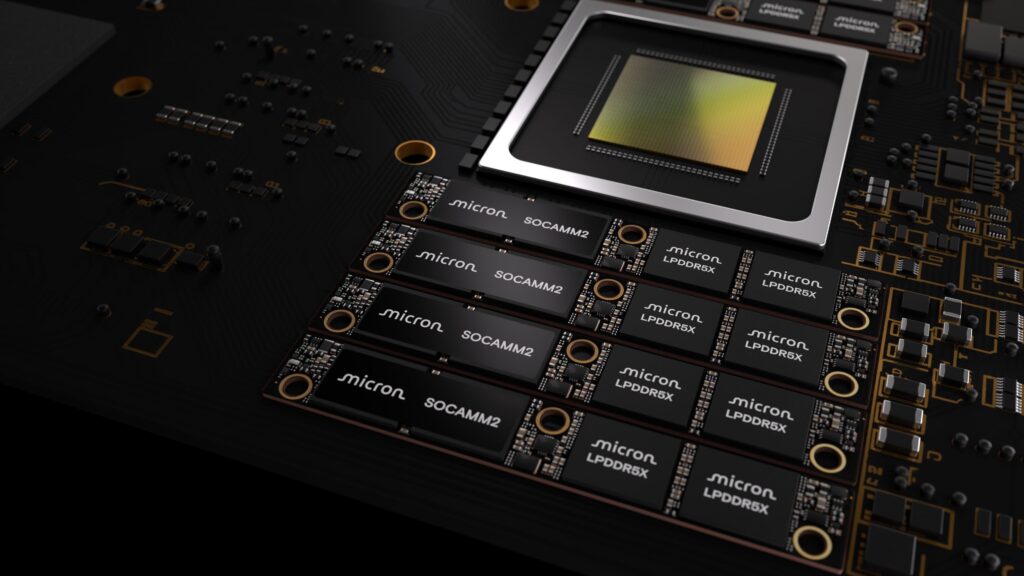
For months, the story of artificial intelligence has revolved around GPUs, large models, and compute capacity. NVIDIA has captured almost all the focus, hyperscalers have announced multi-billion-dollar investments in data centers, and server manufacturers have accelerated their roadmaps. But Micron Technology’s results highlight something less visible: AI doesn’t grow just by having more processors. It grows if those processors receive data at a sufficient speed.
Micron has reported a quarter that changes perceptions about the memory business. The company posted revenues of $41.456 billion in its third fiscal quarter of 2026, up from $23.860 billion in the previous quarter and $9.301 billion a year earlier. Non-GAAP gross margin reached 84.9%, a rare figure for a memory manufacturer, and non-GAAP diluted profit was $25.11 per share.
The market reaction isn’t just due to better-than-expected results. What matters most is that Micron is at one of the tightest points in the AI supply chain: high bandwidth memory, or HBM. Without this memory, the most powerful GPUs cannot operate at full efficiency. When the supply of HBM isn’t growing as quickly as demand for accelerators, the manufacturers able to produce it gain extraordinary bargaining power.
AI needs memory, not just computation
A GPU can execute thousands of operations in parallel, but it constantly needs data. If data arrives late, some of its capacity remains waiting. That’s why HBM has become a strategic component: it offers vastly greater bandwidth than traditional memories and is placed very close to the processor, stacked in multiple layers connected via microscopic vertical vias.
The metaphor is simple. The GPU is the engine. HBM is the highway on which data travels. A more powerful engine is useless if the road feeding it is congested.
HBM isn’t conventional DRAM located far from the processor on the board. It’s stacked in 3D, connected via TSV (through-silicon vias), and integrated into advanced packages alongside GPUs or accelerators. This architecture enables moving enormous volumes of data with lower energy per bit transferred—crucial for training and inference of AI models.
| Memory Type | Common Use | Advantage | Limitation |
|---|---|---|---|
| DDR5 | Servers, PCs, main memory | Capacity, cost, maturity | Lower bandwidth per chip |
| LPDDR5X | Devices, edge, some AI servers | Energy efficiency | Does not replace HBM in high-end GPUs |
| GDDR7 | Graphics, some high-performance loads | Good bandwidth and cost efficiency | Less efficient for large AI accelerators |
| HBM3E / HBM4 | GPUs and AI accelerators | Extremely high bandwidth and proximity to chip | Manufacturing complexity and limited supply |
Memory has ceased being a secondary component and has become a system bottleneck. Models are growing, context windows expand, inference multiplies, and AI agents generate more intermediate steps. All of this demands moving more data, faster, and with less energy.
Why Micron Matters So Much in This Cycle
The global HBM market is concentrated among very few manufacturers. SK hynix, Samsung, and Micron are the main players. This makes Micron more than just a memory supplier—it’s one of the few capable of fueling the next generation of AI infrastructure.
Micron already supplies HBM3E for NVIDIA Blackwell platforms, including its 36 GB HBM3E 12H memory for HGX B300 and GB300 NVL72 systems, as well as 24 GB HBM3E 8H for HGX B200 and GB200 NVL72 platforms. In its latest results, the company also announced that HBM4, manufactured with 1-beta DRAM technology, is in high-volume shipments for its major client’s platform, and that HBM4E, based on 1-gamma technology, is in development with volume production expected in 2027.
That timeline is critical. The next wave of AI accelerators won’t just need more chips; they’ll require more memory per GPU, greater bandwidth, advanced packaging, and reliable supply. If Micron executes well, it can capture a significant share of this growth.
| Micron Product or Advancement | Relevance to AI |
| HBM3E 8H and 12H | Supports current and next-gen AI platforms |
| HBM4 | Spearheading bandwidth leap for advanced accelerators |
| HBM4E | Volume production expected in 2027 |
| SOCAMM LPDDR5X | Efficient modular memory for AI servers |
| DDR5 RDIMM 256 GB | Higher capacity for servers and AI ecosystems |
| SSD QLC 245 TB | Dense storage for data, training, and inference |
Financial results illustrate how this positioning translates into numbers. The Cloud Memory division generated $13.769 billion with an 83% gross margin. The Core Data Center unit reached $11.524 billion with an 87% gross margin. Combined, these data-centric segments explain much of Micron’s recent leap.
A Quarter That Feels Like Software, but Comes from Silicon
Memory has traditionally been a cyclical business—rising prices, capacity expansion, oversupply, margin declines, then repeat. Micron’s quarter suggests that AI is temporarily disrupting this cycle. Multi-year agreements with strategic customers, supply commitments, and HBM scarcity provide more revenue and margin visibility.
| Q3 2026 Fiscal Metrics | Results |
| Revenue | $41.456 billion |
| GAAP gross margin | 84.6% |
| Non-GAAP gross margin | 84.9% |
| GAAP net income | $28.243 billion |
| Non-GAAP net income | $28.857 billion |
| GAAP diluted EPS | $24.67 |
| Non-GAAP diluted EPS | $25.11 |
| Adjusted free cash flow | $18.304 billion |
| Cash, investments, restricted cash | $30.200 billion |
Guidance for the next quarter reinforces a positive outlook. Micron anticipates revenues of around $50 billion, with a variance of ±$1 billion, an approximate gross margin of 86%, and non-GAAP diluted EPS of $31, with a similar margin of error.
These figures explain why the market is beginning to view some memory manufacturers differently. When supply is limited and demand comes from financially strong clients, the bottleneck provider can capture a disproportionate share of value.
HBM Scarcity Also Means Industrial Time Scarcity
Manufacturing HBM isn’t just about producing more memory chips. It requires wafers, advanced DRAM processes, vertical stacking, TSV, packaging, testing, manufacturing yield, and coordination with AI accelerators. Every capacity increase demands investment, equipment, talent, customer qualification, and time.
That’s why the bottleneck isn’t solved overnight. Even if manufacturers invest more, expanding usable HBM capacity takes months or years. Additionally, part of the DRAM capacity must be redirected toward higher-value products, which can strain other memory segments such as traditional servers, PCs, mobile devices, storage, and consumer electronics.
The pressure is felt across the entire chain. Hyperscalers seek to secure supply for their AI clusters, NVIDIA requires HBM for its Blackwell platforms and future generations, memory manufacturers negotiate long-term commitments, and other sectors experience higher prices or less availability.
| Limiting Factor | Why It Matters |
| 3D stacking | Increases complexity compared to conventional DRAM |
| TSV | Requires precise vertical interconnections |
| Manufacturing yield | Minor defects can significantly reduce usable capacity |
| Advanced packaging | Must integrate with GPUs and accelerators |
| Customer qualification | Each platform requires technical validation |
| Capex | Expanding capacity involves billions of dollars in investment |
| Energy & data centers | End demand also depends on physical infrastructure |
The outcome is that AI is limited by very physical elements. It’s not enough to have better models or more software. Memory, packaging, interconnection, energy, cooling, and deployment capacity are essential.
The Risk: Confusing a Bottleneck with a Permanent Advantage
Micron is in a highly favorable moment, but that doesn’t eliminate risks. Memory remains a cyclical industry. If supply grows too quickly, prices drop, or clients reduce purchases, margins could normalize. The industry has seen before how memory manufacturers can go from extraordinary profits to sharp declines.
What sets this cycle apart is the structural demand from AI and longer-term supply contracts. Still, caution is advised. Hyperscalers have purchasing power, seek to diversify suppliers, and will push to reduce costs. NVIDIA and other accelerator designers also have incentives to improve efficiency, reduce dependence on scarce components, or explore architectures that use memory differently.
| Opportunity for Micron | Associated Risks |
| Growing demand for HBM | Capacity increases from competitors |
| Multi-year contracts | Re-negotiation if the cycle shifts |
| Record margins | Potential price normalization |
| Relationship with AI platforms | Dependence on a few key clients |
| HBM4 and HBM4E | Technological execution risk |
| High capex | Pressure if demand cools |
For investors, the key question isn’t just whether Micron is vital to AI. It is. The real question is how much of that importance is already embedded in the valuation, and how much depends on HBM scarcity lasting for several years.
AI Also Writes Its Future in Memory
Micron’s quarterly results help correct an incomplete view of artificial intelligence. AI isn’t just models, GPUs, and software. It’s an industrial chain where memory can determine the entire expansion pace. If HBM is missing or expensive, the most powerful systems aren’t delivered on time or don’t perform as expected. If HBM costs more, inference and training costs rise too.
This makes Micron a critical company for the actual deployment of AI. Not because it controls the entire supply chain but because it occupies one of the strategic segments where supply expansion is most challenging. At this point, the company has moved from selling memory in a cyclical market to supplying a strategic component for the most in-demand infrastructure of the moment.
Focus will remain on NVIDIA, OpenAI, Microsoft, Amazon, Google, Meta, and large models. But underneath all of them lies a more fundamental question: who can produce enough memory so that computing doesn’t have to wait? In 2026, Micron shows that this question involves tens of billions of dollars per quarter.
The enthusiasm for AI often centers on algorithms. Micron’s results remind us that materials matter. The next phase depends not just on who designs the best model but on who can move data faster, with less energy, at an industrial scale.
Frequently Asked Questions
Why is Micron important for artificial intelligence?
Because it manufactures advanced memory, including HBM, essential for powering AI GPUs and accelerators that handle large volumes of data at very high speeds.
What is HBM?
High Bandwidth Memory (HBM) is a 3D-stacked DRAM located very close to the processor or GPU, providing much higher bandwidth than traditional memories.
Which companies manufacture HBM at scale?
The market is mainly concentrated among SK hynix, Samsung, and Micron, making these manufacturers critical players in AI infrastructure.
Can Micron’s favorable cycle change?
Yes. Although AI demand is strong, memory remains cyclical. If supply outpaces demand, prices could fall, and margins could normalize.
