
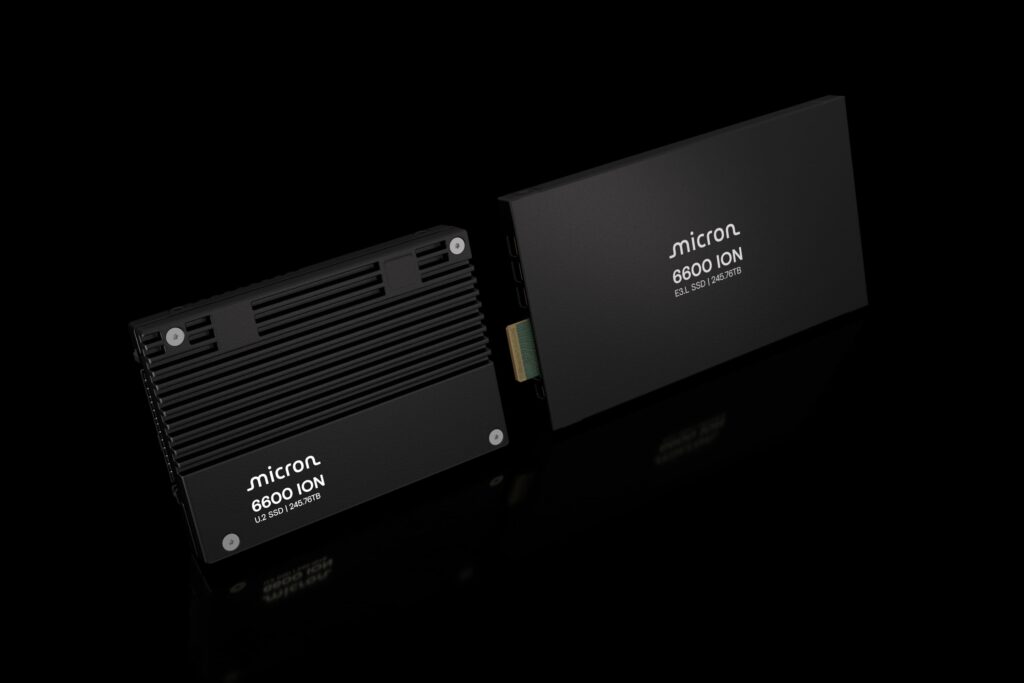
Micron has begun shipping its new Micron 6600 ION SSD with 245 TB capacity, a storage unit designed for data centers that directly addresses one of the most visible pressures of AI infrastructure: storing more data, taking up less space, and reducing energy consumption per terabyte.
The company presents this unit as the highest-capacity commercially available SSD on the market. Precision matters because other manufacturers have already shown or announced similar capacity units, but Micron now emphasizes that it is entering full commercial availability. The product is intended for AI workloads, cloud, enterprise, and hyperscale infrastructure, with a particular focus on next-generation data lakes and large-scale file and object storage.
The Micron 6600 ION reaches 245.76 TB of usable capacity and 256 TB gross in a single unit. It is available in U.2 and E3.L formats, uses PCIe Gen5 interface, and is based on Micron G9 QLC NAND memory. According to the company, this ninth generation of QLC NAND increases density without sacrificing the performance required for read-intensive environments, data analysis, and preparing massive datasets for AI models.
Fewer racks for the same capacity
Micron’s comparison to explain the leap is straightforward: deploying 245 TB Micron 6600 ION E3.L SSDs would require 82% less rack space to achieve the same gross capacity as an equivalent HDD-based infrastructure. The estimate is based on a theoretical scenario of 720 SSDs of 245.76 TB in 36U, versus 720 44 TB hard drives in the same space.
In other words, Micron calculates that a rack could reach up to 176.9 PB of gross capacity with these units, compared to 31.7 PB with an equivalent HDD setup of 44 TB. This figure shouldn’t be taken as a universal recipe for any data center, as it depends on chassis, cooling, network architecture, redundancy, and operational policies. Still, it helps illustrate why storage is no longer measured solely by price per terabyte but also by density, power consumption, physical space, and operating costs.
Maximum declared power consumption for the SSD is up to 30 W. Micron compares this figure with deployments of HDDs of equivalent capacity and asserts that to reach 1 EB of storage, 4,069 SSDs of 245 TB would be needed versus 22,727 44 TB HDDs. In that scenario, the company’s calculations suggest HDD deployments would require 1.9 times more energy than SSD-based systems.
The practical implication is particularly relevant for operators for whom the main constraints are now energy, cooling, and space—not server availability. In data centers serving AI workloads, each rack competes for electrical power with GPU systems, high-speed networks, and increasingly close-to-compute storage solutions. In this context, reducing the number of units, trays, servers, and racks can have a direct impact on capacity planning.
AI is changing the storage economy
Micron’s interest extends beyond replacing HDDs with SSDs. The company positions the 6600 ION as a solution for data that is constantly queried, transformed, and prepared to feed models, training pipelines, inference, search systems, analytics, and object storage.
Internal tests claim that the 245 TB 6600 ION offers up to 84 times more energy efficiency for AI workloads compared to HDD-based systems, along with data preparation speeds 8.6 times faster, ingestion rates 3.4 times higher, and latency up to 29 times lower. For object storage workloads, the company reports up to 435 times more performance per watt, 96 times less time to the first byte, and 58 times higher aggregate performance.
It’s important to interpret these figures cautiously, as they are derived from Micron labs and depend on specific testing conditions, such as load type, object size, disk configuration, and access pattern. Nevertheless, they align with a clear trend: as AI data volumes grow, traditional HDDs are losing appeal in environments where latency, concurrency, and performance per watt matter more than the initial cost per terabyte.
QLC memory, which stores four bits per cell, has gained presence in data centers because it increases capacity and reduces costs compared to other NAND types, although it is usually associated with lower endurance under heavy write workloads compared to TLC technology. Therefore, these units make more sense in read-intensive workloads, data lakes, object storage, training repositories, analytics, and large content libraries than in environments with constant, heavy writing.
The release also highlights how the EDSFF format, particularly E3.L and E3.S, is gaining traction in modern servers. These formats enable higher density and better thermal integration than legacy designs, and server and storage manufacturers are leveraging this to create systems with multiple petabytes within a few rack units.
Dell, Supermicro, and WEKA enter the conversation
Micron has linked this launch to Dell Technologies’ AI storage solutions. Travis Vigil, senior vice president of product management at Dell’s ISG, states in the release that being able to add more storage per rack changes the numbers: less energy, less space, and lower operational overhead for customers building AI environments and large-scale data centers.
Micron’s product page also references Supermicro and WEKA. Supermicro highlights petascale server configurations with up to 36 E3.S SSDs, while WEKA positions this type of unit within infrastructure aimed at moving and processing larger datasets with less physical infrastructure.
The 245 TB Micron 6600 ION will be showcased at Dell Technologies World, from May 18 to 21, 2026, in a 40-bay Dell PowerEdge server designed for data lake storage. Beyond the demonstration, the move reinforces an emerging market trend: ultra-high-capacity flash storage seeking to take market share from traditional hard drives in large repositories of data.
The transition won’t be immediate or complete. HDDs will continue to have a place in cold storage, massive archives, and environments where cost per terabyte is the primary factor. However, in data centers where energy, latency, and density are equally important as gross capacity, units like the Micron 6600 ION with 245 TB capacity point toward the future of infrastructure supporting next-generation AI services.
Frequently Asked Questions
How much capacity does the Micron 6600 ION have?
The new model offers 245.76 TB of usable capacity and 256 TB gross in a single SSD unit.
What workloads is this SSD designed for?
Micron targets data centers, cloud, enterprise, hyperscale infrastructure, AI data lakes, object storage, and large-scale data analytics.
Will this type of SSD replace hard drives?
Not in all cases. HDDs will continue to be useful in cold storage or environments highly sensitive to cost per terabyte, but high-capacity SSDs become more attractive when latency, density, and energy efficiency are priorities.
What formats will the 245 TB Micron 6600 ION be available in?
Micron indicates that the 245 TB unit is available in U.2 and E3.L formats. The family also includes lower-capacity versions in other formats, such as E3.S.
via: investors.micron
