
Micron has presented very compelling figures that confirm a reality the sector has been repeating for months: in the race for artificial intelligence, memory is no longer just “a component” but the bottleneck that determines who scales and who falls behind. In its first fiscal quarter of 2026 (ended November 27, 2025), the company reported $13.64 billion in revenue, with $5.24 billion GAAP net income (equivalent to $4.60 per diluted share), and $8.41 billion in operating cash flow.
The best summary of this moment is the margin: Micron posted a 56.0% GAAP gross margin (56.8% non-GAAP), a significant jump that doesn’t usually happen by chance. In its message, CEO Sanjay Mehrotra linked the improvement to a mix of “technological leadership,” product portfolio, and operational execution, making it clear that the company considers itself an “essential enabler” of AI, as hyperscalers and major integrators compete to secure supply of DRAM, NAND, and especially HBM.
A “Turning Point” Quarter and Guidance That Smells Like a Peak Cycle
Beyond the already closed quarter, the outlook for Q2 fiscal 2026 raises expectations: Micron projects $18.70 billion in revenue (± $0.40), with GAAP gross margin of 67.0% (68.0% non-GAAP), and GAAP diluted EPS of $8.19 (non-GAAP $8.42). Industry-wise, this clearly signals that demand related to AI—and the product mix—is pushing numbers toward a “supply-constrained with premium pricing” zone, especially in memory for data centers.
Micron also announced $4.5 billion in net capex during the quarter and an adjusted free cash flow of $3.9 billion, closing with $12.0 billion in cash and investments (including restricted). To cap it off, the board declared a quarterly dividend of $0.115 per share, payable on January 14, 2026 (record date: December 29, 2025).
Where the Strength is Felt: Cloud, Customers, and an Increasing “AI” Mix
Breaking down by units, the standout metrics are from the Cloud Memory segment, with $5.284 billion in revenue and 66% gross margin (55% operating margin). This combination often appears when the market is rewarding capacity and performance over “commodity memory.”
There’s also strong growth in Mobile and Client ($4.255 billion; 54% gross margin) and steady advances in Automotive and Embedded ($1.72 billion; 45% gross margin). Overall, the message is that the cycle isn’t limited to just one vertical: AI is “pulling” data centers, but other markets benefit from product repositioning and inventory normalization.
HBM4: The Major Lever (and the Big Test)
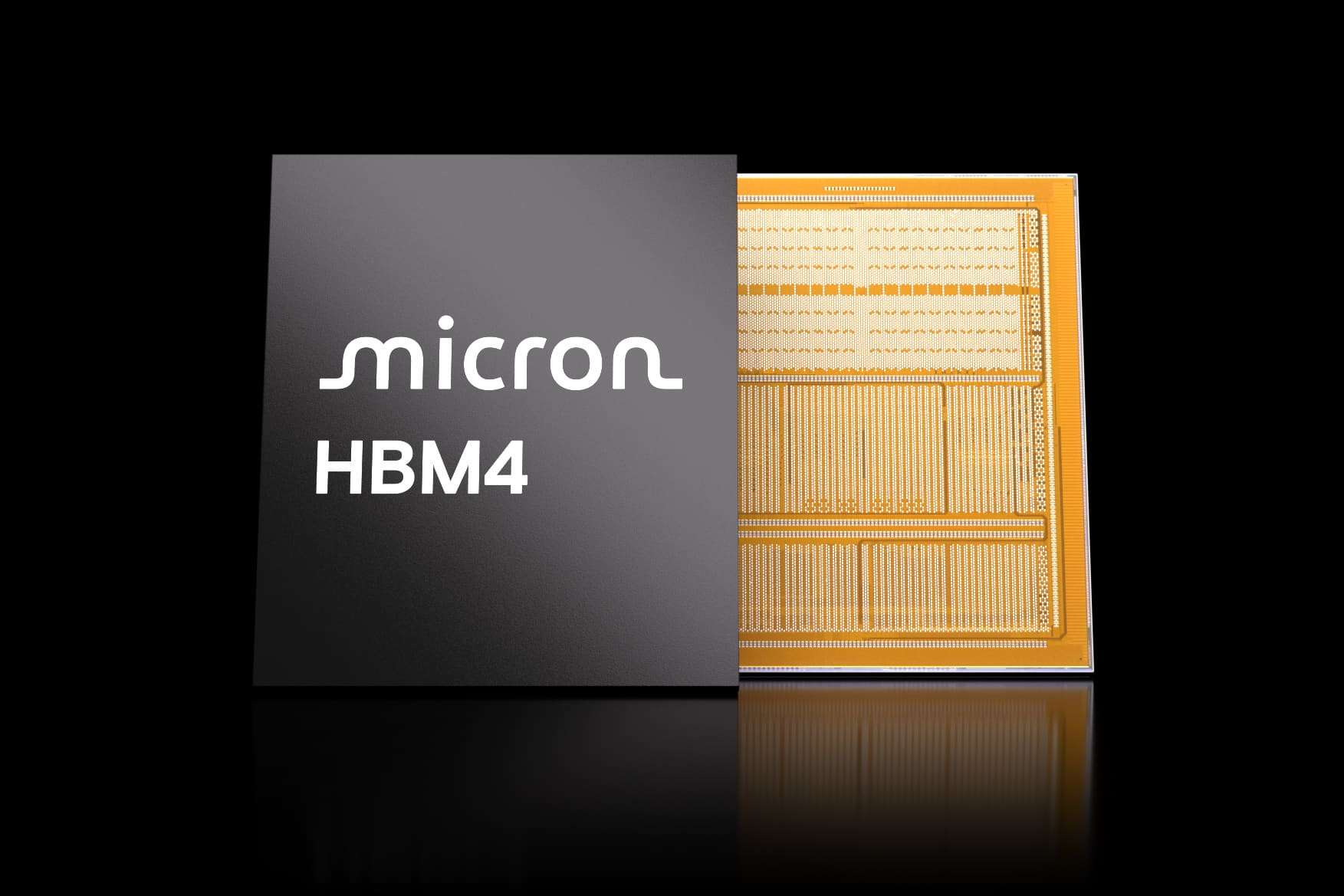
The market has long viewed HBM as “premium fuel” for AI accelerators. In this context, Micron has been emphasizing milestones in HBM4 for months. For example, in mid-2025, it announced sample shipments of HBM4 to key customers, highlighting its reliance on its 1-beta DRAM node and focusing on efficiency, performance, and scalability for next-generation platforms.
Now, with current margins and such an aggressive guidance for the next quarter, the market interpretation is quite straightforward: if HBM (and AI memory) remains tight, those who meet ramp-up and yield targets on time will capture a disproportionate share of the value. Along those lines, various industry reports suggest Micron plans to consolidate HBM4 production on the 1-beta node while adjusting manufacturing schedules (including its assembly and testing capacity outside the US), at a time when any post-fabrication bottleneck could delay actual deliveries.
A Perspective That Is Also Reflected in the Market
Following the earnings release and investment context, the market remains particularly sensitive to any clues about future supply, node ramp-ups, and actual HBM availability. As of early morning December 18, 2025 (UTC), Micron’s stock was trading around $225.52.
Frequently Asked Questions
Why do Micron’s results matter so much for the AI industry?
Because memory (DRAM and especially HBM) determines the performance and overall cost of training and inference clusters: without enough memory, GPU power isn’t fully utilized.
What is HBM4 and why is it key for next-generation accelerators?
HBM4 is the evolution of high-bandwidth stacked memory, designed to feed AI chips with higher throughput and better energy efficiency; practically, it’s a critical piece to scale performance without increasing latency.
What does it mean that HBM4 relies on a “1-beta” DRAM node?
It indicates part of its advancement comes from process improvements (density, power consumption, manufacturing performance). If the node matures well, it helps improve cost per bit and product availability.
What indicators in the report point to an especially strong cycle?
The combination of record revenue, gross margin above 56% this quarter, and guidance of $18.70 billion with nearly 67% margin for the next quarter suggests demand is well above a “normal” market phase.
via: investors.micron