
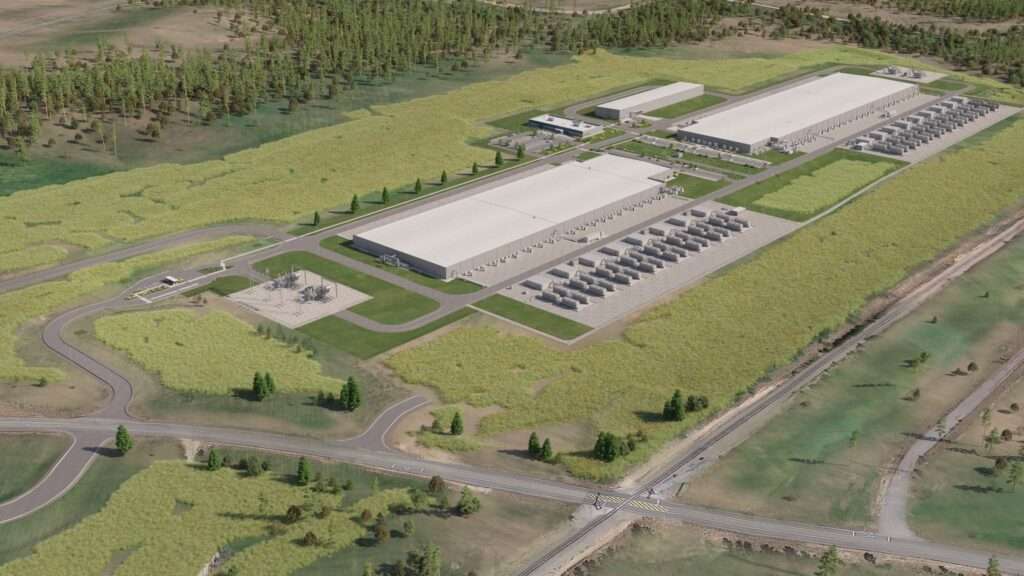
Meta has reached a new agreement with Entergy Louisiana to finance seven new natural gas power plants intended to supply their massive Hyperion data center campus, located in Richland Parish, Louisiana. The operation will expand the project’s associated electric capacity by 5,200 MW and will complement the three plants already approved, potentially bringing the entire complex to over 7 GW of power, with some estimates nearing 7.5 GW upon full infrastructure completion.
This news confirms something industry insiders have suspected for months: the race for Artificial Intelligence (AI) is no longer solely about chips, networks, and data centers, but also about an increasingly fierce battle to secure energy supply. For Meta, this move is especially significant because it involves Hyperion, the campus the company is developing in Louisiana, aiming to become one of its largest AI complexes. According to The Wall Street Journal, the project fits into a total investment plan of around $27 billion for this development.
An agreement for Meta to cover the cost of its own electricity demand
One of the most important aspects of the agreement is its economic structure. Entergy explained that the pact is designed for Meta to pay the full cost of the electricity service associated with this expansion. This is a politically sensitive issue in the United States due to concerns that the rising energy demand from data centers could eventually be passed on to residential consumers. Entergy claims that the new agreement will generate nearly $2 billion in savings for its customers over 20 years, in addition to the $650 million already communicated with the previous agreement.
This part is crucial because public and regulatory pressure on the energy costs of AI is increasing. In recent months, the debate has shifted from the technical capacity of utilities to connect these projects to a much more delicate issue: who actually pays for the deployment of the new infrastructure. Meta and Entergy aim to preempt criticism with a model that, on paper, avoids placing the majority of the burden on residential users.
Not just gas: also lines, batteries, and nuclear options
The new package is not limited to the seven gas plants. The agreement also includes 240 miles of new 500 kV transmission lines, energy storage systems with batteries, and upgrades related to generation infrastructure, while Meta and Entergy have also signed a memorandum to explore nuclear energy development in the future.
Meanwhile, Meta continues its narrative of energy transition, pledging to finance up to 2.5 GW of new renewable energy. This is significant: the company had already secured agreements with NextEra Energy Resources for supporting 2.5 GW of renewable projects and storage across various parts of the U.S. by the end of 2025. However, the contrast is clear: while promoting this volume of renewables, the expansion of Hyperion heavily depends on natural gas as an immediate solution to ensure firm power at a large scale.
AI demands a choice between speed and sustainability
This is the core issue of the news. The tech industry insists it remains committed to its climate goals, but the actual deployment of AI requires timelines and volumes that are difficult to meet solely with intermittent renewables or new nuclear power, which takes years to develop. As a result, natural gas once again appears as the fastest solution for generating firm capacity in the short term.
Meta had already announced in January agreements related to expanding nuclear energy to support U.S. AI leadership and argued that strengthening energy infrastructure was key to sustaining the country’s growth in this technological race. Now, however, the immediate reality involves ten gas facilities linked to Hyperion. This contradiction encapsulates the sector’s current state: AI aims to be the engine of the next digital decade, yet its physical infrastructure still heavily relies on fossil fuels.
A sign of the new AI energy economy
The situation with Meta is not isolated. Major companies like Microsoft, Google, Amazon, and Meta itself are seeking ways to secure their access to electricity on scales that would have seemed excessive just a few years ago—even for the biggest hyperscalers. The problem now is that new AI data centers are measured in gigawatts, transforming the logic of energy planning, grid regulation, and infrastructure funding.
In this context, Hyperion is more than just a campus. It is a signal of where the industry is headed: gigantic data centers that require new power plants, extensive transmission networks, and negotiations with utilities and regulators, almost as if each deployment were a regional industrial project. What Meta is doing in Louisiana reflects—not just a single company—but the kind of infrastructure that AI will demand in the coming years.
Frequently Asked Questions
How many new gas plants will Meta finance?
Meta will finance seven new natural gas plants under the new agreement with Entergy Louisiana. Together with the three already approved for Hyperion, the campus will be associated with ten facilities.
How much total energy will they supply to the Hyperion campus?
The seven new plants will add 5,200 MW, joining the roughly 2,300 MW already approved, bringing the total to over 7 GW, with some estimates approaching 7.5 GW.
Will Meta continue investing in renewable energy?
Yes. The agreement includes a pledge to help finance up to 2.5 GW of new renewable energy, and Meta had already signed such agreements with NextEra by late 2025.
Are the seven new plants fully approved already?
Not yet. Reuters and Tom’s Hardware report that the three initial plants have already received regulatory approval, but the seven new plants still require approval from state regulators before construction can begin.
via: tomshardware