
Meta no wants to compete solely in general language models anymore. Mark Zuckerberg’s company has introduced Muse Code, a new programming agent powered by Muse Spark 1.2, directly entering one of the most contested markets in artificial intelligence: autonomous software development assistants.
This move comes at a time when Anthropic dominates the segment with Claude Code and OpenAI continues to strengthen Codex, while Google, xAI, and other developers accelerate the development of models tailored for software engineering.
The key points of Muse Code in 20 seconds
- Meta announces Muse Code, its first AI-based programming agent.
- Powered by Muse Spark 1.2, optimized for code generation and debugging.
- The benchmarks published by Meta position it very close to Claude Code and ahead of several competitors.
- The main selling point initially is its price, significantly lower than many commercial models.
The announcement confirms an already seemingly irreversible trend: the race in AI is no longer just about the smartest chatbot, but about the best virtual software engineer.
Agents replace simple autocompletion
Just two years ago, tools like GitHub Copilot revolutionized development by helping complete functions.
Today, new agents operate differently.
They no longer just suggest lines of code, but:
- analyze entire repositories;
- plan changes;
- generate code;
- run tests;
- debug errors;
- validate results.
This is precisely the approach of Muse Code.
Meta claims it can perform complete software engineering tasks asynchronously, working in the background on large projects.
The platform is initially available through API for developers and OpenRouter, allowing integration into external tools.
Muse Spark 1.2 clearly improves over the previous version
The new agent is built on Muse Spark 1.2, a specific update for programming compared to the model Spark 1.1, introduced just a few weeks earlier.
According to Meta, the improvements focus on three areas:
- code generation;
- understanding large codebases;
- automatic debugging.
The first published benchmarks show a significant jump compared to Spark 1.1.
The race among major models for programming looks like this
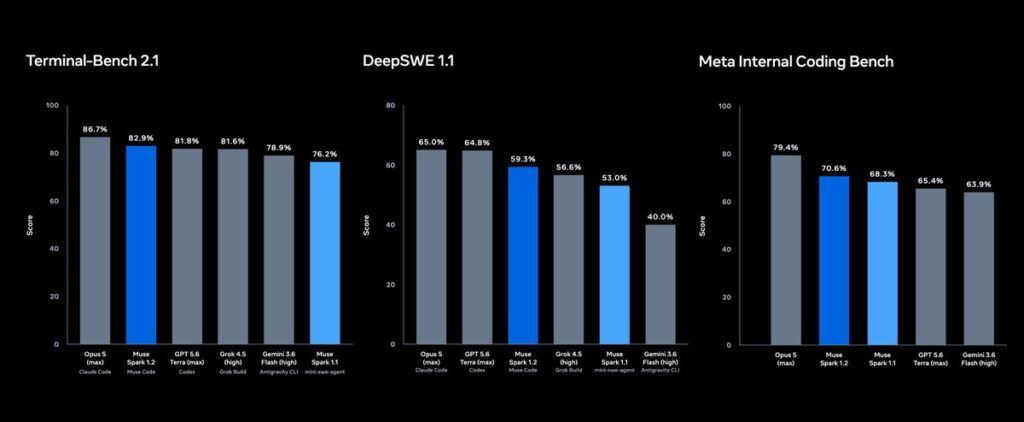
Although fully independent evaluations are still pending, the data published by Meta lets us get an idea of the current situation.
| Benchmark | Claude Opus 5 | Muse Spark 1.2 | GPT-5.6 Terra | Grok 4.5 | Gemini 3.6 Flash |
|---|---|---|---|---|---|
| Terminal-Bench 2.1 | 86.7% | 82.9% | 81.8% | 81.6% | 78.9% |
| DeepSWE 1.1 | 65.0% | 59.3% | 64.8%* | 56.6% | 40.0% |
| Meta Internal Coding Bench | 79.4% | 70.6% | 65.4% | — | 63.9% |
*Meta compares GPT-5.6 Terra only in this specific benchmark.
The overall picture is interesting.
Claude Opus 5 continues to lead most tests, but Meta manages to place Muse Spark 1.2 very close from its first public version, also surpassing well-established models in several metrics.
As with all benchmarks published by the manufacturers themselves, these results should be interpreted with caution until they are reproducible by independent labs.
The difference may be in the price
Where Meta seems determined to break into the market is in cost.
The company has set prices at:
- $1.25 per million input tokens
- $4.25 per million output tokens
Additionally, it offers a model called Contributor Tier, where developers who contribute to improving the model pay a cost that, according to Meta’s AI director Alexandr Wang, is more than ten times lower.
In a time when many companies are starting to control the expenses associated with using multiple programming agents, price could become as crucial as the model’s quality.
Another important point: code privacy
One of the main concerns for companies is what happens to the source code sent to these models.
Meta has announced that organizations can request that their data not be used to train future models, a particularly relevant option for companies working with proprietary software.
The next battle is no longer about who programs better, but who automates more
Muse Code arrives as the market begins to evolve from simple assistants to full teams of specialized agents.
Delegating tasks like writing unit tests, reviewing pull requests, locating bugs, updating dependencies, or even implementing complete features is becoming more common.
Meta’s entry introduces a significant new competitor in a market where until now Anthropic and OpenAI have been leading.
If Muse Spark continues to evolve at the pace shown between versions 1.1 and 1.2, competition in the coming months will intensify, benefiting both developers and companies with more capable and likely more affordable models.
Frequently Asked Questions
What is Muse Code?
It is the new AI-powered programming agent developed by Meta to automate complete software engineering tasks.
What model does it use?
It runs on Muse Spark 1.2, a model specifically optimized for code generation, understanding, and debugging.
What does it compete against?
It directly competes with Claude Code, Codex, GitHub Copilot, and other AI-based programming agents.
What is its main advantage?
Besides the performance demonstrated in initial benchmarks, Meta adopts a much more aggressive pricing strategy compared to some of its main competitors.
