
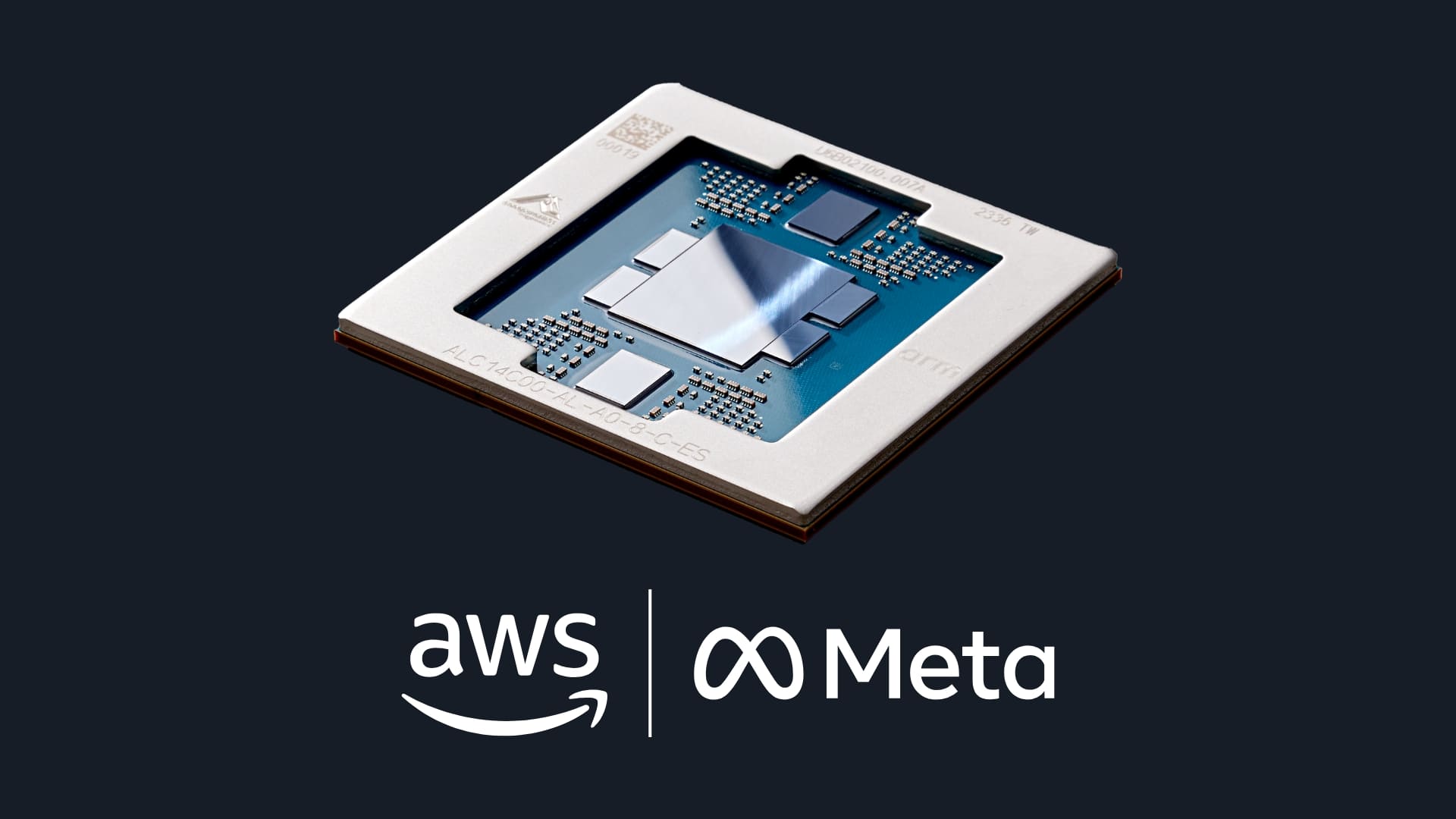
Meta has signed an agreement with Amazon Web Services to incorporate tens of millions of AWS Graviton cores into its computing infrastructure. The move reinforces a growing industry trend: artificial intelligence is no longer solely dependent on GPUs. As models evolve into systems capable of reasoning, searching, generating code, and coordinating tasks, the demand for efficient CPUs is also skyrocketing.
The agreement makes Meta one of the largest global customers of Graviton and extends a long-standing relationship the company has maintained with AWS. This operation is part of the broader infrastructure Meta needs for its next generation of artificial intelligence, especially for agent-based workloads, where systems do not just respond but execute multi-step processes.
Agent-based AI also requires CPUs, not just GPUs
The AI race has historically been centered around GPUs. NVIDIA has become the symbol of training large models, and much of the investment from hyperscalers has focused on clusters of accelerators. But this is only part of the story. When an AI system must handle millions or billions of interactions, search for information, call external tools, generate code, coordinate agents, and maintain real-time responses, CPUs become central to the architecture.
This is where the Meta-AWS partnership fits in. According to Amazon, the initial deployment will involve tens of millions of Graviton cores, with the possibility of expansion as Meta’s needs grow. The company will use these processors across various workloads, including those related to its AI initiatives.
The distinction is significant. Training a large model typically requires GPUs or specialized accelerators. Running AI services at scale, orchestrating agents, processing requests, managing searches, or coordinating complex workflows may depend much more on CPUs, memory, networking, and energy efficiency. In other words, while generative AI is developed in massive accelerator factories, many of its daily functions are run on highly optimized general-purpose computing layers.
Meta has explained this in terms of diversification. Santosh Janardhan, the company’s infrastructure lead, noted that diversifying computing sources is a strategic priority as Meta scales its AI infrastructure. AWS, for its part, presents the partnership as a validation of its proprietary silicon strategy.
Graviton5: 192 cores and a clear commitment to Arm
The technical highlight of the announcement is Graviton5, AWS’s new generation of processors. This chip features 192 cores, five times larger cache than the previous generation, and, according to Amazon, can reduce inter-core communication latencies by up to 33%. AWS also claims that Graviton5 delivers up to 25% more performance than Graviton4.
This leap isn’t solely about the number of cores. Agent-based workloads can generate many simultaneous processes, external service calls, queries, auxiliary inferences, and coordination operations. In such a context, larger caches, wider bandwidth, and lower latency between components can significantly impact both cost and performance—especially when deploying millions of cores.
Built on 3-nanometer technology and supported by AWS Nitro System—a cloud architecture that separates virtualization, networking, and storage functions into dedicated hardware and software—Graviton5 enables offerings like bare metal instances and virtualized environments with direct hardware access. This is particularly relevant for large clients that already have their own layers of virtualization, automation, and deployment systems.
An additional key feature is support for Elastic Fabric Adapter, AWS’s technology for low-latency, high-bandwidth communication between instances. In distributed AI workloads, networking can become as critical as processing power. When many nodes work in concert, inter-node communication impacts overall performance just as much as raw chip power.
The choice of Graviton also underscores Arm’s growing role in data centers. For many years, x86 architecture dominated enterprise computing. AWS began shifting this dynamic with its own Arm-based chips—initially as a cost-effective option for general cloud workloads, and now as a strategic choice for large-scale AI infrastructure.
AWS gains influence beyond GPU dominance
For AWS, the partnership with Meta comes at a pivotal moment. The company has been investing for years in proprietary chips, not only with Graviton for CPUs, but also with Trainium and Inferentia for AI training and inference. It competes in a market where Microsoft, Google, and other hyperscalers are also designing custom silicon to reduce costs, improve efficiency, and reduce reliance on external vendors.
Amazon’s clear message: not all AI computation needs to be done with GPUs. In certain scenarios, a CPU tailored for its cloud environment can offer better operational costs and energy efficiency. This becomes especially important as companies move from experimenting with AI to deploying large-scale services with many users, high concurrency, and constant responsiveness demands.
For Meta, the benefits are evident. The company requires massive computing capacity to support its AI products—from virtual assistants to integrated functions across Facebook, Instagram, WhatsApp, devices, and tools for creators and advertisers. Relying on AWS Graviton allows Meta to diversify its infrastructure and reduce dependence solely on GPUs or its data centers.
Energy efficiency is also a key factor. AI computing demands are increasing pressure on data centers, electrical grids, and capital budgets. AWS claims Graviton5 improves performance while maintaining high energy efficiency. For companies like Meta, committed to sustainability and expanding their AI capabilities, every watt of performance per efficiency gain is vital.
This partnership doesn’t alone reshape the chip market but signals an important shift. Major platforms are beginning to design AI architectures that combine accelerators, custom CPUs, fast networks, distributed storage, and orchestration software. While GPUs will remain essential for training and running many models, the layers enabling these models to become mass services will be more diverse.
For Meta, Graviton offers increased capacity and flexibility. For AWS, it demonstrates that its investment in proprietary processors can attract one of the world’s largest AI infrastructure consumers. For the industry, it indicates that the next AI era will be influenced both by the visible chips and the often-overlooked compute layers working behind the scenes, usually outside of public view.
Frequently Asked Questions
What have Meta and AWS agreed upon?
Meta will incorporate tens of millions of AWS Graviton cores into its computing infrastructure to support AI workloads, including agent-based AI functions.
What is AWS Graviton?
AWS Graviton is a family of Arm-based processors designed by Amazon Web Services to run cloud workloads with high performance, energy efficiency, and cost control.
Why does Meta need CPUs for artificial intelligence?
Because many agent-based AI tasks—such as real-time reasoning, code generation, searching, and coordinating—depend heavily on CPUs, networking, and memory, in addition to GPUs.
Does Graviton replace GPUs in AI?
No. GPUs remain essential for training and executing many models. Graviton covers other types of workloads, especially those requiring efficient general-purpose computing at scale.
