
The global semiconductor market started 2026 with a record-high figure. According to Omdia, sector revenues grew 27% in the first quarter compared to the fourth quarter of 2025, reaching $319 billion. This is the largest quarterly growth observed by the consultancy since it began tracking the market with quarterly data in 2002.
The main explanation lies in memory. DRAM and NAND have broken the sector’s usual pattern, turning a typically weaker quarter into a new high. Demand driven by artificial intelligence, data centers, and high-performance storage has boosted prices, strained supply, and caused memory to account for more than 40% of all semiconductor revenues in Q1 2026—significantly above its historical average around 20%.
Memory changes the market’s pace
The overall figure is impressive, but the division between memory and the rest of the market helps to better understand what’s happening. Total semiconductor revenues grew by 27% quarter-over-quarter. However, excluding memory, growth was much more modest, just over 2%. This difference shows that the current boom is not evenly distributed across the industry.
| Q1 2026 Metric | Omdia Data |
|---|---|
| Global semiconductor revenues | $319 billion |
| Total quarterly growth | +27% |
| Memory quarterly growth | Over 80% |
| Quarterly growth excluding memory | A little over 2% |
| DRAM + NAND share of total revenues | Over 40% |
| Historical memory average | Around 20% |
| Forecast for H1 2026 | Over $700 billion |
| Annual market threshold heading towards | $1 trillion |
Memory has shifted from being a cyclical component, often subject to sharp price swings, to acting as the industry’s main growth driver amid the race for artificial intelligence. It’s not that the rest of the market is stagnant, but its behavior resembles a more traditional pattern. In a typical first quarter, both the overall market and the ex-memory segment usually decline around 4%. This time, even without memory, the sector grew by just over 2%, supported by components linked to AI and data centers.
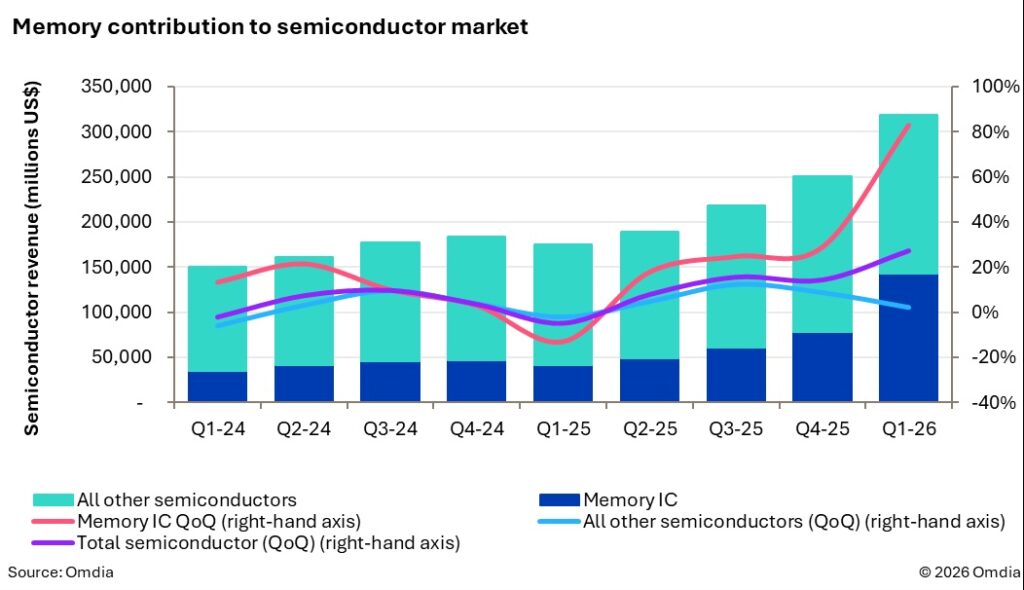
The difference is that memory has moved at a different pace. DRAM and NAND revenues nearly doubled in just one quarter. Omdia notes that demand from AI has affected both segments, with strong increases in average selling prices. The result is a market where memory no longer just follows the cycle but is now the force driving total figures toward new highs.
NAND becomes a major engine
Within memory, NAND has played an especially prominent role. According to Omdia, NAND revenues reached just under $48 billion in Q1 2026, a 96% increase quarter-over-quarter. Average selling prices also rose by 95% during the same period.
| Indicator for NAND in Q1 2026 | Omdia Data |
| NAND revenues | Just under $48 billion |
| Quarterly revenue growth | +96% |
| Quarterly ASP increase | +95% |
| Main drivers | AI, data centers, supply constraints |
| Forecast for Q2 2026 | Continued momentum in revenues and prices |
The explanation combines demand and supply factors. On the demand side, data centers require more storage to support AI workloads, training, inference, vector databases, data pipelines, and distributed storage systems. On the supply side, recovery isn’t immediate. Omdia points to constraints due to technological transitions, performance learning, and product mix challenges.
This balance favors memory manufacturers but poses challenges for many buyers. When NAND and DRAM prices rise sharply, the impact extends beyond manufacturer margins to servers, storage systems, enterprise SSDs, cloud infrastructure, client devices, and data center projects already pressured by GPU costs, energy, and networking.
| Factor | Market impact |
| AI demand | Increases consumption of DRAM, NAND, and enterprise storage |
| Data centers | Boosts purchases of SSDs and high-performance memory |
| Supply constraints | Sustain high prices |
| Technological transitions | Limit capacity recovery speed |
| Factory utilization high | Reduces margin for quick response to new demand |
| ASP increase | Boosts revenues despite volume not growing at the same pace |
Memory has become a critical variable in the AI economy. In recent years, much of the debate centered on GPUs and accelerators. That view is incomplete. Without enough memory, system performance drops, infrastructure costs rise, and bottlenecks shift elsewhere in the stack.
Other sectors grow, but with less euphoria
Omdia’s analysis also avoids an overly optimistic conclusion: not all of the semiconductor market is growing at the same rate. Outside memory, growth was a little over 2% in Q1 2026. This is a good figure compared to the usual seasonal decline of around 4% in the first quarter, but it’s vastly different from the over 80% increase seen in memory.
Some components behaved more traditionally. Microcontrollers, discretes, and optical products saw slight or mid-digit declines compared to the previous quarter. Conversely, other segments linked to the AI ecosystem and data centers outperformed the seasonal pattern, helping the ex-memory market to grow.
| Segment | Omdia’s quoted behavior |
| DRAM and NAND memory | Very strong growth, nearly doubling revenues |
| NAND | +96% quarterly revenue growth |
| Ex-memory market | Just over 2% quarterly growth |
| Microcontrollers | Slight decline or mid-digit drop |
| Discretes | Slight decline or mid-digit drop |
| Optics | Slight decline or mid-digit drop |
| AI and data center components | Better performance than seasonal trend |
This difference is important for investors, manufacturers, and buyers. A market that grows mainly via memory can present outstanding global figures but hide very different realities across categories. Memory providers enjoy favorable price cycles, while other component manufacturers may experience more normalized environments. End customers face increasing infrastructure costs concentrated in specific parts of their systems.
A historic rise with cycle risks
Memory is a highly cyclical industry. When shortages occur, prices rise quickly, and revenues soar. When new capacity comes online or demand cools, prices can decline just as rapidly. The current moment is backed by clear fundamentals in AI and data centers, but the risk of overinvestment, corrections, or inventory adjustments remains.
Omdia foresees continued growth into the second quarter of 2026. The consultancy expects a smaller sequential increase than in Q1 but still enough to surpass 20% quarter-over-quarter growth in total market size. If this forecast holds, the industry would sustain four consecutive quarters of double-digit growth.
| Forecast / Outlook | Description |
| Q2 2026 | Over 20% sequential growth for the total market |
| First half 2026 | Revenues exceeding $700 billion |
| Full 2026 | Market on track to surpass $1 trillion |
| Main driver | Memory driven by AI and data centers |
| Main risk | Future imbalance between supply, demand, and prices |
Clifford Leimbach, Practice Leader at Omdia, summarizes the moment by noting that four consecutive quarters of double-digit growth demonstrate the strength of current semiconductor demand. According to the consultancy, this pace could propel the market past the $1 trillion mark this year.
The nuance is that this forecast depends on memory maintaining its momentum and AI demand continuing to absorb capacity. If data centers keep expanding, prices may stay high longer. Conversely, if clients delay projects, stockpile inventory, or find alternatives to moderate consumption, the cycle could cool off.
Why it matters for AI infrastructure
The technological takeaway is straightforward: AI is elevating the importance of memory across the entire semiconductor supply chain. Large models require more capacity and bandwidth. Inference systems need to deliver responses with low latency. Data centers require enterprise SSDs, high-performance storage, server memory, HBM in accelerators, and solutions that reduce bottlenecks between compute and data.
The rise in NAND also signals a phase where storage is regaining prominence. Companies are generating more data, moving more vectors, storing more checkpoints, training and fine-tuning models, and deploying more AI workloads in production. All these increase pressure on storage, not just on GPUs.
| Infrastructure Layer | Role of memory and storage |
| AI training | Requires high bandwidth and capacity for models and data |
| Inference | Needs low latency and efficient data access |
| Vector databases | Consume fast storage and search-memory solutions |
| Cloud servers | Depend on DRAM and SSD for density and performance |
| Enterprise systems | Increased storage demand due to automation and agents |
| Data centers | Combine memory, NAND, network, and accelerators in one ecosystem |
For major buyers, the conclusion is uncomfortable. The cost of AI isn’t just about acquiring accelerators. It also includes memory, storage, networking, power, cooling, and data center capacity. If NAND and DRAM prices surge, the total cost of deploying AI at scale also increases.
A record market increasingly driven by few engines
The $319 billion figure in a single quarter confirms that semiconductors are experiencing an exceptional phase. But the composition of growth demands more than headlines. Memory is contributing a disproportionate share of the expansion, making this cycle a mix of opportunity and risk.
For manufacturers like Samsung, SK Hynix, Micron, and other memory players, the outlook is favorable. For AI infrastructure providers, it may mean increased pressure on costs. Cloud and enterprise clients deploying AI will face more complex capacity planning. And for the industry as a whole, the question remains whether this demand is structural or if part of the growth is driven by a price cycle that could eventually correct.
The industry is approaching the $1 trillion annual mark, but this growth is increasingly dependent on memory and AI-related demand. That’s the main takeaway from Q1 2026: the market hasn’t just grown; its composition has shifted. When the makeup changes, so do the winners, risks, and investment decisions.
Frequently Asked Questions
How much did the semiconductor market generate in Q1 2026?
Omdia reports that global revenues reached $319 billion in the first quarter, a 27% increase from the previous quarter.
What role did memory play in this growth?
Memory was the main driver. Memory revenues grew over 80% quarter-over-quarter, with DRAM and NAND covering more than 40% of the total market.
How much did NAND grow in Q1 2026?
Omdia indicates NAND revenues reached just under $48 billion, with a 96% quarter-over-quarter growth. Average selling prices increased by 95%.
What does Omdia expect for the rest of 2026?
Omdia expects growth to continue into Q2 2026, and for the market to exceed $700 billion in the first half of the year, with a potential to surpass $1 trillion for the full year.
via: omdia.tech.informa
