
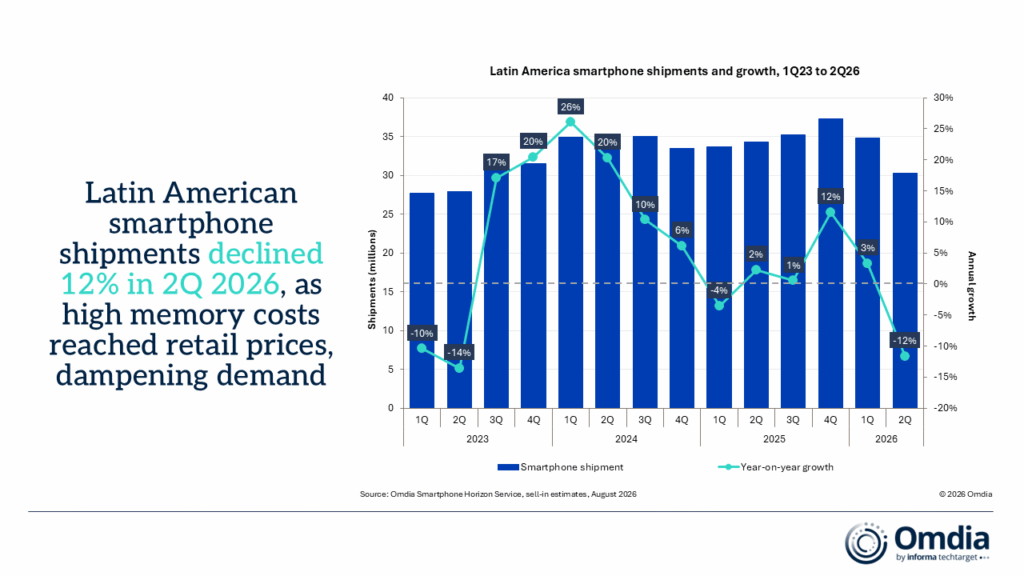
Latin America’s smartphone market suffered a sharp pullback in the second quarter of 2026. Vendors shipped 30.3 million devices, down 12% from a year earlier, according to estimates from Omdia. Rising DRAM and NAND memory prices are already showing up in retail prices, with an especially strong effect on budget phones. Samsung was the major exception among the top vendors, growing its shipments 9%.
Latin America’s smartphone market in 30 seconds
- Shipments fell 12% year over year to 30.3 million units in the second quarter.
- Omdia links the decline to rising DRAM and NAND prices being passed on to phone prices.
- Samsung grew 9% and reached a 39% share.
- Xiaomi, Motorola, HONOR, and TRANSSION all saw shipments decline.
- Omdia now forecasts a 16% decline for full-year 2026.
The situation marks a considerable shift from the start of the year. The first quarter of 2026 still posted 3% year-over-year growth, after vendors and distributors pulled forward part of their shipments and drew down inventory to cushion rising costs.
That cushion disappeared during the second quarter. Higher component prices ended up being passed on to consumers, and the most affordable segment of the market took the biggest hit.
Smartphones under $100 plunge 72%
The breakdown by price band explains much of what happened.
Shipments of phones priced under $100 fell 72% year over year during the second quarter — a much steeper decline than the market as a whole.
Phones priced between $100 and $300 held up better, though they also fell 6%. Even so, this band remained the largest in Latin America, accounting for 61% of the smartphones shipped.
At the opposite end, phones priced above $500 grew their share to 18% of units and generated 51% of the market’s total value.
The result is a market selling fewer devices overall, but where higher-priced models are gaining a bigger role.
Omdia calculates that the average selling price rose 25% year over year during the quarter. The firm links this to higher costs and to a shift in the market toward higher-tier devices.
Financing is also helping sustain these sales. Vendors, carriers, and retailers are turning to interest-free installment plans, discounts, trade-in programs, bundled promotions, and rental options to soften the upfront impact of buying a pricier phone.
Memory pricing matters especially for budget devices, because there’s less room to absorb higher component costs.
DRAM and NAND are core components of any smartphone. DRAM provides the working memory the operating system and apps need, while NAND is used for permanent storage.
When both rise in price, vendors can absorb part of the increase, cut specs, or pass it on to the final product. In entry-level tiers, any of those options is especially difficult.
Samsung reaches 39% as its main rivals decline
The decline also wasn’t distributed evenly across vendors.
Samsung shipped 12 million smartphones in Latin America during the second quarter, up from 11 million in the same period of 2025. That 9% increase let the vendor raise its share from 32% to 39%, its highest level since the first quarter of 2022.
Omdia attributes part of this to models like the Galaxy A07 and A17 in the entry-level tier and the A37 and A57 in the mid-range segment. It also notes that Samsung has had relatively lower exposure to memory-related issues and holds a strong position in distribution channels.
The gap with its main competitors was considerable.
| Vendor | Q2 2026 shipments | Share | Year-over-year change |
|---|---|---|---|
| Samsung | 12.0 million | 39% | +9% |
| Xiaomi | 4.9 million | 16% | -27% |
| Motorola | 4.4 million | 14% | -15% |
| HONOR | 2.0 million | 6%* | -32% |
| TRANSSION | 2.0 million | 6%* | -19% |
| Others | 5.0 million | 17% | -16% |
| Total | 30.3 million | 100% | -12% |
*Omdia’s unrounded figures put HONOR’s and TRANSSION’s shares at 6.5% and 6.4%, respectively.
Xiaomi held on to second place, but its shipments fell 27%, from 6.7 million to 4.9 million units. Its share dropped from 20% to 16%.
The company managed to push high-end and premium phones to a record 14% of its regional sales. The problem was below $500, a band that still accounts for 85% of its units.
Motorola held on to third place with 4.4 million devices and a 14% share. Its shipments dropped 15%, even though its higher-tier models grew 46%, driven by the Edge 70 and Razr 70.
HONOR posted the steepest decline among the top five vendors, down 32% year over year. Omdia notes this is its first contraction since it officially launched in the region in the fourth quarter of 2021.
TRANSSION, which groups brands like TECNO, Infinix, and itel, returned to fifth place with roughly two million units and a 19% decline.
Apple falls outside this top five by regional volume, though it shows a different trend. Omdia’s data credits it with roughly 5% of the Latin American market and 49% year-over-year growth during the quarter.
Brazil and Mexico keep Samsung on top
Differences between countries are significant too.
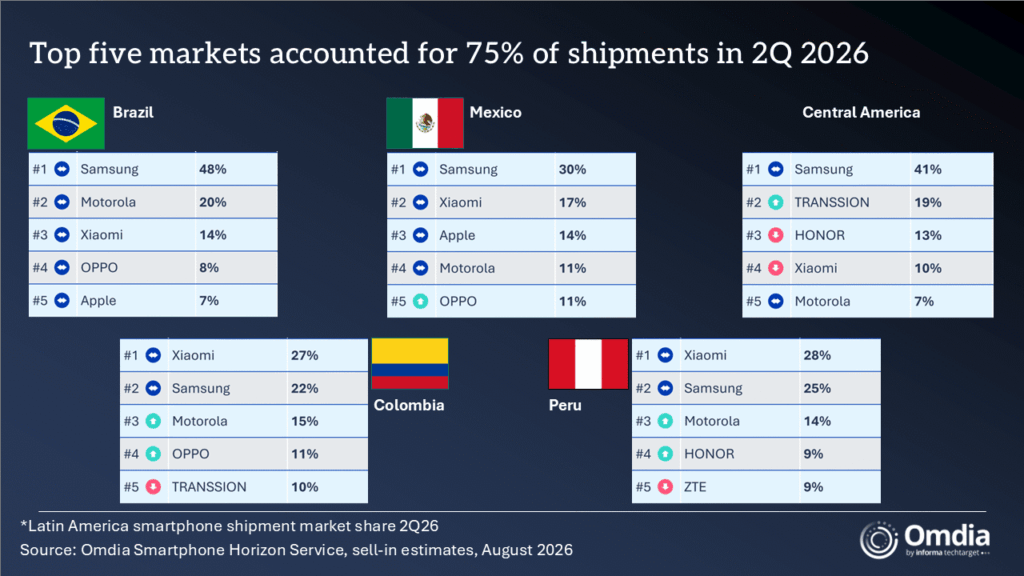
The top five markets accounted for roughly 75% of Latin American shipments during the second quarter.
Samsung dominated Brazil with a 48% share, followed by Motorola with 20% and Xiaomi with 14%. Apple took fifth place with 7%.
In Mexico, Samsung also led with 30%. Xiaomi took 17%, Apple 14%, while Motorola and OPPO each reached 11%.
The picture changes in Colombia and Peru.
Xiaomi was the top vendor in Colombia with 27%, ahead of Samsung’s 22%. Motorola took 15%, OPPO 11%, and TRANSSION 10%.
In Peru, Xiaomi also kept the lead with 28%, versus Samsung’s 25%. Motorola reached 14%, HONOR 9%, and ZTE another 9%.
Central America also shows just how much rising phone prices can affect markets that depend on budget devices.
Smartphones under $300 accounted for 84% of its shipments in 2025. During the second quarter of 2026, the Central American market fell 22% year over year.
Samsung held a 41% share there, followed by TRANSSION with 19% and HONOR with 13%.
This regional pattern fits Omdia’s explanation: the greater a market’s dependence on budget tiers, the more sensitive it can be to a cost increase that ends up hitting the final price.
The firm isn’t expecting an immediate recovery either.
Its current forecast points to Latin American smartphone shipments falling 16% for full-year 2026, with further deterioration in the second half of the year.
That’s a forecast, not a settled outcome. But Omdia believes the component configurations and models vendors will sell over the coming months are already largely locked in. So even if memory prices eventually ease, it would take time to show up in the devices available in stores.
The Latin American market thus enters the second half of 2026 with an unfavorable mix for budget phones: higher costs, more cautious consumers, and vendors that need to protect their margins.
Samsung’s performance also shows that the overall decline isn’t hitting every brand equally. While the market lost four million units compared with the second quarter of 2025, the South Korean vendor added roughly one million.
How consumers respond to the new prices will determine how much of the contraction forecast for 2026 actually plays out.
Frequently asked questions
How many smartphones were sold in Latin America in the second quarter of 2026?
Omdia estimates 30.3 million units shipped (sell-in), down 12% from the same quarter of 2025. The figure refers to shipments into the channel, not necessarily final sales to consumers.
Which is the best-selling phone brand in Latin America?
Samsung led the market in the second quarter of 2026 with 12 million smartphones shipped and a 39% share. Xiaomi came second with 16%, and Motorola third with 14%.
Why are smartphone prices rising?
Omdia points to rising DRAM and NAND memory costs as one of the factors reaching retail prices. The impact is greater on budget devices, where vendors have less room to absorb the increases.
Will Latin America’s smartphone market keep falling in 2026?
Omdia currently forecasts a 16% contraction for full-year 2026 and expects the decline to intensify in the second half. This is a forecast that could change as the market evolves.
Source: omdia.tech
