
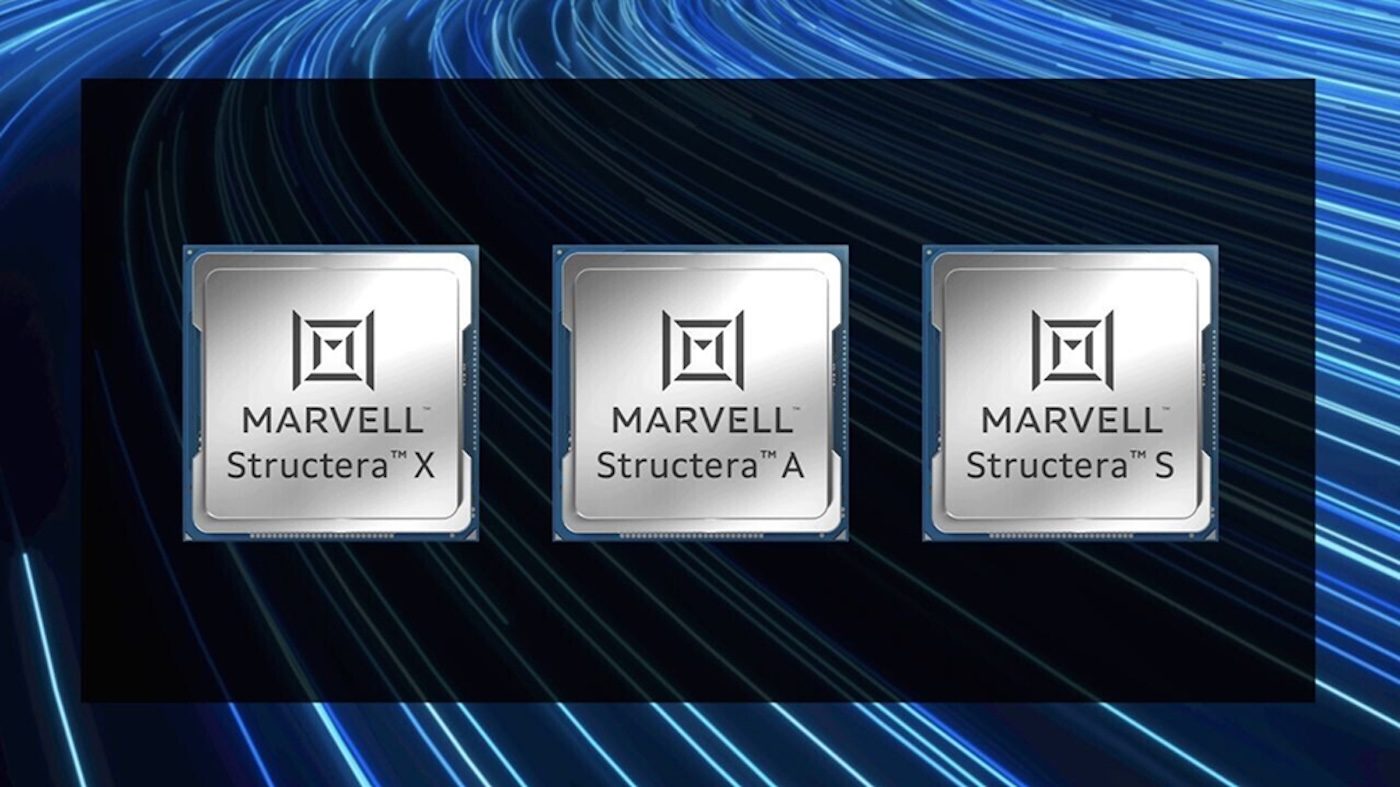
Marvell Technology has raised its 2028 revenue forecast to $20 billion, driven by the growth of infrastructure needed for artificial intelligence. The company expects data center expansion, and especially the need to connect accelerators, processors, and memory systems, to drive its business over the coming years.
Marvell’s 2028 forecast in 20 seconds
- Marvell now sets its 2028 revenue target at $20 billion.
- Artificial intelligence is boosting demand for connectivity inside data centers.
- The company develops interconnect, optical, Ethernet, and custom semiconductor solutions.
- The growth of AI systems requires moving more data between accelerators, memory, and networks.
- The new forecast reflects Marvell’s expectations about the expansion of AI infrastructure.
The new target marks a significant shift from the company’s previous forecasts and reflects how artificial intelligence is reshaping the semiconductor market beyond GPUs themselves. As data centers add more accelerators, the amount of information that needs to move between the different components also grows.
That traffic needs faster, more efficient connections. That’s where Marvell is focusing much of its strategy, with products and technologies aimed at data center networking, optical connectivity, and custom chips for large customers.
The company has identified connectivity as one of the areas that stands to benefit most from AI’s growth. Systems used to train and run artificial intelligence models require thousands of processors working in coordination. Overall performance depends as much on compute capacity as on how fast those components can exchange data.
AI is shifting the pressure from compute to connectivity
During the early phases of the current AI investment cycle, most of the attention focused on GPUs and accelerators. NVIDIA dominates a large share of that market, while AMD, Google, Amazon, and other manufacturers develop their own alternatives.
But AI infrastructure doesn’t end at the accelerator. Processors need to communicate with other accelerators, access high-bandwidth memory, and send and receive large amounts of data over internal and external networks.
Every increase in compute capacity, in turn, places more demands on connections.
Data centers are evolving toward architectures with higher Ethernet speeds, faster optical connections, and interconnect systems capable of handling large volumes of traffic. Marvell is active in several of these segments.
The company supplies connectivity technologies for data centers and also works on solutions tailored to customers designing their own accelerators and systems. This latter business is especially relevant because large tech operators are increasingly developing their own chips to cut costs, control design, and tailor hardware to their workloads.
Marvell can supply some of the components these custom designs need without having to compete directly with its customers in the accelerator market.
Custom chip growth is gaining weight
One of the trends behind Marvell’s expectations is the rise of ASICs, integrated circuits designed for specific tasks.
Large data center operators are increasingly looking for alternatives to off-the-shelf accelerators for certain workloads. Designing a proprietary chip requires heavy investment, but it can be worthwhile when deployment volume is large enough.
These custom systems need numerous additional components: memory interfaces, high-speed connections, controllers, networking, and optical links.
Marvell is active in several of these very markets. Its position in custom chips lets the company benefit from rising AI investment even when the main processor in a system doesn’t carry its brand. That strategy builds on deals such as its $3.25 billion acquisition of Celestial AI, aimed at strengthening its position in optical interconnection for AI data centers.
The strategy also reduces dependence on any single product. Growth can come from connectivity between accelerators, from optical links, or from the custom semiconductors built into large operators’ systems.
The company has highlighted the potential of so-called XPUs, a broad category covering different types of processors used for AI and other accelerated workloads. As data centers combine GPUs, CPUs, and specialized accelerators, the need to connect them with high bandwidth grows.
Optical connectivity is becoming an increasingly important piece
AI’s growth is also increasing the importance of optical connections.
Electrical signals have limits when they need to travel certain distances at very high speeds. Fiber optics can carry large amounts of information with less loss over longer links.
In an AI data center, optics can be used both within the network infrastructure and in connections between different systems. As link speeds increase, so does the need for more advanced transceivers and optical components.
Marvell has invested in this segment for years and has technologies related to optical DSPs, lasers, and other components needed for high-speed communications.
The shift toward 800 Gb/s networks and later 1.6 Tb/s generations is part of this trend. These figures don’t mean every link in a data center runs at those speeds, but they show the direction infrastructure is heading as accelerator density increases.
For Marvell, the growth of these links opens up an additional revenue stream tied directly to the expansion of AI computing.
The challenge will be turning demand into sustained revenue
Raising the forecast to $20 billion for 2028 means Marvell expects the AI investment cycle to continue for several years. However, a corporate forecast isn’t the same as guaranteed revenue.
The pace of growth will depend on how much large data center operators invest, how accelerators evolve, and how quickly connectivity needs increase.
Competition will matter too. Marvell shares different segments with companies such as Broadcom, NVIDIA, and other manufacturers specializing in networking, optics, and custom semiconductors.
The AI market is generating an investment chain far broader than accelerator manufacturing alone. Data centers need power, cooling, memory, storage, and networking, in addition to the processors themselves. Connectivity is among the areas that benefit most directly from the growing number of accelerators installed.
Marvell’s new forecast reflects exactly that thesis. The company doesn’t need every server to use an accelerator it manufactures to benefit from AI’s growth. It just needs systems to need ever more fast, efficient connections, and large customers to keep developing specialized hardware.
The $20 billion figure for 2028 will therefore serve as a benchmark for how far this cycle can go. For the coming quarters, the most relevant signals will be growth in data-center-related orders, how custom chip projects evolve, and the adoption of new generations of optical and Ethernet connectivity.
Frequently asked questions
How much does Marvell expect to earn in 2028?
Marvell has raised its 2028 revenue forecast to $20 billion.
Why does artificial intelligence benefit Marvell?
AI systems need to connect accelerators, memory, processors, and networks at ever-higher speeds. Marvell supplies technologies used in those connections and also takes part in developing custom semiconductors.
What are Marvell’s custom chips?
They are semiconductors designed for the specific needs of particular customers, including large data center operators. They can be used in AI infrastructure and other specialized workloads.
Why does connectivity matter in AI data centers?
Accelerators need to exchange large amounts of data. As the number and capacity of these processors grows, the networks and links connecting them must deliver more bandwidth and lower latency.
