
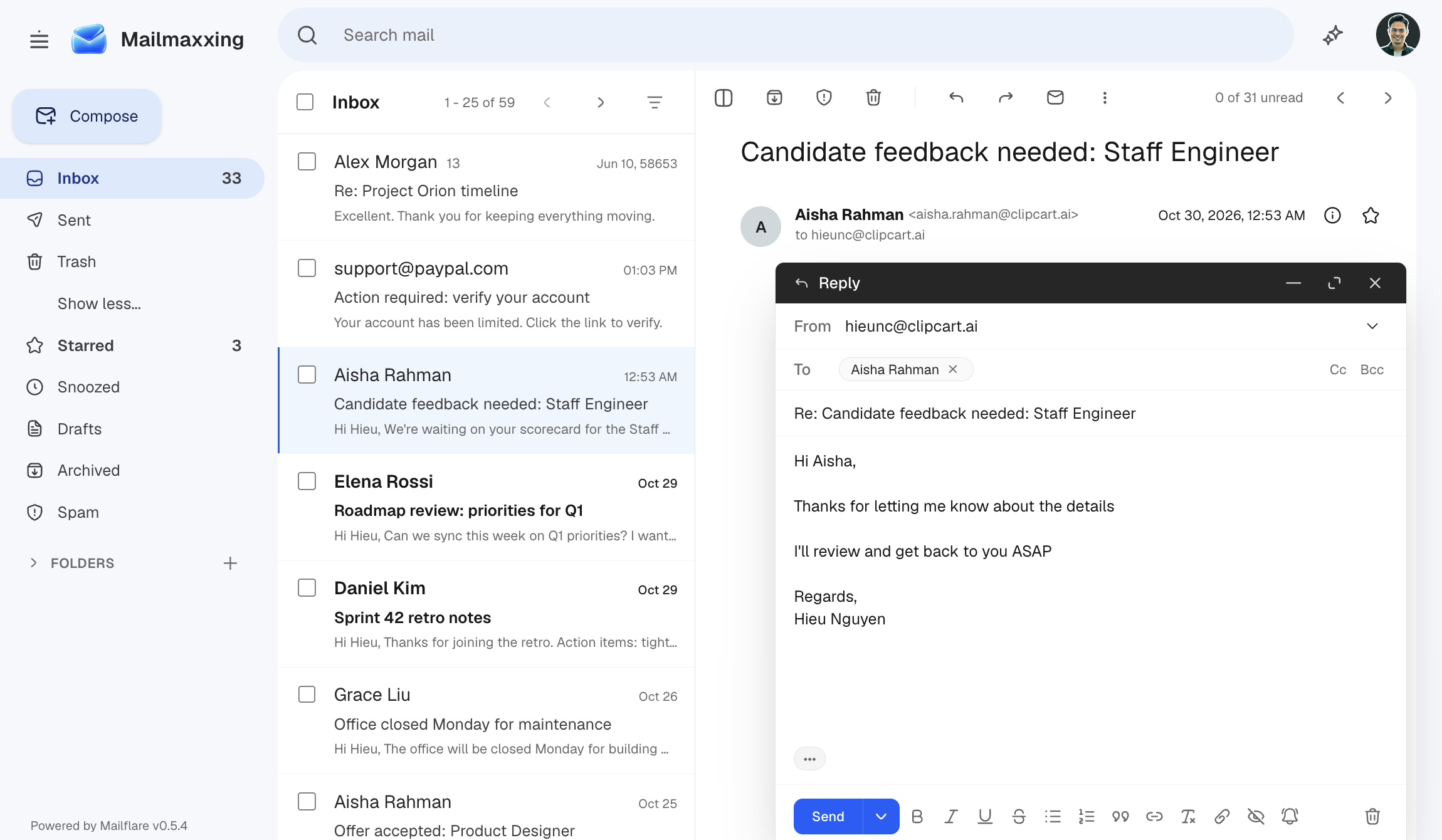
Mailflare is an open-source project pitched as a self-hosted alternative to Google Workspace: email with your own domain, calendar, public booking links, file storage, and AI agents, all deployed by the organization itself. Published on GitHub under an AGPL-3.0 license with more than 5,400 stars, it can be installed with one click on Cloudflare Workers or in a single Docker container. That choice is what decides whether it fits into a European digital-sovereignty strategy.
Mailflare and European sovereignty in 20 seconds
- Mailflare bundles email, calendar, booking, Drive, and AI agents into a self-hosted AGPL-3.0 suite.
- It deploys on Cloudflare Workers or in Docker with SQLite, PostgreSQL, or MySQL.
- Sending email depends on Cloudflare, Resend, or Amazon SES — all American companies.
- The free edition is full-featured; the Professional and Team licenses are one-time purchases.
Interest in tools like this is growing in Europe at the same pace as concern over dependence on US providers. We recently looked at how Europe is trying to cut its tech dependence without abandoning the US giants, and the recent Microsoft 365 outage made clear what it means to concentrate an organization’s email with a single provider.
What Mailflare offers
Email includes personal or shared mailboxes with your own domain, conversation threads, aliases, signatures, snoozing, send undo, scheduled sends, follow-up reminders, and full-text search, plus routing rules that save, forward, reject, or sort mail. The spam filter combines SPF, DKIM, and DMARC checks, Spamhaus and URLhaus blocklists, domain age, and a per-mailbox Bayesian classifier. The calendar supports recurring events with time zones and email invitations, and booking links let others pick an open slot.
On top of that there’s a Drive for storing and sharing files, user management with API keys, webhooks, audit logs and backups, two-factor authentication, and import tools from IMAP, Google Takeout, and .eml and .mbox files — useful for anyone leaving Gmail. The suite includes a JMAP server, an MCP server for connecting AI assistants, and a native macOS client; iOS and Android apps are listed as coming soon. The AI agents can search mail, draft replies that require human approval, and manage events, using Cloudflare’s Workers AI or any OpenAI-API-compatible provider configured per mailbox.

Self-hosted doesn’t always mean sovereign
The project’s website insists that email and files never leave the user’s own infrastructure. That’s true in the sense that there’s no managed Mailflare service storing the data, but it’s worth specifying what that infrastructure actually is. The most heavily promoted option, the one-click deployment, runs on Cloudflare Workers, with the database on D1, files and raw email on R2, and inbound mail handled through Cloudflare Email Routing. The data stays in the customer’s own Cloudflare account, but Cloudflare is a US company subject to US law, so this mode doesn’t solve the dependency that worries many European organizations.
The Docker mode changes the picture. According to the README, Mailflare runs in a single container with SQLite and local files, or with PostgreSQL, MySQL, or Turso, and can store files on local disk or in S3-compatible storage. Installed on your own server or with a European provider, the data can stay entirely in Europe. There is, however, one point the project doesn’t solve: for sending mail it only documents Cloudflare Email Sending, Resend, and Amazon SES — three US services. Free inbound mail is also built around Cloudflare Email Routing, and the README requires a Cloudflare account with the domain on it. An organization that wants fully European email would have to figure out whether it can replace those pieces, or accept that its outbound mail passes through a US third party.
Price and maturity
The Community edition is free and open source. The Professional license, a one-time purchase, adds custom branding and activates the macOS client, while the Team tier adds unlimited team accounts, shared mailboxes, and audit logs; the website lists promotional prices of $29 and $249 respectively. Third-party costs depend on the services chosen: Resend allows 3,000 free sends per month, and Cloudflare’s own sending requires its paid Workers plan.
Mailflare is a young project. The website doesn’t identify a company behind it or publish a formal privacy policy, and the repository belongs to an individual developer. For business use, that means weighing support, the project’s continuity, and the in-house capacity to run a mail server — a job that requires watching sender reputation, backups, and updates. As a technical foundation for running your own email, though, it offers a feature set that isn’t common in open-source software.
Frequently asked questions
What is Mailflare?
An open-source suite with email, calendar, booking, storage, and AI agents, pitched as a self-hosted alternative to Google Workspace.
Does Mailflare guarantee European data sovereignty?
It depends on the deployment. On Cloudflare, the data stays with a US provider; on Docker over European infrastructure, it can largely stay in Europe, though sending mail still depends on US services.
How much does Mailflare cost?
The Community edition is free. The Professional and Team licenses are one-time purchases, on top of which come the costs of whichever sending and storage services you choose.
Can you migrate from Gmail?
Yes. Mailflare imports mail from Google Takeout, IMAP, and .eml and .mbox files.
Sources:
This article is also available in Spanish: “Mailflare, la alternativa a Google Workspace que puedes alojar en Europa,” on revistacloud.com.
