
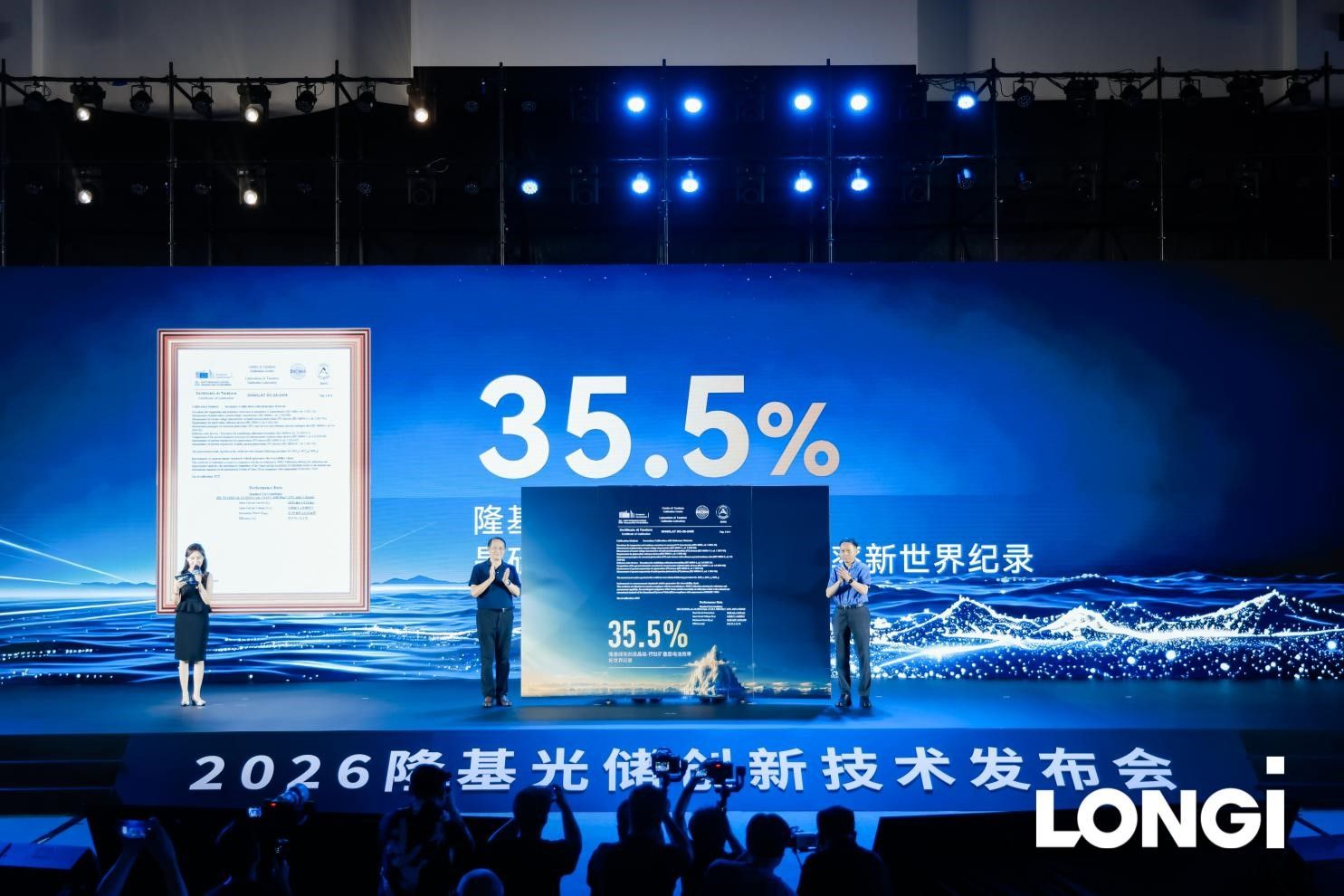
The Chinese company LONGi has announced a 35.5% conversion efficiency for a crystalline silicon-perovskite tandem solar cell. Certified by the European Solar Test Installation (ESTI), this result sets a new record for this photovoltaic architecture, though it still belongs to an experimental cell and not a commercially available panel.
The key points of LONGi’s solar record in 30 seconds
- LONGi achieved a 35.5% efficiency with a silicon-perovskite cell.
- The result was certified by ESTI, a reference lab for the European Commission.
- This technology clearly outperforms the most advanced commercial panels, which approach 25%.
- LONGi also reported efficiencies above 30% in larger cells and modules.
- Durability, industrial manufacturing, and cost remain factors influencing their market entry.
The breakthrough was announced on July 14 at the 2026 Solar and Energy Storage Innovation Conference. LONGi states that the device was developed independently by its central research institute and that it improves upon its previous record of 35.2%, reported a few months earlier.
ESTI certification provides external validation of the result. This lab, part of the Joint Research Centre of the European Commission, works on calibrating and verifying the electrical performance and lifespan of photovoltaic devices. Its involvement does not mean the cell is ready for commercial sale, but it allows for performance comparison with other results obtained under controlled measurement conditions.
How a silicon-perovskite cell works
Conventional solar panels mainly use single-junction silicon cells. This design converts part of the solar radiation into electricity but loses energy because a single material cannot efficiently utilize all wavelengths of light.
Tandem cells aim to reduce this loss by combining two materials. The top layer of perovskite absorbs part of the solar spectrum, while the silicon cell beneath captures other wavelengths. By distributing the work between these layers, the device can surpass the practical limit of single-junction technologies.
The theoretical limit of a single-junction cell under unconcentrated sunlight is around 33.5%, commonly known as the Shockley-Queisser limit. Multijunction architectures can surpass this barrier by using materials with different band gaps to absorb more of the spectrum.
LONGi estimates that silicon-perovskite tandem cells could theoretically reach efficiencies close to 43%. Although the 35.5% figure is below that maximum, it significantly exceeds the performance of commercial photovoltaic products.
The U.S. Energy Information Administration notes that the most advanced modules on the market today approach 25%. Experimental cells and specialized devices, such as satellites, are reaching efficiencies near 50%, but they use costly materials and processes unsuitable for large-scale rooftop or solar farm deployment.
This efficiency difference also requires distinguishing between cell and module. Cell efficiency measures the performance of the small device that directly converts sunlight, while a full module includes connections, encapsulation, glass, gaps between cells, and other components that cause some losses. Therefore, module efficiencies are typically lower than the best cell efficiencies inside them.
From laboratory advances to industrial sizes
LONGi has progressively improved this technology over recent years. In November 2023, it announced 33.9% efficiency, which was increased to 34.6% in June 2024. Subsequent reports include 34.85%, 35.2%, and now 35.5%.
The 34.85% record, achieved with a cell roughly one square centimeter and certified by the U.S. National Renewable Energy Laboratory (NREL), has been incorporated into international solar efficiency charts coordinated by researcher Martin Green. These charts list some of the most efficient experimental photovoltaic devices verified by independent laboratories.
Size matters because many records are set with tiny cells produced through complex procedures difficult to reproduce in industrial lines. As the surface area increases, maintaining uniform layers, avoiding defects, and preserving performance becomes more challenging.
LONGi reports achieving 34.3% efficiency in a 261 cm² cell and 32.2% in another measuring 274 cm². These dimensions are much closer to those used in panel manufacturing than small research samples.
The company has also announced efficiencies of 31.4% and 29.4% in tandem modules certified externally. These figures are more relevant for commercial production because they include losses of a full module, though LONGi has not yet announced when mass production might begin or at what price.
High efficiency does not equal immediate commercialization
Perovskite technology has advanced rapidly since its initial solar research, but several issues remain before it can compete at scale with silicon panels.
One main challenge is stability. Perovskite materials can degrade from humidity, oxygen, heat, UV radiation, and thermal cycling. Commercial panels must maintain high performance over decades and pass rigorous aging tests.
Manufacturing large-area uniform perovskite layers on silicon cells also requires precise control. Processes successful in labs often lose efficiency when scaled to large wafers or high-volume lines.
The U.S. Department of Energy acknowledges the rapid progress of perovskite-silicon tandem cells but reminds that large-scale manufacturing is still in development. Challenges include durability, stability, production capacity, and demonstrating cost competitiveness.
Some perovskites contain small amounts of lead. Researchers are exploring encapsulation, recycling, and alternative compositions to prevent material release if panels break or reach end of life.
If these hurdles are overcome, the additional efficiency could have significant impacts by enabling higher power outputs in limited rooftop space, reducing land use for solar farms, and sharing infrastructure costs across more energy generation.
However, final price remains critical. A 35% cell won’t replace a 25% cell if its manufacturing is costly, it degrades faster, or requires major changes in industrial lines. For LONGi and its competitors, the goal isn’t only to set records but to maintain high efficiencies reliably in millions of affordable, durable panels.
Frequently Asked Questions
What efficiency has LONGi’s new solar cell achieved?
LONGi announced a 35.5% conversion efficiency for a crystalline silicon-perovskite tandem cell. The result was certified by the European Solar Test Installation.
Can I buy a solar panel with 35.5% efficiency now?
No. This percentage pertains to an experimental cell, and LONGi has not announced a commercial release date. Its certified tandem modules have achieved lower efficiencies but still surpass current commercial panels.
Why are tandem cells more efficient?
They combine materials that absorb different parts of the solar spectrum. Perovskite captures part of the light, and silicon captures another, reducing the losses inherent to single-junction cells.
What prevents large-scale manufacturing of these cells?
Main obstacles include the durability of perovskite materials, uniform production over large areas, cost, encapsulation, and maintaining high efficiency over decades.
via: longi
