
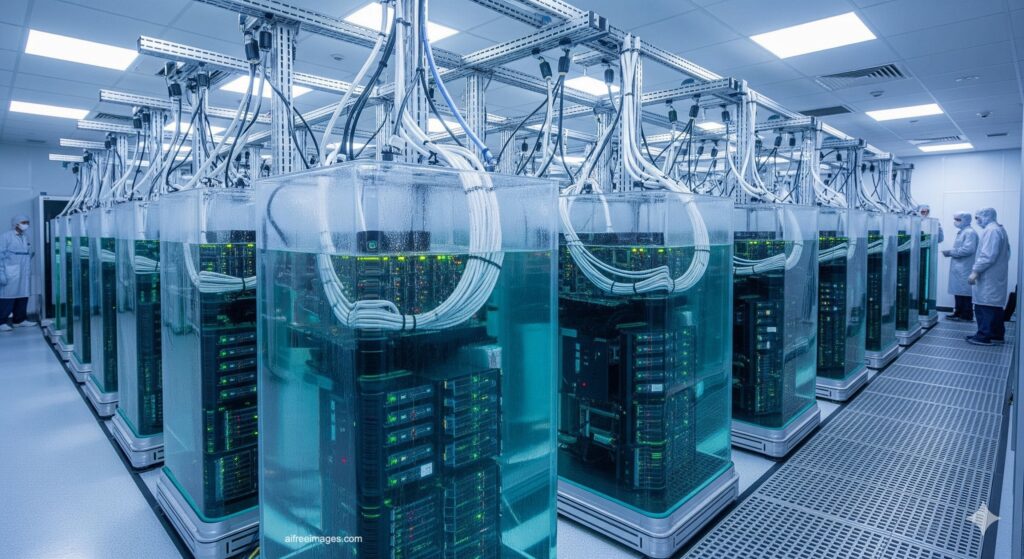
Liquid cooling is no longer a rarity limited to supercomputers and laboratories. The arrival of racks with dozens of GPUs, AI accelerators, and increasingly dense servers is forcing a redesign of parts of data centers that for years operated with a more stable logic: moving air, controlling cold and hot aisles, and gradually improving efficiency.
This model doesn’t disappear, but it’s no longer sufficient in all scenarios. New AI platforms increase rack power, concentrate heat in specific chips, and require more direct removal of thermal energy. That’s where a much broader chain of suppliers comes into play: manufacturers of CDUs, liquid-ready racks, cold plates, pumps, valves, pipes, dielectric fluids, heat exchangers, leak sensors, automation, and integration services.
From Air to Liquid: Why Data Centers Are Changing
For years, air cooling has been adequate for most enterprise workloads. It still is in many virtualization, storage, private cloud, traditional database, or corporate application environments. The shift occurs when a room starts housing high-density racks with AI accelerators, where heat generated by CPUs, GPUs, HBM memory, and internal switches can quickly surpass what a traditional design can efficiently evacuate.
Liquid cooling is not a single technology. It can take several forms. The most common in new AI platforms is direct-to-chip cooling, where a cold plate is placed directly over CPUs, GPUs, or other hot components, and a liquid circuit removes the heat. There’s also immersion cooling, where servers or components are submerged in dielectric fluids, and hybrid solutions that combine air and liquid depending on the load.
The shared supplier report clearly illustrates this complexity. In a modern facility, simply buying a “liquid-ready” server isn’t enough. A complete thermal architecture is necessary. The refrigerant distribution units, known as CDUs, control flow rate, pressure, and heat transfer between the IT circuit and the facility’s refrigerant circuit. Manifolds and piping deliver the liquid to racks. Pumps, valves, and control systems maintain the flow. Heat exchangers and dry coolers expel the heat. Leak sensors and monitoring reduce operational risks.
Different specialists appear at every layer. Vertiv, STULZ, Schneider Electric, nVent, Danfoss, Submer, LiquidStack, and ASUS ESC4000 are active in the CDUs space. Dell Technologies, HPE, Lenovo, Supermicro, and Wiwynn appear in racks and ready-to-cool solutions. CoolIT Systems, Asetek, Mitsubishi Electric, Rittal, and Koolance stand out in cold plates and modules. In fluids, names like 3M, Shell, Castrol, ExxonMobil, Chemours, and DuPont are prominent. This isn’t an exhaustive list, but it helps illustrate that the market relies on a highly specialized technical supply chain rather than a single provider.
AI Forcing Racks, Not Just Rooms, to Be Designed Differently
The difference between a conventional data center and one prepared for AI isn’t just in megawatt capacity. It’s in how the power is distributed. A building may have high electrical capacity but still not be ready for very dense racks if it lacks proper distribution, compatible cooling, piping, redundancy, sensors, water treatment, or integration with the facility management system.
NVIDIA’s GB200 NVL72 is a clear example of this new phase. This platform integrates 36 Grace CPUs and 72 Blackwell GPUs in a liquid-cooled rack. Such architecture scales AI computing per rack, not just per server, making energy, network, and cooling considerations a unified challenge. The rack ceases to be a passive unit stacking equipment and becomes a full thermal and electrical platform.
For operators, this shifts fundamental decisions. Liquid cooling can improve efficiency, increase density, and reduce reliance on large volumes of air moved by fans. But it also raises new questions: material compatibility, maintenance, leak management, fluid quality, quick connections, staff training, spare parts, monitoring, and coordination between server and facility manufacturers.
CDUs play a particularly crucial role here. They act as the interface between the IT environment and the facility infrastructure. In many designs, the fluid touching the servers isn’t the same as circulating through the building’s general system. This separation allows better control of pressure, temperature, chemistry, and safety. It also ensures that a failure in one circuit doesn’t compromise the entire system.
Leak detection systems are also vital. In environments with liquids near critical equipment, operational trust depends on sensors, alerts, valves, procedures, and preventative design. Companies like Vertiv, Raritan, Schneider Electric, nVent, Emerson, Honeywell, Sensaphone, and Uptime Intelligence contribute in this monitoring sector. Mass adoption of liquid cooling will only happen if operators see it as controllable rather than a constant risk source.
An Industrial Opportunity, But Not a Universal Solution
Market pressure is evident. Every new AI cluster demands higher density, better cooling, and more integration capacity. This opens opportunities for engineering firms, component manufacturers, integrators, data center operators, and maintenance specialists. Closer collaboration among server manufacturers, chip suppliers, cooling providers, and cloud operators also benefits from this trend.
However, it’s important not to overstate. Liquid cooling won’t replace air everywhere in data centers. The Uptime Institute notes that its adoption remains gradual, with many facilities continuing to use traditional systems for most equipment. The main driver is high rack densities, not a fashion applicable uniformly across all workloads.
Practically, this means a data center can maintain air-cooled zones for conventional loads and reserve liquid cooling for AI, HPC, or high-density servers. Such coexistence is expected to persist for years. Many companies don’t need to overhaul their entire facility, just adapt specific areas for new racks.
Integration with the facility infrastructure also matters. Heat exchangers, dry coolers, chillers, water plants, automation, and facility services determine the efficiency and maintainability of the design. Suppliers like Kelvion, Alfa Laval, Modine, GPX Cooling, Güntner, Carrier, Trane, and Johnson Controls, along with key infrastructure players such as Schneider Electric, Vertiv, STULZ, Eaton, and Danfoss, are involved in this ecosystem.
Sustainability is another sensitive point. Liquid cooling can reduce energy consumption related to fans and allow more favorable operating temperatures but doesn’t alone solve AI’s high electricity demand. It also requires reviewing water use, fluid compositions, maintenance routines, heat recovery, and environmental compatibility. Real efficiency depends on total system design, not mere labels or certifications.
The rise of AI is making thermal management a strategic decision. Once considered part of invisible infrastructure, now it can determine what servers are installed, how many GPUs fit per rack, the energy cost of clusters, and how quickly a operator can deploy new capacity.
The clear lesson is this: liquid cooling is not just about pipes. It’s a complete chain of design, supply, operation, and service. Data centers aiming to host the next generation of AI must consider chips, networking, storage, but also flow rates, heat exchangers, sensors, fluids, and skilled personnel capable of operating this new environment safely.
Frequently Asked Questions
What is a CDU in liquid cooling?
A CDU, or Coolant Distribution Unit, manages the heat exchange, flow rate, and pressure of the refrigerant between the IT racks and the facility’s cooling system.
Will liquid cooling completely replace air?
Not in the short term. Likely, there will be an coexistence: air for conventional loads and liquid cooling for high-density racks, AI, HPC, and high-power GPUs.
What is the difference between direct-to-chip and immersion?
In direct-to-chip, the liquid circulates through cold plates attached to specific chips. In immersion cooling, servers or components are submerged in dielectric fluid that absorbs heat.
Why does AI need more liquid cooling?
Because AI accelerators concentrate significant power in small spaces, increasing thermal density per rack and making efficient heat evacuation with air alone more challenging.
via: LinkedIn
