
Lenovo used IFA 2026 in Berlin to refresh much of its professional lineup around one common idea: running more and more artificial intelligence directly on work devices and combining it with cloud services when needed. Highlights include the compact ThinkCentre X Ultra with up to 128 GB of unified memory, new ThinkCentre models with NPUs delivering up to 50 TOPS, the ThinkBook 14 Gen 9 with Snapdragon X2 Plus, and two concept devices that preview fanless laptops and rollable screens.
Key facts about Lenovo’s new business lineup in 30 seconds
- The ThinkCentre X Ultra combines an AMD Ryzen AI Max+ PRO 495, up to 128 GB of unified memory, and a chassis of just 1.6 liters.
- Lenovo lets users link up to four X Ultra units together to handle larger AI models and multi-agent workloads.
- The ThinkCentre M75q and M75s Gen 6 offer up to 50 TOPS of local acceleration.
- The ThinkBook 14 Gen 9 uses a Snapdragon X2 Plus chip and reaches up to 80 TOPS of AI performance.
- Project AeroBlade and Project Swan are concepts, not confirmed commercial products.
The presentation also shows just how much artificial intelligence is starting to reshape business PC design. During the early years of generative AI, the PC mainly acted as a gateway to models running in large data centers. Lenovo is now proposing a hybrid architecture where part of the inference can stay on the device and another part can rely on remote infrastructure.
That doesn’t mean these computers will replace GPU-equipped servers. The difference lies in being able to run smaller models, assistants, document processing, and certain inference tasks locally without constantly sending information to external services.
ThinkCentre X Ultra: Up to 128 GB for Running Local AI
The most eye-catching product in the lineup is arguably the ThinkCentre X Ultra.
Lenovo describes it as a new class of desktop computer for so-called agentic AI. Beyond that marketing label, its specs point to an unusual machine within the compact corporate desktop market.
Its configuration can go up to an AMD Ryzen AI Max+ PRO 495, paired with Radeon 8065S graphics and an NPU rated at up to 55 TOPS. It can be equipped with up to 128 GB of LPDDR5X memory at 8,533 MHz and two M.2 SSDs of up to 4 TB each. All of that fits into a chassis measuring roughly 1.6 liters and weighing 2 kilograms.
One of its most interesting features is precisely its unified memory.
Lenovo specifies that the integrated graphics can access up to 96 GB of that memory as graphics memory. For certain AI workloads, this makes it possible to work with models that would be out of reach for a conventional GPU with 8, 12, or 16 GB of VRAM.
Memory capacity shouldn’t be confused with performance, though. Being able to load a large model doesn’t mean running it at the speed of a dedicated data center GPU.
The X Ultra also includes 10 GbE Ethernet, Thunderbolt 4, DisplayPort 2.1, and HDMI 2.1, along with Wi-Fi 7 on certain configurations.
Lenovo has added another feature rarely seen in an office PC: the ability to cluster up to four units together.
According to the manufacturer, this architecture makes it possible to expand the resources available for running larger models, extend context windows, handle several requests at once, or experiment with workflows built from multiple AI agents.
The company also integrates the machine with the AMD Ryzen AI Developer Center, which provides tools, models, and ready-made workflows for Windows and Linux.
The ThinkCentre X Ultra is expected to arrive in November 2026 with an estimated starting price of €3,100, subject to configuration and market.
More AI for Mainstream Corporate PCs Too
Not every business needs 128 GB of memory to run models locally.
For more conventional workstations, Lenovo has introduced the ThinkCentre M75q Gen 6 and M75s Gen 6, both built around AMD Ryzen AI PRO 400 processors.
The M75q keeps the company’s well-known Tiny form factor. It can be configured with up to 64 GB of RAM, two M.2 SSDs, and an NPU rated at up to 50 TOPS. Its small size lets it be mounted behind a monitor or installed in workspaces where room is limited.
The M75s uses a more traditional SFF (Small Form Factor) design and offers greater expansion capacity, including PCIe, two SSDs, and the option to add SATA storage.
Both can run Windows 11 or Ubuntu, depending on configuration.
Lenovo also keeps its focus on corporate manageability. The machines include TPM 2.0 and ThinkShield, while the AMD PRO platform adds features aimed at enterprise management and security.
Estimated pricing starts at €999 for the M75q Gen 6 and €1,059 for the M75s Gen 6, with availability expected in October.
The move reflects a shift that will likely matter more than any single model: the NPU is becoming a standard component of the business PC.
For decades, CPU, RAM, and storage were the main variables when refreshing a fleet of computers. The arrival of AI-specific processing units introduces a fourth capability that IT departments will need to weigh, including how NPUs actually compare with GPUs for local AI, based on the applications they really use.
ThinkBook Pushes the NPU to 80 TOPS
Lenovo has also refreshed its lineup of business laptops.
The ThinkBook 14 Gen 9 uses a Snapdragon X2 Plus chip and reaches, according to specs provided by Lenovo, 80 TOPS of AI performance.
It can be configured with up to 32 GB of LPDDR5X and 1 TB of storage. It features a 14-inch WUXGA display, Wi-Fi 7, and support for Copilot+ PC features.
Lenovo claims up to 26 hours of local video playback, though that figure comes from internal lab conditions, and real-world battery life will depend on configuration, connectivity, brightness, and workload.
The manufacturer has also built in Lenovo Qira, with features aimed at everyday work, such as retrieving information from a meeting or helping keep track of the conversation.
The ThinkBook 14 Gen 9 is expected in October starting at €1,099.
Alongside it comes the ThinkBook 14x Gen 2, less focused on local AI and more on portability. It weighs from 990 grams, measures 12.9 millimeters at its thinnest point, and uses Intel Core Series 3 processors.
It can be configured with a 2.8K 120Hz OLED display, up to 32 GB of memory, and up to 2 TB of storage depending on configuration. It’s expected in September starting at €1,079.
A Laptop Under 830 Grams, and Another That Grows to 17 Inches
Lenovo’s more experimental proposals won’t be hitting stores for now.
Project AeroBlade and Project Swan are proofs of concept, an important distinction because the features shown in Berlin don’t necessarily mean they’ll turn into commercial products.
AeroBlade explores a 14-inch laptop under 10 millimeters thick and weighing 830 grams.
Its most distinctive feature is its cooling system.
Lenovo has worked with Frore Systems to use AirJet, a solid-state active cooling technology that eliminates traditional fans. The company says its Active Flow solution can sustain heavy loads while cutting down on noise, dust intake, and moving parts.
The concept includes an OLED display, a magnesium-and-aluminum build, Thunderbolt 4, and Wi-Fi 7.
Project Swan tackles a different problem.
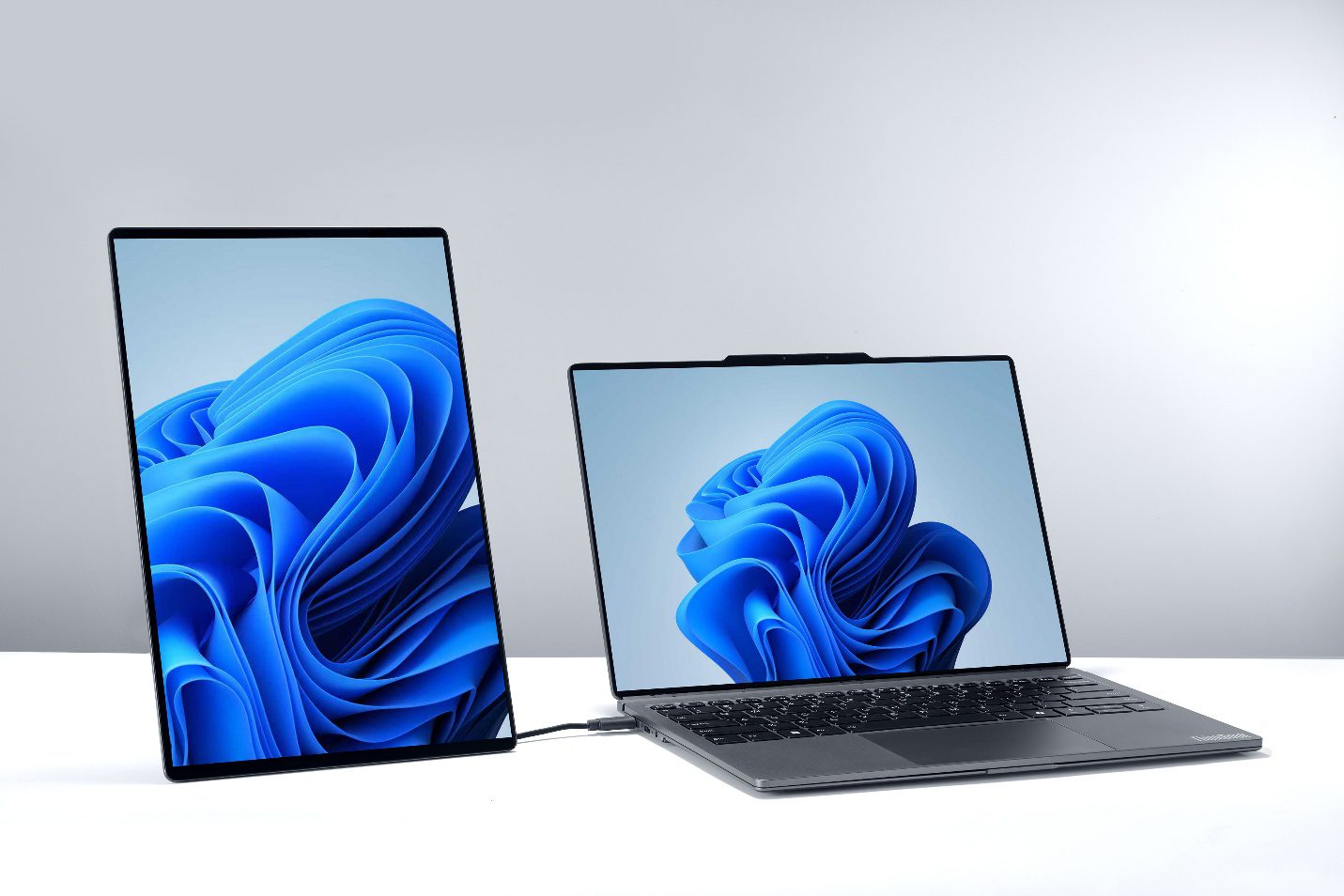
It’s a 14-inch laptop whose screen can unfold horizontally to reach 17 inches in a 16:9 format. The idea is to offer more screen space for documents, dashboards, or multitasking without having to carry a full 17-inch machine at all times.
The prototype is 17.9 millimeters thick and weighs 1.6 kilograms.
Both projects show that the evolution of the business laptop isn’t limited to fitting a more powerful NPU into the same design. Cooling, memory, displays, and physical form factors are also changing to accommodate more demanding local workloads.
Security for Devices — and for AI Use Too
The spread of local AI also introduces new challenges for IT leaders.
Lenovo has introduced ThinkShield TraceLock, built on Absolute Security technology. On ThinkPad models with persistent WWAN connectivity, it lets IT teams locate, wake, lock, or remotely wipe certain devices even when they’re disconnected or powered off.
The second addition targets artificial intelligence specifically.
Lenovo will build Prompt Security technology, from SentinelOne-owned Prompt Security, into ThinkShield to provide visibility and policy controls over the use of generative AI tools.
The goal is to let IT departments know which tools are being used and reduce risks tied to sensitive information and unauthorized AI services.
It’s a particularly relevant issue as AI moves from the browser into applications and features built directly into the operating system.
Corporate security no longer has to control only what software gets installed on a computer. It also increasingly needs answers about which models employees can use, what information those models receive, and where that information gets processed.
Lenovo’s presentation in Berlin paints a fairly clear picture of where the business PC is headed. The NPU is ceasing to be a feature reserved for a handful of machines, while local models are starting to take advantage of memory amounts that were, until recently, unusual in a compact computer.
It remains to be seen how much of that capability will actually get used by businesses. The gap between having 50 or 80 TOPS and getting a concrete benefit from it will depend on the software, the models available, and whether organizations find workloads where running AI locally beats the cloud.
The hardware, at least, is already getting ready for that possibility.
Frequently Asked Questions
What is the Lenovo ThinkCentre X Ultra?
It’s a new 1.6-liter compact business desktop that can be equipped with an AMD Ryzen AI Max+ PRO 495 and up to 128 GB of unified memory. Lenovo positions it for local AI workloads and allows up to four units to be linked together.
When will the ThinkCentre X Ultra be available?
Lenovo expects to bring it to market starting in November 2026 with an estimated starting price of €3,100. The final price will depend on country and configuration.
What’s the difference between the ThinkBook 14 Gen 9 and the ThinkBook 14x Gen 2?
The ThinkBook 14 Gen 9 bets on Snapdragon X2 Plus and up to 80 TOPS of AI performance, while the 14x Gen 2 prioritizes light weight and design, with Intel Core Series 3 processors and a weight starting at 990 grams.
Will Project AeroBlade and Project Swan go on sale?
Lenovo has presented them as proofs of concept, so it hasn’t confirmed they’ll go on sale. They mainly serve to showcase technologies and form factors that could appear in future products.
