
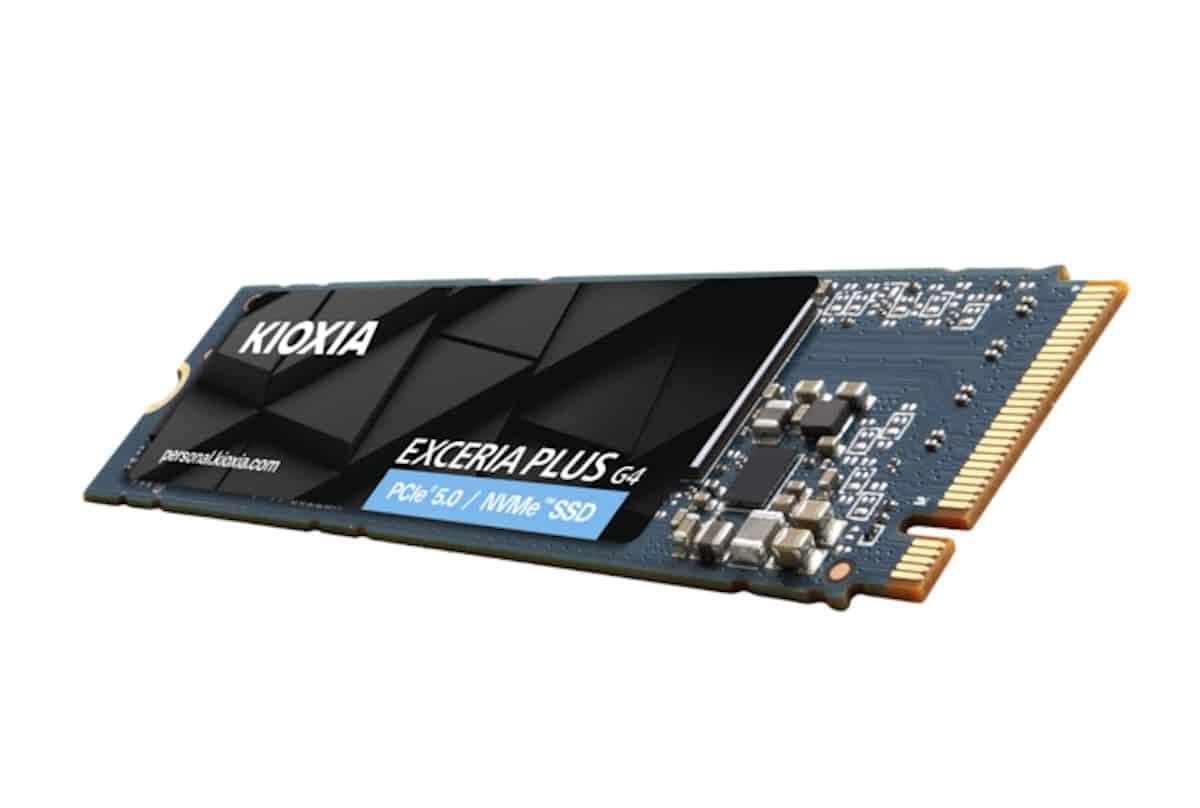
The global NAND flash market is experiencing an unusual period of tension even for an industry accustomed to aggressive cycles of supply and demand. In an interview held in Seoul, Shunsuke Nakato, an executive from Kioxia’s memory division, stated that this year’s production is already “sold out”, describing a scenario where supply cannot keep up with demand driven, especially, by accelerated investments related to artificial intelligence.
This assertion is not limited to the corporate sphere. Nakato frames the situation as a phase of “premiumization” and rising prices, where supply deficits affect both the enterprise SSD market — crucial in data centers and high-performance storage — and, by extension, consumer segments. Practically, when NAND becomes more expensive and capacity is allocated sparingly, the impact filters down the supply chain: manufacturers, integrators, channel partners, and ultimately, prices and availability for end-users.
From auctioning to “gentleman’s agreement”: trust-based allocation, not bidding
One of the most striking elements of the executive’s statements is the commercial approach. Instead of prioritizing “first come, first served” or “highest bidder,” Kioxia appears to favor a distribution model based on a “gentleman’s agreement”: allocation and planning agreements made annually with strategically considered customers.
The operational argument is clear: it’s impossible to adjust deliveries or arbitrarily increase volumes when production capacity is already committed. Accordingly, the goal becomes minimizing market chaos and protecting long-term relationships with customers who require predictability in their product schedules.
Table — What Kioxia describes about the current NAND market
| Market Signal | Practical Implication | Risks for Customers |
|---|---|---|
| Annual “sold out” production | Capacity booked in advance | Less margin for demand spikes |
| Price increases >30% (in some cases) | Upward revision of contracts and PVP | Margin pressure and higher end-user prices |
| Supply deficit reaching consumption | “Domino effect” from enterprise segment | Reduced availability in channels |
| Allocation by agreements | Prioritization of “long-term” partners | Losers if contracts aren’t secured or stable |
According to Nakato, rising prices are already visible: he mentions cases where, depending on the contract, prices have increased by over 30% year-over-year. He also expects that, should the market trend upward, passing on these increases to end-user prices will be difficult to avoid.
A supercycle extending to 2027… but with risks along the way
Kioxia’s thesis is that this upward cycle could continue at least until 2027. The reason stems from a psychological and strategic dynamic among buyers: the perception that halting investment in AI means falling behind, which fuels ongoing infrastructure spending.
However, Nakato also acknowledges variables that could disrupt this timeline: he mentions energy limitations in the United States and supply constraints in other industrial sectors as risk factors. In a market where demand is growing and increasingly concentrated in higher-value products (enterprise SSDs and intensive profiles), supply stability becomes the primary brake on “clean” expansion.
Industrial commitment: Yokkaichi and Kitakami as responses to bottlenecks
Kioxia bases its narrative on its manufacturing prowess. The executive highlights two pillars:
- Yokkaichi, one of the world’s largest flash production centers, operated as a “smart factory”.
- Kitakami, where Fab2 is expected to enter mass production from 2026, according to their statements.
In Yokkaichi, Nakato emphasizes operational efficiency driven by data: the complex collects roughly 50 TB of manufacturing data daily for analysis aimed at maximizing yield. The key message: if physical capacity is finite, the competitive edge shifts towards process optimization, quality, and consistency.
Meanwhile, Kitakami’s Fab2 and the introduction of BiCS FLASH 8th generation (BiCS 8) serve as levers to ease supply tensions and enhance market share. It’s a significant promise: in a shortage scenario, launching a new generation with structural improvements typically aims for two simultaneous effects: more bits per wafer and better production economics.
South Korea as an “unquestionable market”: QLC, DRAM-less, and demanding users
Nakato dedicates part of his speech to justifying why Kioxia won’t cede ground in South Korea. He describes it as a market with “trend-sensitive” users with high technical demands, especially in two recurrently debated categories:
- QLC (Quad-Level Cell), due to concerns over endurance and performance in specific scenarios.
- DRAM-less SSDs, driven by fears of performance loss compared to designs with dedicated DRAM.
His response is to position BiCS 8 as a generation that, “structurally,” addresses traditional limitations. Nonetheless, the main message remains commercial: despite the extreme supply situation being “sold out,” Kioxia affirms it will meet its committed volumes with South Korean partners within the planned agreements framework.
What this means for businesses and consumers in 2026
For enterprise buyers, the subtext is clear: in a tight NAND market, advantage is not solely technological; it’s contractual. Securing supply depends on multi-year agreements, demand forecasts, and alignment with suppliers.
For consumers, the impact tends to be less direct but nonetheless real: if enterprise segments absorb capacity and NAND prices increase, channels may experience less availability and higher PVPs on SSDs, especially in higher-capacity ranges.
And for the industry, this episode reinforces an uncomfortable conclusion: AI infrastructure not only pressures GPUs and networks but also reshapes priorities in “silent” components like flash memory. When NAND enters a phase of allocation and rising prices, the market shifts from operating on abundance to functioning on managed scarcity.
Frequently Asked Questions
Why does AI demand impact NAND price and availability so heavily?
Because large-scale AI deployment accelerates the use of enterprise SSDs for fast storage, data pipelines, and high IOPS workloads. When this segment consumes capacity, the rest of the market often experiences noticeable effects in availability and pricing.
What does it mean when Kioxia says annual production is “sold out”?
It means that a significant portion of the year’s manufacturing capacity is already contractually committed, limiting flexibility for handling demand spikes or last-minute renegotiations.
What is BiCS 8 and why does Kioxia consider it key for 2026?
BiCS 8 is the 8th generation of Kioxia’s NAND technology. According to the executive, its deployment starting in 2026 (linked to Kitakami Fab2) will be a strategic lever to ease supply pressures and strengthen competitiveness.
What do these signals mean for companies and consumers in 2026–2027?
They point to ahead-of-time planning, medium- to long-term contracts, diversifying suppliers where feasible, and reviewing architectures (capacity, tiering, compression/deduplication) to mitigate exposure to price spikes.
Sources:
- DigitalDaily (ddaily.co.kr), statements by Shunsuke Nakato (Kioxia) published on 01/20/2026