
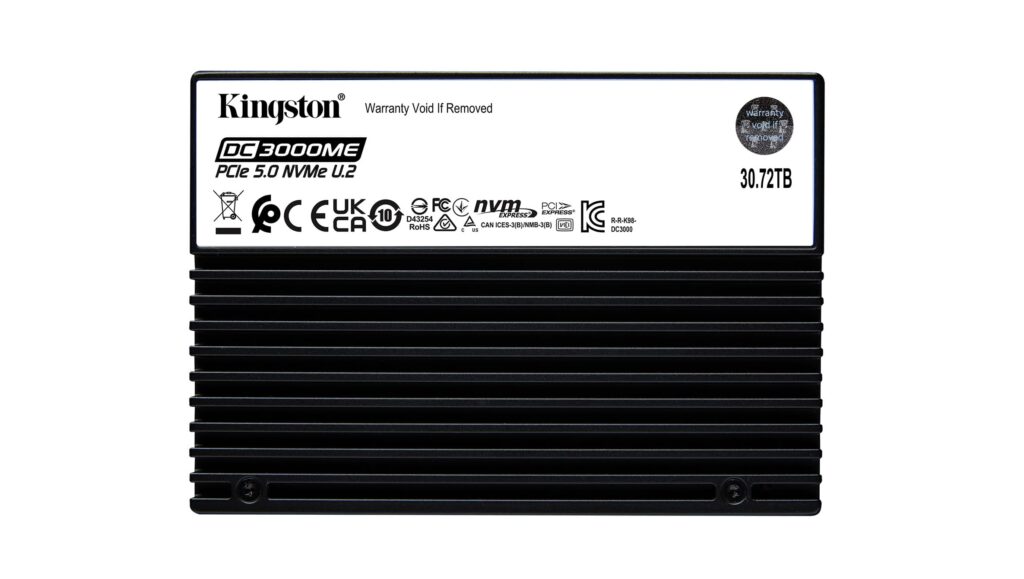
Kingston has taken a new step in its data center storage catalog with the launch of the DC3000ME, a 30.72 TB NVMe U.2 PCIe 5.0 SSD designed for enterprise environments that need to combine capacity, performance, and reliability in less physical space. The new version expands a family that already included models of 3.84 TB, 7.68 TB, and 15.36 TB, arriving at a time of growing demand from artificial intelligence workloads, HPC, databases, and cloud services.
The announcement is not just a capacity upgrade. In modern data centers, every occupied bay, every watt consumed, and every square meter of server room matters. A 30.72 TB drive enables more storage per server, reduces the number of disks needed for the same usable capacity, and simplifies parts of the physical architecture. For operators deploying AI platforms, software-defined storage, or high-performance clusters, this density begins to offer a tangible operational advantage.
PCIe 5.0, 14 GB/s, and U.2 Format
The Kingston DC3000ME uses PCIe 5.0 x4 interface and NVMe protocol, with a 2.5-inch, 15 mm U.2 form factor. The choice of this format is deliberate. U.2 remains prevalent in enterprise servers due to its ease of integration, hot-swap capability in compatible platforms, and broad chassis support in data centers. Compared to more consumer-oriented formats, U.2 maintains a strong position where availability and maintenance are as critical as speed.
In sequential performance, the DC3000ME family reaches up to 14,000 MB/s read speeds. The 30.72 TB model delivers up to 9,700 MB/s sequential write performance, making it suitable for workloads that move large volumes of data such as training checkpoints, dataset ingestion, analytical processing, or intermediate storage for AI workflows.
In random operations, Kingston states that the 30.72 TB model achieves up to 2.6 million IOPS in 4K read and 350,000 IOPS in 4K write. The family’s maximum capacity unit reaches 2.8 million IOPS in 4K read with the 7.68 TB model. It is important to distinguish between peak performance and the actual sustained performance of higher capacity units.
| Capacity | Sequential Read | Sequential Write | Random 4K Read | Random 4K Write |
|---|---|---|---|---|
| 3.84 TB | 14,000 MB/s | 5,800 MB/s | 2,700,000 IOPS | 300,000 IOPS |
| 7.68 TB | 14,000 MB/s | 10,000 MB/s | 2,800,000 IOPS | 500,000 IOPS |
| 15.36 TB | 14,000 MB/s | 9,700 MB/s | 2,700,000 IOPS | 400,000 IOPS |
| 30.72 TB | 14,000 MB/s | 9,700 MB/s | 2,600,000 IOPS | 350,000 IOPS |
The drive is backwards compatible with PCIe 4.0 platforms, although performance will be limited by the interface generation. For companies upgrading infrastructure in phases, this compatibility allows current units to be installed in existing servers and fully utilized once migrated to PCIe 5.0 platforms.
More Density for AI, HPC, and Cloud
The pressure of artificial intelligence on storage often receives less attention than GPU demand, but it is equally real. Training models, serving inference, running RAG systems, maintaining vector repositories, moving data between nodes, and saving checkpoints all require a fast, predictable storage layer. If data doesn’t arrive on time, accelerators will be waiting.
Within this context, the new DC3000ME fits into infrastructure seeking to reduce the cost per usable terabyte without sacrificing performance. Fewer units for the same capacity mean less overall power consumption, fewer potential points of failure, simpler cabling, and easier cooling. The advantage is not just in the unit price but in the overall impact on the rack’s efficiency and density.
Kingston positions this family for mixed and read-intensive workloads such as AI, HPC, OLTP, databases, cloud services, edge computing, and software-defined storage. The 3D eTLC NAND memory balances cost, capacity, and endurance—common in enterprise SSDs designed for heavy, stable use, not for constant extreme writing.
Endurance figures are also noteworthy. The 30.72 TB model offers 56,064 TBW, equivalent to 1 DWPD over five years. In other words, it’s designed to withstand a full daily write of its capacity throughout the warranty period. For many enterprise workloads, this level of endurance is sufficient; for highly aggressive write environments, the specific I/O profile should be evaluated.
PLP, Encryption, and Enterprise Telemetry
Kingston has integrated power-loss protection (PLP), a vital feature for data center SSDs. In case of power failure or unexpected shutdowns, the unit helps preserve in-transit data and reduces corruption risks. This feature is essential for databases, virtualization, distributed storage, or cloud platforms, where it’s a minimum requirement for safe operation.
The DC3000ME includes AES-256 encryption and TCG Opal 2.0 support, positioning it for organizations needing data at rest protection and policy compliance. Additional features include support for 128 namespaces, telemetry, enterprise diagnostics, thermal monitoring, and health status reporting.
Regarding quality of service, Kingston states that the 30.72 TB version maintains latencies under 175 microseconds in read and 12 microseconds in write at the 99th percentile. In environments with many concurrent operations, consistency of latency can be more critical than isolated peak performance. A fast but irregular SSD may negatively affect database stability, inference queues, or services with strict response time requirements.
Power consumption is rated at 9 W idle and 9.5 W at maximum read. While the difference seems small for a single SSD, in deployments with hundreds or thousands of units, power efficiency and rack density become significant factors in overall economics.
Kingston has not announced an official price, which is typical for enterprise units sold through channels, integrators, and volume agreements. The limited warranty is five years. Availability will likely depend on distribution channels and data center customer demand.
The release of the 30.72 TB DC3000ME clearly reflects market evolution. While AI has accelerated the need for GPUs, high-bandwidth HBM memory, and fast networks, it is also pushing storage toward higher capacities, faster interfaces, and increased rack efficiency. In the coming years, the difference between a well-utilized AI cluster and an underused one will not only be in accelerators but also in the ability to feed those accelerators consistently, securely, and sustainably with data.
Frequently Asked Questions
What is the capacity of the new Kingston DC3000ME?
The new version reaches 30.72 TB in U.2 format and is part of a family that also includes 3.84 TB, 7.68 TB, and 15.36 TB models.
What performance does the 30.72 TB model offer?
Kingston states up to 14,000 MB/s sequential read, 9,700 MB/s sequential write, 2.6 million IOPS in 4K random read, and 350,000 IOPS in 4K random write.
Why is this relevant for AI data centers?
Because it increases storage density per server and provides a fast layer for datasets, checkpoints, inference, RAG, databases, and HPC workloads.
Does it include enterprise security and reliability features?
Yes. It provides power-loss protection, AES 256-bit encryption, TCG Opal 2.0 support, telemetry, enterprise diagnostics, and a five-year limited warranty.
