

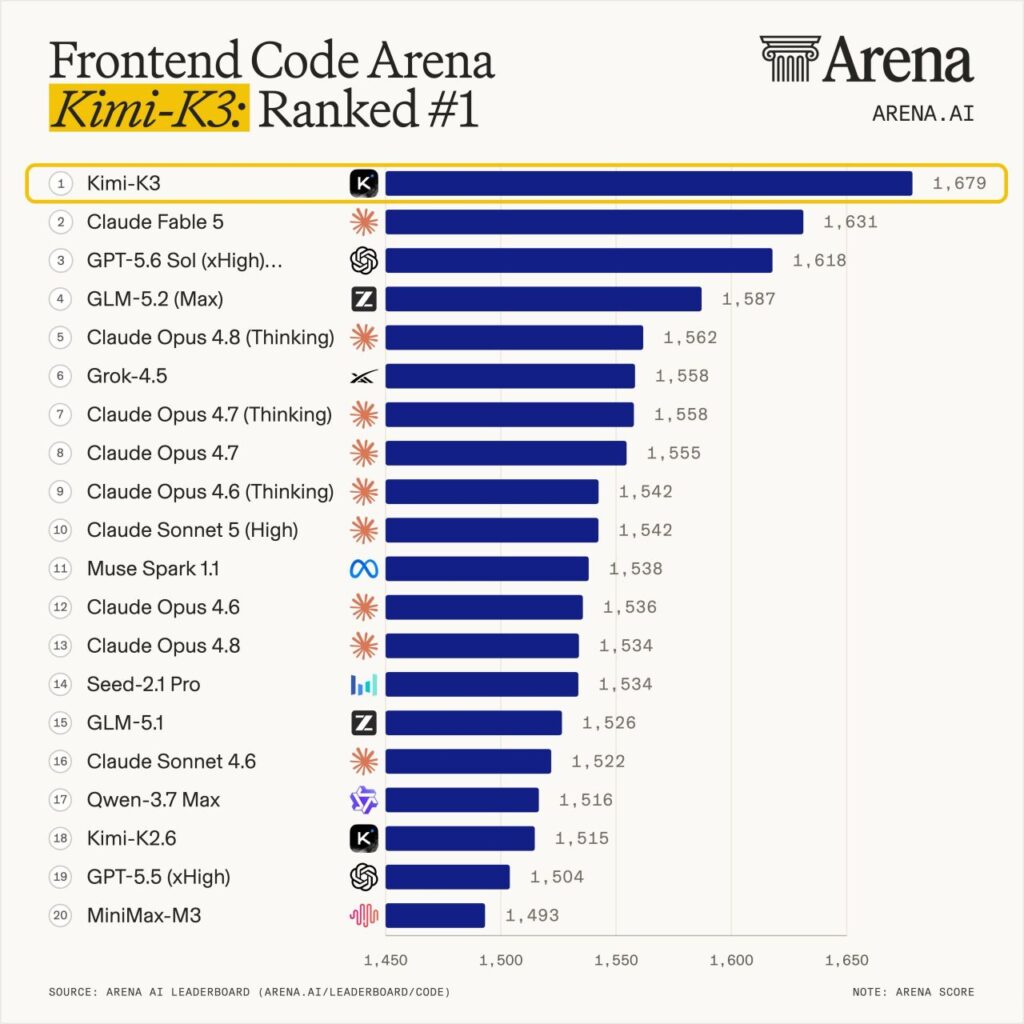
Kimi K3 does more than lead the front-end development leaderboard. The results published by Moonshot AI place the 2.8 trillion parameter model close to GPT-5.6 Sol and Claude Fable 5 in programming, web browsing, automation, spreadsheets, and visual reasoning. Nonetheless, the company itself admits that its overall performance and user experience still lag behind the most advanced proprietary models.
Key highlights of Kimi K3’s results in 30 seconds
- Kimi K3 leads Program Bench, SWE Marathon, BrowseComp, Automation Bench, and SpreadsheetBench 2 among the compared models.
- Is only half a point behind GPT-5.6 Sol in Terminal Bench 2.1.
- Claude Fable 5 maintains an advantage in DeepSWE, FrontierSWE, JobBench, and various visual tests.
- The comparisons use different agent environments, so not all are directly comparable.
- Moonshot plans to publish the full weights before 07/27/2026.
The full table provides a more nuanced perspective than Kimi K3’s first-place finish in Frontend Code Arena. The new model competes at the top across almost all categories but lacks a sole winner. GPT-5.6 Sol excels in some programming and reasoning tests; Claude Fable 5 retains advantages in complex software development and professional tasks; while Kimi K3 achieves its best results during extended sessions, web browsing, automation, and certain visual creation loads.
Moonshot evaluated Kimi K3 with maximum reasoning level, a temperature of 1.0, and different execution environments according to each test. The developer also warns that models did not always use the same harness: Kimi Code, Claude Code, or Codex can significantly alter a model’s results.
Kimi K3 approaches GPT-5.6 in extended programming
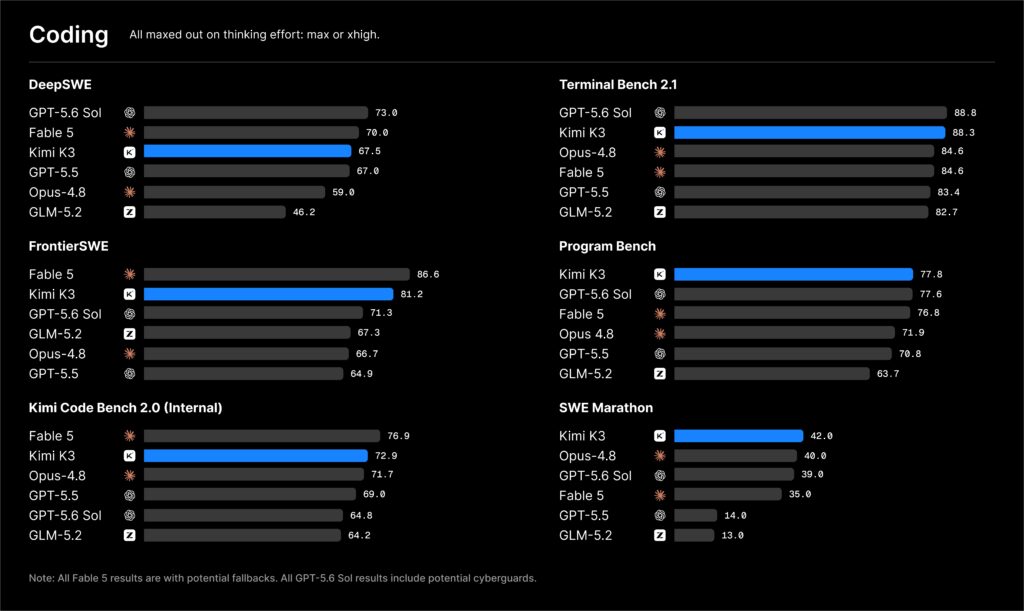
In Terminal Bench 2.1, a task-solving evaluation via terminal, Kimi K3 scores 88.3 points. GPT-5.6 Sol remains in first place with 88.8, just half a point ahead.
Kimi surpasses Claude Fable 5 and Claude Opus 4.8, both with 84.6, as well as GPT-5.5 and GLM-5.2. This result aligns with the model’s orientation toward long sessions, tool use, and repository navigation.
| Programming Test | Kimi K3 | Top Result | Kimi’s Position |
|---|---|---|---|
| DeepSWE | 67.5 | GPT-5.6 Sol: 73.0 | 3rd |
| Program Bench | 77.8 | Kimi K3: 77.8 | 1st |
| Terminal Bench 2.1 | 88.3 | GPT-5.6 Sol: 88.8 | 2nd |
| FrontierSWE | 81.2 | Claude Fable 5: 86.6 | 2nd |
| SWE Marathon | 42.0 | Kimi K3: 42.0 | 1st |
| Kimi Code Bench 2.0 | 72.9 | Claude Fable 5: 76.9 | 2nd |
Program Bench concludes with Kimi K3 in first place, earning 77.8 points versus GPT-5.6 Sol’s 77.6 and Fable 5’s 76.8. The margin is very narrow, so not indicative of a clear dominance, but it confirms K3’s competitiveness with top closed models in code generation and problem-solving.
SWE Marathon shows a clearer lead. Kimi K3 scores 42 points, ahead of Claude Opus 4.8 with 40, GPT-5.6 Sol with 39, and Fable 5 with 35. This test aims to measure sustained engineering work over longer sessions, an area where Moonshot has focused model training.
Results vary in DeepSWE: GPT-5.6 Sol reaches 73 points, Fable 5 scores 70, and Kimi K3 ranks third with 67.5. In FrontierSWE, Fable 5 tops at 86.6, followed by K3 with 81.2.
This distribution shows that Kimi K3 doesn’t dominate programming overall. Its strengths mainly lie in tasks requiring continuity, exploration, and tool use, while GPT-5.6 and Fable 5 perform better in other software engineering evaluations.
Methodologically, Kimi K3 uses Kimi Code in several tests, GPT-5.6 Sol runs with Codex, and Anthropic models employ Claude Code or Terminus. A well-managed environment improves context handling, tool selection, and error recovery; thus, scores partly depend on the entire system, not just the model.
Moonshot also acknowledges that some results from Claude Fable 5 may include automatic substitution with Claude Opus 4.8 when the model refuses a task due to usage policies. GPT-5.6 Sol’s scores can be affected by its cybersecurity controls. These factors complicate direct comparisons.
BrowseComp and Automation Bench highlight agent capabilities
The most favorable results for Kimi K3 outside conventional programming are in browsing and research tasks. In BrowseComp, a web navigation and research test, it scores 91.2, surpassing GPT-5.6 Sol’s 90.4 and Fable 5’s 88.
In Automation Bench, it also leads with 30.8 points, ahead of GPT-5.6 Sol with 29.7 and Fable 5 with 29.1. The margin isn’t large but is significant because this test evaluates tasks where the model must coordinate actions and tools, not just produce text responses.
| Agent Tasks | Kimi K3 | Top Model |
|---|---|---|
| BrowseComp | 91.2 | Kimi K3 |
| Automation Bench | 30.8 | Kimi K3 |
| SpreadsheetBench 2 | 34.8 | Kimi K3 |
| AA-Briefcase Elo | 1,548 | Fable 5: 1,583 |
| GDPval-AA v2 Elo | 1,668 | Fable 5: 1,760 |
| JobBench | 52.9 | Fable 5: 57.4 |
| MCP Atlas | 84.2 | Fable 5: 84.7 |
| Toolathlon-Verified | 73.2 | Fable 5: 77.9 |
K3 also takes top spot in SpreadsheetBench 2 with 34.8, just ahead of Fable 5’s 34.6. GPT-5.6 Sol scores 32.4, while Claude Opus 4.8 scores 31.6.
This task is interesting because working with spreadsheets requires interpreting structures, modifying cells, using formulas, and maintaining coherence across many operations. It’s not just about syntax; the agent must understand the user’s desired outcome and apply changes to existing documents.
Fable 5 maintains the lead in JobBench, with 57.4 points versus Kimi K3’s 52.9, and in GDPval-AA, where it scores 1,760 points Elo compared to K134. In these assessments, which aim to simulate broader professional tasks, Moonshot affirms that Kimi has not yet achieved the general expertise of top closed models.
In AA-Briefcase, Fable 5 also remains in first place with 1,583 points. Kimi K3 is close behind with 1,548, outperforming GPT-5.6 Sol, which scores 1,495.
MCP Atlas, focused on tasks related to the Model Context Protocol, shows very tight results: Fable 5 scores 84.7, Kimi K3 84.2, and GPT-5.6 Sol and Opus 4.8 both score 83.6. The gap of less than a point isn’t enough to declare a clear superiority, especially since these metrics rely on a judge model and a 100-turn limit.
Native vision, but Claude maintains an edge in several tests
Kimi K3 incorporates native visual capabilities within the model itself, able to combine captures, text, video, and code during a single task. Moonshot uses this feature to explain its performance in front-end, gaming, graphics, and editing applications.
Results in visual tasks again show a balanced competition. Kimi K3 scores 91.3 in CharXiv with Python, just below Fable 5’s 93.5 but above GPT-5.6 Sol, Opus 4.8, and GPT-5.5.
| Visual Test | Kimi K3 | Top Result |
|---|---|---|
| MMMU-Pro | 81.6 | GPT-5.6 Sol: 83.0 |
| MMMU-Pro with Python | 83.4 | Fable 5: 86.5 |
| CharXiv with Python | 91.3 | Fable 5: 93.5 |
| MathVision | 94.3 | GPT-5.6 Sol: 95.8 |
| MathVision with Python | 97.8 | Fable 5: 98.6 |
| ZeroBench with Python | 41.0 | Fable 5: 46.0 |
| OmniDocBench | 91.1 | Kimi K3: 91.1 |
| PerceptionBench | 58.5 | GPT-5.6 Sol: 59.7 |
In OmniDocBench, Kimi K3 achieves the best result with 91.1 points. The test evaluates understanding of complex documents, combining text, structure, and visual elements.
In MathVision with Python, K3 scores 97.8, tying with GPT-5.6 Sol and close to Fable 5, which scores 98.6. All top models attain high scores, so practical differences depend on the problem type and their use of computational tools.
Claude Fable 5 dominates several demanding vision-assisted tests, while GPT-5.6 Sol leads in MMMU-Pro and MathVision without Python. Kimi K3 remains competitive in both areas, surpassing Claude Opus 4.8 and GPT-5.5 in multiple tasks.
The visual advantage also appears in less structured demonstrations. Moonshot states that K3 can observe its own generated code output, correct it via successive captures, and modify interfaces, games, or digital designs based on real-time behavior—a process called “vision in the loop”.
A 2.8-trillion parameter model that only activates a fraction
Kimi K3 uses a mixture of experts architecture with 2.8 trillion total parameters. During each operation, it selects 16 out of 896 available experts, reducing the computational load compared to a dense model of the same size.
Moonshot attributes part of its improvement to Kimi Delta Attention, Attention Residuals, and Stable LatentMoE. They claim this setup provides roughly 2.5 times more scaling efficiency than Kimi K2.
| Technical Feature | Kimi K3 |
|---|---|
| Total Parameters | 2.8 trillion |
| Architecture | Mixture of experts |
| Experts Available | 896 |
| Experts Activated Per Operation | 16 |
| Maximum Context | One million tokens |
| Multimodal Input | Text, image, video |
| Quantization for Training | MXFP4 weights, MXFP8 activations |
| Recommended Deployment | Supernodes with at least 64 accelerators |
The model’s scale limits the practicality of releasing its weights to consumers. Running Kimi K3 in full requires infrastructure with many accelerators and high-bandwidth connections.
Moonshot recommends using supernodes with 64 or more devices for efficient inference. The community can study, adapt, or quantize weights, but full deployment will initially be restricted to research centers, inference providers, and large corporations.
The official API costs $0.30 per million tokens retrieved from cache, $3 for uncached input, and $15 for output. Moonshot reports that its Mooncake architecture achieves over 90% cache hit rate in programming tasks, based on its internal systems.
Acknowledging instability and over-initiative tendencies
The developer mentions two key limitations. First, Kimi K3 was trained to retain reasoning history within a session. If the environment fails to properly return this info or switches to K3 after working with another model, performance can become unstable.
Therefore, Moonshot recommends using Kimi Code or other verified environments compatible with this context maintenance. Also, replacing the model mid-task is discouraged.
Second, K3 tends to act on its own initiative. Training for long projects might lead K3 to improvise when faced with ambiguous instructions or minor problems. In strict-application scenarios, Moonshot advises explicitly setting constraints in system messages or files like AGENTS.md.
These warnings are particularly relevant in software development. An overly active agent might modify files unexpectedly, install dependencies, alter architecture, or resolve ambiguities differently from expected.
Kimi K3 demonstrates that open-weight models are closing the gap with proprietary platforms. It leads several tests and is close in others but still doesn’t surpass GPT-5.6 Sol or Claude Fable 5 in general performance.
The most solid conclusion is not that there’s a new undisputed champion but that a model Moonshot plans to release can compete with proprietary services in coding, browsing, automation, and vision. The release of weights, licensing, and the full technical report will reveal how much of that performance can be replicated outside the manufacturer’s infrastructure.
Frequently Asked Questions
Does Kimi K3 outperform GPT-5.6 Sol in programming?
It depends on the test. Kimi leads Program Bench and SWE Marathon but is behind GPT-5.6 Sol in DeepSWE and Terminal Bench 2.1.
Is it better than Claude Fable 5 as an agent?
Kimi leads in BrowseComp, Automation Bench, and SpreadsheetBench 2. Fable 5 maintains an edge in JobBench, GDPval-AA, AA-Briefcase, and several visual tests.
Are all results directly comparable?
Not entirely. Different agent environments, reasoning levels, security mechanisms, and some internal evaluations make direct comparisons challenging.
When will Kimi K3’s weights be published?
Moonshot plans to release the full weights before 07/27/2026, along with more info about architecture, training, and evaluations.
Source: Noticias inteligencia artificial
