
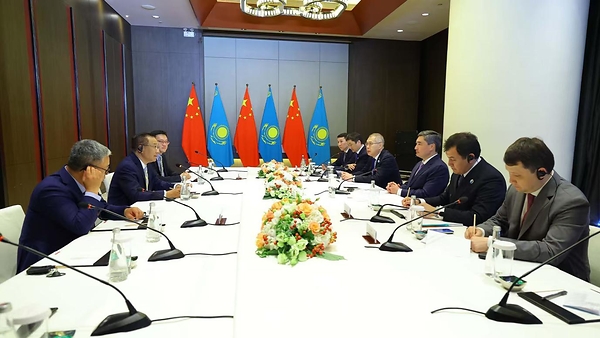
Kazakhstan aims to become one of the new hotspots for artificial intelligence (AI) infrastructure between Europe and Asia. SuperX AI Technology, a Nasdaq-listed provider of AI computing infrastructure, has held discussions with Kazakh Prime Minister Olzhas Bektenov to explore the phased development of a computing park with up to 1 GW of capacity.
The proposal is still far from being a finalized project. There is no confirmed timeline, announced funding, or location. However, the scale of this initiative demonstrates how the global race for AI is moving beyond traditional markets. Computing capacity is no longer concentrated solely in the United States, China, Western Europe, or major Asian cloud hubs. Countries rich in energy, with available land and strategic geographic positions, are trying to attract next-generation data centers.
The meeting took place on June 23 in Dalian, during the Summer Davos event of the World Economic Forum. SuperX presents the project as a potential entry into Central Asia’s digital infrastructure market and as a link to connect computing capacity between Europe and Asia. Meanwhile, Kazakhstan has declared 2026 the Year of Digitalization and Artificial Intelligence and seeks to reduce dependence on foreign hardware and software by developing sovereign computing capacity.
A 1 GW plan in three phases
The proposal discussed between SuperX and the Kazakh government is structured in three stages. The first phase aims for a 200 MW cluster by 2027. The second would add 300 MW in 2028. The third would raise an additional 500 MW in 2029, reaching the conceptual goal of 1 GW of total capacity.
| Phase | Target Year | Expected Capacity | Project Outlook |
|---|---|---|---|
| First phase | 2027 | 200 MW | Start of the computing cluster |
| Second phase | 2028 | +300 MW | Initial capacity scaling |
| Third phase | 2029 | +500 MW | Jump to a 1 GW park |
| Total planned | 2027-2029 | 1 GW | Regional AI node connecting Europe and Asia |
A 1 GW data center is not a conventional project. It aligns with the scale of large AI campuses that are beginning to reshape global electricity demand. To put this in perspective, many traditional enterprise data centers historically operated at tens of megawatts. AI is driving the market towards campuses of hundreds of megawatts and, in some cases, proposals approaching a gigawatt.
This leap fundamentally changes the nature of the challenge. It is no longer enough to build rooms, install servers, and connect to the internet. An AI park of this size requires reliable power, substations, electrical lines, cooling infrastructure, water access or alternative solutions, international fiber connectivity, physical security, permits, funding, GPU availability, regulatory compliance, and local technical talent.
SuperX has also proposed the potential formation of a tripartite working group to study land, energy, taxation, incentive policies, and training. According to the company’s communications, the Kazakh government has invited the SuperX team to conduct site selection visits to assess project feasibility.
Why Kazakhstan wants to be an AI hub
Kazakhstan’s interest is not spontaneous. The country has been striving for months to position itself as a regional platform for AI and digitalization. The government has approved the Digital Qazaqstan strategy through 2029 and has identified building digital infrastructure as a national priority.
The most obvious advantage is energy. Large AI data centers require a stable and scalable electrical supply. Kazakhstan boasts abundant energy resources and a geography that appeals to operators seeking nodes between Europe and Asia. The government has also emphasized that digital infrastructure and AI demand a reliable energy base, as high-performance computing deployment significantly increases electricity consumption.
The country is already working on other data infrastructure projects. One notable example is Data Center Valley in Ekibastuz, envisioned as a platform capable of hosting global digital infrastructure. Authorities have mentioned an initial availability of 300 MW, with a scalable design up to 1 GW, as part of a strategy to attract international partners and turn electricity into exportable digital services.
SuperX’s proposal complements this pattern. Kazakhstan aims to combine energy, land, incentives, regional connectivity, and political ambition. For AI infrastructure companies, this blend could be attractive if concerns about international connectivity, regulatory stability, critical equipment access, and data compliance are addressed.
| Potential advantage | Why it matters for AI |
| Available energy | AI clusters need continuous, scalable power |
| Land for large campuses | Enables the design of hundreds of MW parks |
| Eurasian position | Can serve as a node between Europe, Central Asia, and China |
| Investment incentives | Facilitate large-capital projects |
| National AI strategy | Provides political backing for infrastructure |
| Need for local computing | Reduces dependence on foreign providers |
SuperX aims to sell complete infrastructure, not just servers
SuperX positions itself as a full-stack provider of AI infrastructure. The company offers AI servers, high-voltage DC solutions, liquid cooling, software, operations, and maintenance. This approach aligns with market trends: AI data centers are no longer bought as a collection of separate parts but as integrated systems encompassing power, cooling, networking, and operation.
In its communications, SuperX highlights its credentials as an OEM partner of NVIDIA, its HVDC solutions, liquid cooling technology, and its compliance framework for cross-border data. The company claims it can replicate proven deployment models from other markets in Kazakhstan to reduce time to operational readiness.
Importantly, this project remains a proposal. The announcement contains language of intent, potential, and evaluation. It does not represent a final investment decision or a construction contract. For projects of this magnitude, the gap between political discussions and operational campuses can be significant.
Obstacles are evident. The first is energy: not just nominal availability, but connection capacity, stability, cost, and scalability. The second is cooling, especially in high-density campuses. The third is international connectivity, as an AI node needs low-latency data movement along reliable routes. The fourth is access to GPUs and accelerators, impacted by global demand, pricing, and export controls. The fifth involves regulation: data policies, taxation, security, ownership, sanctions, and engagement with international clients.
| Risk or condition | Pending question |
| Energy | What reliable power capacity will be available, and at what cost? | Connectivity | Which international routes will ensure low latency and redundancy? | Cooling | What design will enable high-density AI operation? | Critical equipment | Will there be sufficient access to GPUs and advanced networking? | Funding | Who will provide the necessary capital for each phase? | Regulatory compliance | How will data, export controls, and international clients be managed? | Talent | Will there be enough technical personnel to operate the campus? |
AI turns energy into industrial policy
Kazakhstan’s case exemplifies a broader trend. AI is bringing energy back to the forefront of technological policy. For years, digital infrastructure discussions focused on fiber, cloud, software, latency, or regional availability. Now, the fundamental question is: where is there sufficient electrical power to run thousands of accelerators?
This question is opening opportunities for countries that previously did not feature prominently in the public cloud landscape. Latin America, the Middle East, Central Asia, Northern Europe, and regions with abundant energy or industrial land are beginning to compete for new AI campuses. Not all will materialize, but the digital infrastructure map is shifting.
Kazakhstan aims to leverage this shift. Its narrative combines technological sovereignty, export of digital services, and geographic positioning among markets. A 1 GW park would attract investment, create specialized jobs, and enhance international presence. It could also foster a local AI ecosystem if capacity is utilized by universities, companies, government agencies, and startups, rather than solely serving foreign clients.
This will be key. A large data center can either be a national infrastructure or an export-oriented compute facility. The difference depends on who accesses the capacity, what applications are developed, what talent is cultivated, and how much local value is retained.
For SuperX, the opportunity lies in breaking into Central Asia and establishing itself as a provider of comprehensive infrastructure in an emerging market. For Kazakhstan, it’s about accelerating its digital leap. For both, the challenge is turning a high-level proposal into connected energy, installed servers, and actual clients.
The global race for AI is no longer just about models and chips. It also takes place in territories capable of offering electricity, land, connectivity, and a coherent industrial policy. Kazakhstan wants to be part of that map. Now, it must prove it can move from announcement to operational megawatt.
Frequently Asked Questions
What has SuperX proposed in Kazakhstan?
SuperX has outlined a data center for AI of up to 1 GW, to be developed in phases from 2027 to 2029.
Is the project confirmed?
Not as a finalized investment. Currently, it’s a proposed plan under evaluation, with planned site selection visits and discussions with Kazakhstan Invest.
Why does Kazakhstan interest AI data centers?
Due to its energy availability, land for large campuses, strategic position between Europe and Asia, and a national strategy focused on digitalization and AI.
What capacity is planned for each phase?
200 MW in 2027, an additional 300 MW in 2028, and 500 MW in 2029.
What are the challenges for a 1 GW AI campus?
Reliable energy, electrical grid capacity, cooling, international connectivity, GPU access, funding, permits, regulatory compliance, and technical talent.
via: superx.sg
