
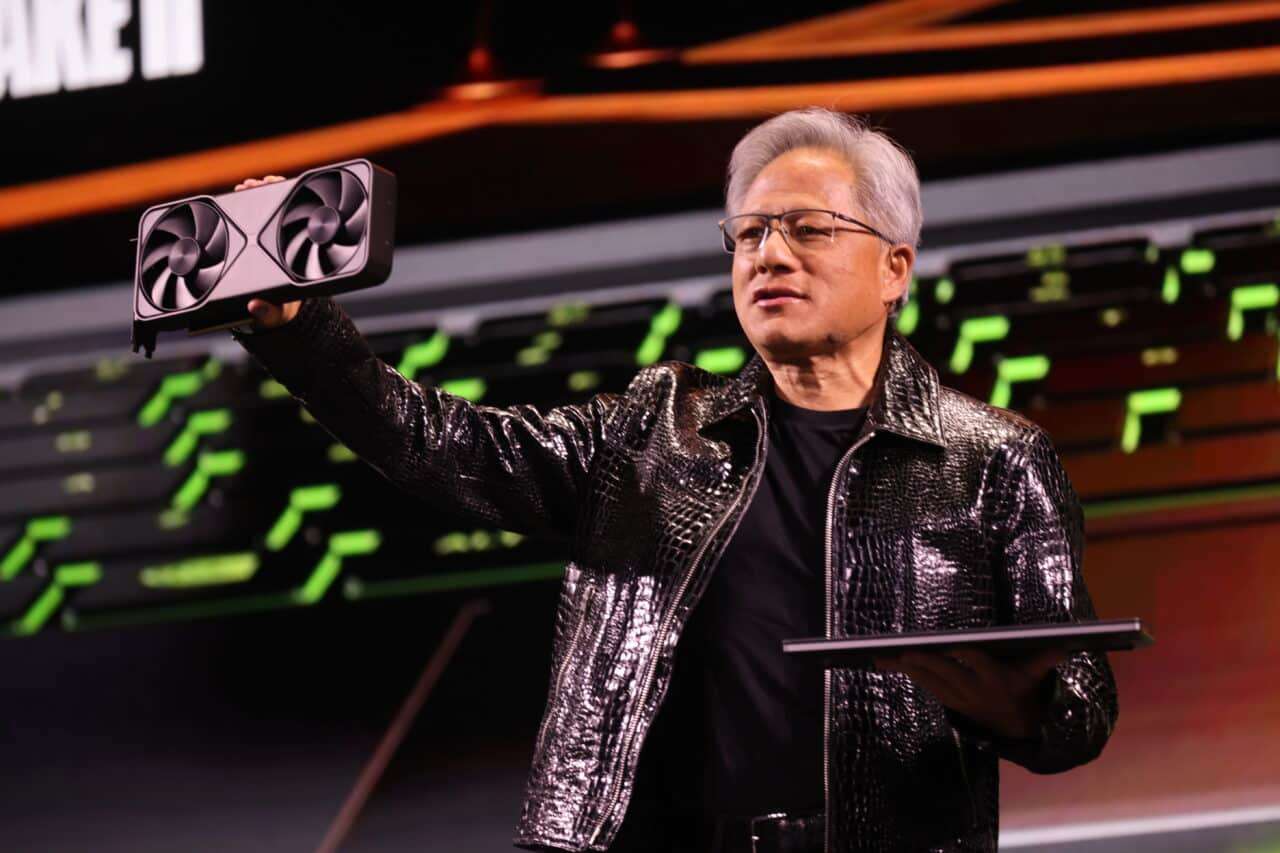
Jensen Huang plans to participate on July 15th in an event held in Akihabara to commemorate the 30-year relationship between Nvidia and Sega. The visit comes after some Asian media interpreted his recent visits to Taiwan and South Korea—without a comparable stop in Japan—as a sign that the country was losing prominence in the AI race.
The event has a business component, featuring the Japan debut of the RTX Spark platform, but also revisits one of Nvidia’s lesser-known historical episodes. Three decades before becoming the leading provider of AI accelerators, the company narrowly avoided failure after a misstep with its first graphics architecture. An investment from Sega gave Nvidia the necessary time to change course.
The Key Points of Jensen Huang’s Visit to Japan in 20 Seconds
- Nvidia and Sega celebrate 30 years since their partnership began.
- The event will be held at GiGO Akihabara in Tokyo.
- Jensen Huang will participate alongside current and former Sega representatives.
- Nvidia will debut RTX Spark in Japan for the first time.
- The company will raffle off a GeForce RTX 5090 Founders Edition among attendees.
- This event does not indicate that Sega will announce a new console.
- The relationship started around the NV1 and NV2 chips in the 1990s.
- The Sega console project was ultimately unsuccessful.
- Sega decided to invest $5 million when Nvidia was facing financial difficulties.
- That investment allowed the development of RIVA 128 and an exit from an obsolete graphics architecture.
- The visit also reopens discussions about Japan’s position in the Asian AI industry.
- Japan remains relevant in materials, equipment, photonics, robotics, and semiconductor manufacturing.
The event is scheduled between 5:00 PM and 6:00 PM local time at GiGO Akihabara 3. Nvidia Japan has framed it as an event for the gaming community, with limited access by invitation. The program includes a review of the shared history of both companies, a technology showcase, and the local launch of RTX Spark.
Participants announced include Jensen Huang, Sega officials, former executive Shoichiro Irimajiri, and Yu Suzuki—creator of titles such as Virtua Fighter, Shenmue, and Out Run. His presence shifts the focus back to a time when Nvidia did not manufacture AI accelerators and was still seeking a foothold in the emerging 3D graphics market.
The Technical Mistake Nearly Leading to Nvidia’s Collapse
Nvidia began developing its first graphics processor, NV1, shortly after its founding in 1993. The chip was released in 1995 and combined graphics acceleration, sound, and connectivity for Sega Saturn controllers. Some Sega games were adapted to run on PCs equipped with these cards.
The architecture made a technical decision that ultimately proved problematic. Nvidia chose to represent surfaces with quadrilaterals and used a rendering technique known as forward texture mapping. Conversely, the market favored triangles and Z-buffers, an approach Microsoft incorporated into Direct3D.
This discrepancy was not a minor issue that could be fixed with a driver update. Games and tools began to be built around a different way of processing graphics, sidelining NV1 and making it obsolete in the industry’s evolving path.
Despite this, Sega and Nvidia began developing NV2, a processor intended to be part of Sega’s next console. The effort continued while Huang began to realize that the architecture would not have a future. Continuing with the contract could bring short-term revenue but would also lock Nvidia into investing its last resources into a likely-failing technology.
Huang’s account often centers on Shoichiro Irimajiri, who agreed to let Nvidia abandon the project and convinced Sega’s leadership to invest $5 million in the American company. This funding didn’t guarantee Nvidia’s survival but gave it months to develop another product.
Some accounts differentiate between the $5 million investment and a contractual payment of $1 million linked to delivering a working NV2 prototype. The key point is Sega didn’t demand Nvidia proceed with a design that both knew had slim chances, allowing Nvidia to focus resources on a new architecture.
Nvidia reduced its workforce and focused remaining efforts on RIVA 128, a processor compatible with the dominant PC graphics model. It launched in 1997 and gained acceptance Nvidia’s first architecture never achieved. This enabled Nvidia to finance RIVA TNT and release its first GeForce in 1999.
Sega’s rescue alone doesn’t explain Nvidia’s later rise, but it prevented Nvidia from running out of time to correct its biggest technical mistake. Since then, Huang has used this episode to argue that a CEO’s role isn’t about always being right but about recognizing bad decisions early and keeping the company afloat while seeking alternatives.
An irony of the story is that Sega abandoned home console business after the Dreamcast’s end, whereas Nvidia transformed gaming graphics into the foundation for computing architectures used in scientific simulations, data centers, and AI.
A Symbolic Visit Amidst the AI Competition in Asia
The trip also has contemporary relevance. Over recent months, Jensen Huang has paid close attention to Taiwan and South Korea. Nvidia depends on TSMC to manufacture its processors and relies on a vast Taiwanese supply chain for servers, cooling systems, motherboards, and complete setups. Huang described Taiwan as the epicenter of the AI revolution and announced that Nvidia’s annual spending there could reach approximately $150 billion.
South Korea plays a critical role as well. Samsung and SK Hynix supply advanced memory and compete for HBM orders essential for data-center GPUs. Both companies have benefited directly from the growth of AI infrastructure.
Japan currently lacks a direct equivalent to TSMC in advanced manufacturing or a comparable HBM producer to the South Korean leaders. This has fueled interpretations of a possible “Japan passing,” implying Nvidia was prioritizing other Asian countries.
The situation is more nuanced. Japan maintains key manufacturers of equipment, wafers, chemicals, sensors, NAND memory, and power components. It’s also investing heavily to recover manufacturing capacity and attract international projects.
TSMC has announced plans to upgrade its second Kumamoto facility to 3 nanometers, aimed at producing advanced AI, robotics, and autonomous driving chips. Japan also supports Rapidus in its effort to develop 2nm chips, and recently backed a $1 billion expansion of Tower Semiconductor focused on silicon photonics and communications tech.
SoftBank is exploring the development of AI servers produced in Japan with Nvidia and Foxconn. The project would start with assembling systems from external components, with plans to gradually increase domestic supplier involvement.
Therefore, Huang’s absence on a specific tour doesn’t necessarily indicate Nvidia has dismissed Japan. The country plays a different role in the supply chain: fewer direct competitors in AI accelerators but strategic assets in manufacturing, materials, optics, and industrial automation.
The Sega event also doesn’t confirm new semiconductor deals or larger industrial alliances. Nvidia has only announced this commemorative event and the Japanese launch of RTX Spark. Any additional announcements remain speculative at this point.
RTX Spark at least serves as a bridge between Nvidia’s gaming origins and its current AI endeavors. The platform combines CPU and GPU to enable PCs with AI functions that previously required workstations or servers. Nvidia introduced it in 2026 as part of its entry into PC processors—a historically dominated market by Intel, AMD, and in Arm-based systems, Qualcomm and Apple.
The chosen setting also carries intention. Akihabara symbolizes Japanese gaming culture, electronics, and personal computing. Here, Nvidia isn’t just celebrating Sega’s risky investment. It also remembers that its current AI status started with a failed graphics chip, a console that never used it, and a partner willing to let it course-correct.
Frequently Asked Questions
Why is Jensen Huang visiting Japan?
He will attend an event celebrating 30 years of Nvidia and Sega’s partnership and will unveil RTX Spark in Japan for the first time.
Did Sega actually save Nvidia from bankruptcy?
The $5 million investment in the 1990s bought Nvidia time to abandon its initial architecture and develop RIVA 128. It was a crucial help, though subsequent success depended heavily on Nvidia’s new product lineup.
Did Nvidia manufacture the Dreamcast processor?
No. Nvidia worked with Sega on the NV2 project, but that design was abandoned. The Dreamcast used PowerVR graphics technology from VideoLogic, later known as Imagination Technologies.
Will Sega reveal a new console at the event?
There are no official announcements indicating so. Confirmed details only include the commemoration, Nvidia’s tech showcase, and guest activities.
Source: en.sedaily.com
