
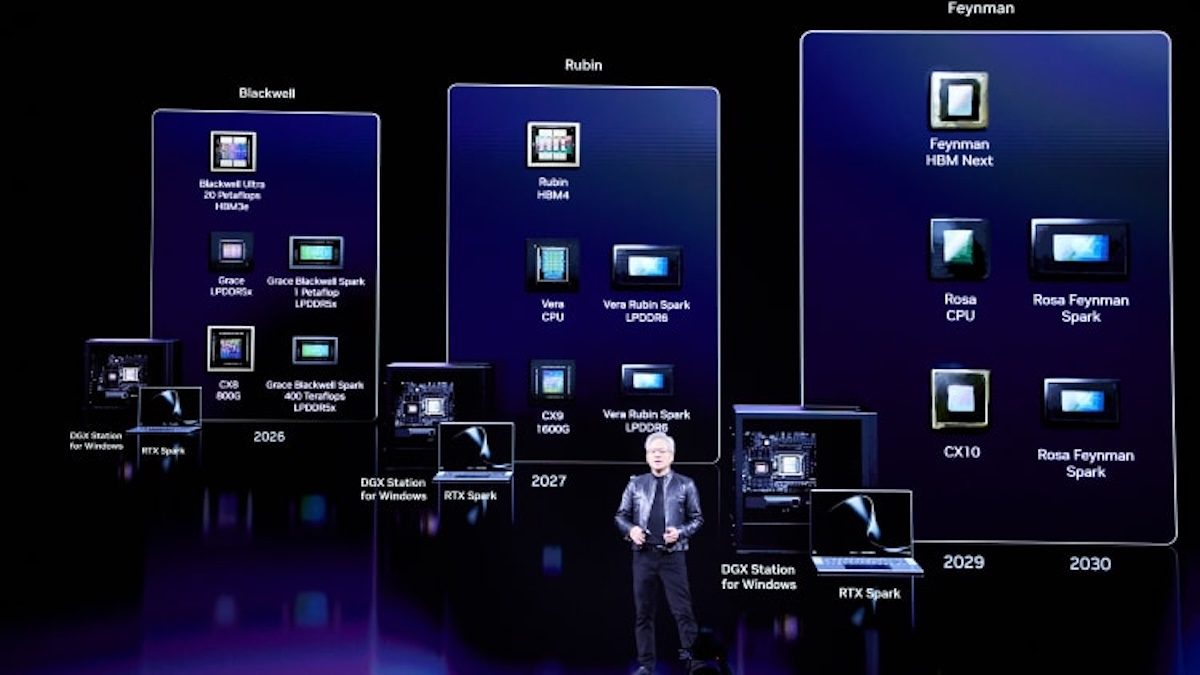
Jensen Huang, NVIDIA’s CEO, argued on October 21, 2026 at GTC Berlin that the useful life of one of the company’s GPUs is now about eight years or more, double the four-year cycle that had been considered standard until now. The claim comes amid an ongoing debate over how long major cloud providers should depreciate their AI investments, and it coincides with comments from Elon Musk, who maintains that even older GPUs now deliver more intelligence per watt than when they were bought.
The GPU lifespan debate in 20 seconds
- Huang puts the useful life of an NVIDIA GPU at eight years or more.
- Musk says H100s are now rented out above their original price.
- Big Tech companies depreciate their servers over five to six years.
- Critics like Michael Burry believe those timelines inflate profits.
The remarks were reported by Wccftech based on videos from the conference and from SpaceX’s earnings presentation. Beyond the headline, the issue carries real financial weight: the longer a GPU is considered useful, the lower the annual depreciation expense companies subtract from their profits, and the more profitable AI data center investment appears.
Huang’s, Musk’s, and Baker’s arguments
Huang attributed that longer lifespan to the massive adoption of NVIDIA’s platform, to the durability of its performance, and to the fact that software keeps improving older hardware through updates. He added that this compute still has many potential buyers, so it remains useful and resellable. He also offered a quick calculation: each gigawatt of AI compute costs about $50 billion and generates about $40 billion in revenue per year, which would mean recovering the investment in a little over a year. These are the executive’s own figures, not audited data.
Musk, on SpaceX’s third-quarter earnings call, argued that GPUs don’t lose value because AI software keeps improving and extracting more useful intelligence from every watt. As proof, he cited that H100s are now rented out above their original price. He also explained that SpaceX prefers short-term rentals, because AI compute is priced at between $30 billion and $50 billion per gigawatt with payback in under a year, and renewals come with higher prices per watt.
Investor Gavin Baker, in a session held ahead of Huang’s keynote, added that the hourly rental price of a GPU has risen sharply even as token prices fall, because every GPU-hour now produces more useful output. Market data points in that direction: according to Silicon Data, cited by Wccftech in September, the residual value of a B200 is around 158% of its launch price a year after reaching the market, and the residual values of the A100 and H100 are well above what straight-line depreciation over three to five years would suggest.
How Big Tech depreciates its servers
The debate isn’t new. In November 2025, investor Michael Burry accused Meta, Alphabet, Microsoft, Oracle, and Amazon of stretching the accounting life of their chips and servers to six years, when AI product cycles run two to three years. By his calculations, that practice would inflate Big Tech’s profits by $176 billion between 2026 and 2028. Burry had disclosed short positions against NVIDIA.
Actual timelines vary. Alphabet depreciates its servers and networking equipment over six years. Microsoft uses a range of two to six years. Meta extended the life of part of its servers to 5.5 years starting in January 2025. Amazon moved in the opposite direction: in the first quarter of 2025 it cut the estimated life of part of its servers from six to five years, precisely because of how fast AI is advancing. On the other side, a Bernstein report from November 2025 argued that GPUs can run profitably for around six years and typically lose between 20% and 30% of their value in the first year before stabilizing.
A manufacturer’s estimate versus each generation’s efficiency
Huang’s eight years is an estimate from the company that sells the GPUs, and Musk’s thesis rests on a rental market shaped by compute scarcity. Neither provided data on how many older-generation GPUs remain in production in large data centers, or at what average prices they are being rented.
NVIDIA itself gives ammunition to those who favor shorter cycles, since it claims every generation multiplies performance per megawatt. CloudNews previously reported how NVIDIA measures up to 30x more throughput per MW with Vera Rubin compared to Blackwell, a figure from the company itself. In data centers constrained by available electrical power, that difference is what tips the scale when deciding whether to keep an older GPU or replace it.
Frequently Asked Questions
How many years does an NVIDIA GPU last according to Jensen Huang?
Huang said at GTC Berlin that an NVIDIA GPU’s useful life is now about eight years or more, compared with the four years previously considered standard.
What did Elon Musk say about GPU value?
That GPUs don’t lose value because software extracts more intelligence per watt, and that H100s are now rented out above their original price.
Over how many years does Big Tech depreciate its servers?
Alphabet over six years, Meta over 5.5 years for part of its equipment, Microsoft between two and six years, and Amazon cut part of its fleet from six to five years in 2025.
Why does GPU lifespan matter?
Because it determines the annual depreciation expense: the longer a GPU’s life is considered, the lower that expense, and the more profitable AI investment appears to be.
Sources:
