
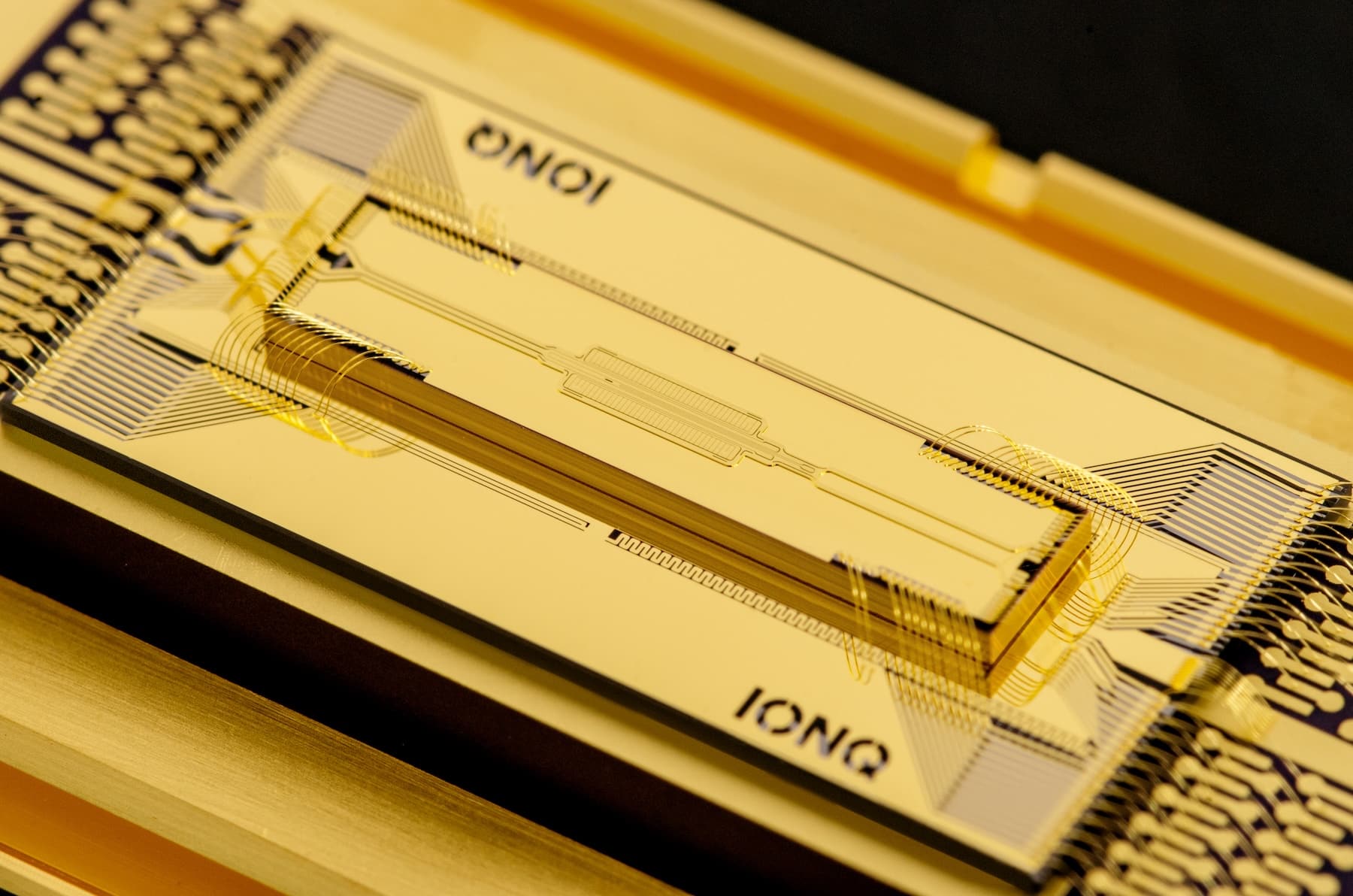
IonQ and the University of Cambridge have opened the IonQ Quantum Innovation Centre, a research facility located at the Ray Dolby Centre, home of the university’s Cavendish Laboratory. The facility launches a collaboration spanning quantum computing, quantum networking, sensors, and security, with nine initial projects meant to connect academic research with industrial applications. The announced plans include deploying a 256-qubit Superion quantum computer and a network to distribute quantum entanglement across the campus.
IonQ’s Cambridge quantum center in 30 seconds
- IonQ and the University of Cambridge have opened a center dedicated to researching quantum technologies in the United Kingdom.
- The first nine projects span hardware, algorithms, quantum networking, and applications in engineering, finance, chemistry, and medicine.
- The company plans to deploy a 256-qubit Superion system and a network with two data centers and three quantum connection nodes.
- Innovate UK will give the National Quantum Computing Centre access and computing time for three years.
- The collaboration will also fund academic positions, postdoctoral researchers, and PhD students.
The center turns into a physical facility the agreement both organizations announced on March 11, 2026. The initiative is part of Cambridge’s largest corporate research collaboration, according to the organizations involved, and aims to bring together university specialists and IonQ engineers to work on problems ranging from device design to algorithm development.
The scope is broader than a lab dedicated solely to quantum computers. The projects include optical connections between processors, the development of detection techniques, and the study of applications that could benefit from quantum computing methods. However, the center’s opening and the project announcements don’t mean all of those applications are already commercially available.
Nine projects to connect research with real-world applications
The first projects were selected by a joint committee made up of scientific and business leaders from both organizations. They involve researchers from Cambridge’s departments of Physics, and Engineering and Computer Science and Technology, as well as the Milner Therapeutics Institute and Cambridge Judge Business School.
One experimental line focuses on developing microscopic mirrors capable of more efficiently collecting the light emitted by trapped ions. This work aims to lay the groundwork for optical connections between quantum processors, a building block needed to research distributed systems that can exchange quantum information.
IonQ builds its quantum computing technology on trapped ions. In this type of architecture, ions act as qubits and are manipulated using precisely controlled physical techniques. The ability to connect processors through optical links could help researchers study larger architectures, though building a useful quantum network also requires solving problems around fidelity, synchronization, memory, and the transmission of quantum states.
The computational projects are aimed at problems in chemistry, materials science, finance, engineering, and medicine. Examples described by the organizations include building investment portfolios that seek to maximize expected returns for a given level of risk. Another project will analyze how engineering structures respond to different forces, while a biomedical line will study biological networks to identify possible therapeutic targets against cancer.
These are areas where quantum computing draws interest because of the complexity of some problems, but the results will need to be measured against the classical methods already available. The announcement doesn’t include experimental results showing that these projects already outperform conventional computers, nor does it say when they might become commercial tools.
The collaboration also has a training component. Cambridge and IonQ plan to fund new academic positions, postdoctoral researchers, and PhD students. The intent is for participants to work on both fundamental research and the development of technologies and applications, a combination that could help prepare specialists for a sector that is still evolving.
A Superion computer and a quantum network on campus
One of the central elements of the plan is the planned deployment of a 256-qubit Superion quantum computer. IonQ presented this family of systems as a platform designed to scale toward larger quantum computers. In Cambridge’s case, the system would provide quantum computing capacity for the research projects tied to the center.
The 256-qubit figure describes the system’s announced capacity, but it isn’t enough on its own to measure its usefulness. Evaluating a quantum computer also requires looking at factors such as the fidelity of its operations, connectivity between qubits, accumulated errors, and performance on specific tasks. The launch announcement doesn’t offer specific performance results for the system that will be installed at the university, even as IonQ’s own CEO has claimed its upcoming quantum chips will make NVIDIA and AMD GPUs obsolete by 2027.
Beyond the computer itself, IonQ plans to deploy a quantum network on campus made up of two quantum-networking data centers and three nodes. The infrastructure will be used to research entanglement distribution and related technologies, including quantum memory and optical frequency conversion.
Entanglement is a physical property that allows quantum correlations to be established between systems. Distributing it between nodes is one of the relevant research lines for building quantum networks, though infrastructure of this kind doesn’t by itself amount to a fully operational commercial network, nor does it demonstrate that it can already offer large-scale quantum communications.
The collaboration also includes access to IonQ’s quantum computers through its cloud platform. That way, researchers will be able to combine experimental work in Cambridge with remote computing resources, depending on each project’s needs.
Separately, Innovate UK, the British innovation agency, will give the National Quantum Computing Centre (NQCC), the UK’s national center dedicated to this technology, access and computing time for three years. The move extends the reach of the collaboration beyond researchers working directly at the university facility.
A bet on quantum technology in the United Kingdom
For IonQ, the center strengthens its presence in the British market and connects its technology platform with a university with a long track record in physics — a presence it had already deepened with its $1.075 billion acquisition of Oxford Ionics. For Cambridge, the partnership provides access to enterprise technology and resources for research projects, as well as new training opportunities for students and research staff.
The collaboration aligns with the United Kingdom’s National Quantum Strategy, which aims to build scientific and industrial capabilities in this field. The announcement also reflects a broader trend in the sector: quantum computing companies are trying to strengthen ties with universities and public research centers to advance hardware, networking, algorithms, and possible commercial uses.
The outcome will depend on how the projects are carried out and on the ability to turn experimental progress into applications that deliver measurable advantages. In fields such as chemistry, finance, or medicine, scientific interest doesn’t remove the need to validate results, nor does it guarantee that a quantum computer will prove more efficient than classical alternatives for every problem.
Opening the center establishes a shared space for that work. Installing the Superion system, the quantum network, and the shared resources are all part of the announced plans, so their availability dates and results will need to be confirmed as the collaboration moves forward.
Frequently Asked Questions
Where is the IonQ Quantum Innovation Centre?
It’s located at the Ray Dolby Centre, home of the University of Cambridge’s Cavendish Laboratory, in the United Kingdom.
Which quantum computer does IonQ plan to install in Cambridge?
The company has announced the deployment of a 256-qubit Superion system. The opening announcement doesn’t give a specific date for when it will go into service.
What will the campus quantum network be used for?
It will be used to research entanglement distribution, connections between quantum nodes, and technologies related to quantum memory and optical frequency conversion.
What projects will be researched at the center?
The nine initial projects include work on quantum hardware and networking, algorithms, and possible applications in chemistry, materials science, finance, engineering, and medicine.
