
The restoration of internet in Caracas following the double earthquake on June 24 reveals two realities simultaneously. On one hand, local and national connectivity has visibly improved in recent days. On the other, international access remains conditioned by damage to critical infrastructure, backup routes, and a dependence that many users only perceive when latency rises, external pages load poorly, or certain international services experience interruptions.
The initial impact was severe. NetBlocks recorded a significant drop in connectivity in Venezuela, including Caracas, after magnitude 7.2 and 7.5 earthquakes affected the northern part of the country, damaging electrical and telecommunications infrastructure. The organization noted that the interruption coincided with problems in the electrical grid and telecom systems—two layers that tend to collapse together during such an emergency: without power, many nodes, radios, transport equipment, routers, and stations stop functioning even if the fiber optic cables are not directly damaged.
The most delicate part concerns international connectivity. Cirion Technologies confirmed progress in restoring its services in Venezuela following the rupture of a submarine cable near La Guaira, an especially sensitive point given its connection with Caracas’s connectivity and the international exit for several operators. According to DPL News, the company had restored 62% of the affected services by July 6 and was working on repairing the damaged submarine cable caused by the earthquakes.
Caracas recovers internal traffic, but not everything depends on the city
In a technical LinkedIn post, Gabriel Salas, managing partner of IP Net, C.A., summarized the network’s status well: connectivity within Caracas and to other regions of Venezuela has shown remarkable recovery, while international connectivity continues to be the main bottleneck. According to his analysis, Cirion managed to fully restore Caracas’s connectivity ring in less than 48 hours, which likely allowed much of the local and national traffic to normalize.
That nuance is important. For many users, “internet works” or “internet doesn’t work” seems like a single issue. In reality, a network can be reasonably recovered within a city and still have problems accessing abroad. It’s not the same to open a service hosted inside the country, communicate with a national provider, or route traffic between local networks than to access platforms, clouds, enterprise applications, or content hosted outside Venezuela.
The difference is noticeable in daily experience. When an international route fails or degrades, users may have local connection, IP address, browse some pages, and use local services, but experience higher latency, packet loss, or slower speeds toward servers in the United States, Europe, or other regions. Longer or congested routes may also appear, as some traffic is diverted through alternative paths.
CANTV has also conducted recovery efforts. The Ministry of Science and Technology reported the deployment of the “Blue Force” in Caracas, Miranda, and La Guaira to restore services after the earthquakes, with technical work in affected areas and connectivity initiatives at strategic points. In La Guaira, satellite links were installed at command posts, and connectivity was reinforced for response and recovery operations. Additionally, local media reported the restoration of fiber optic connectivity at Maiquetía International Airport, a key infrastructure in the midst of this emergency.
The submarine cable is critical, but redundancy makes a difference
The rupture of Cirion’s cable has become a symbol of the connectivity crisis, but it’s important to avoid overly simplistic interpretations. In the comments on Gabriel Salas’s analysis, Manuel Estacio highlighted a relevant technical point: Venezuela has multiple submarine cable landings, so Cirion isn’t “vital” for all operators equally. It will be critical for those depending solely on that route without sufficient redundancy.
This observation shifts the focus. The problem isn’t just a single cable breaking; it’s what happens when an operator lacks sufficient alternative routes, backup capacity, or interconnection agreements prepared to handle a large-scale outage. In telecommunications, redundancy isn’t just a luxury; it’s a fundamental aspect of design.
A well-designed provider should have multiple exit points, alternative terrestrial or submarine routes, sufficient transit agreements, and the capacity to reroute traffic in case of a cut. But that capacity costs money. In markets under economic pressure, with aging infrastructure or low investment, resilience often falls short until an extreme event tests it.
Venezuelan regulators have taken steps. CONATEL announced an exceptional regulatory fast-track plan allowing several internet providers to establish terrestrial interconnections with companies in Colombia, aiming to recover capacity affected by the cable rupture. Among the companies listed by local media are Thundernet, VNET, Fibex, and Airtek.
Such solutions help, but they do not immediately replace submarine cable capacity. A terrestrial route can alleviate traffic, provide continuity, and improve short-term resilience, but it depends on permits, agreements, available capacity, equipment, transportation, latency, and network coordination.
Submarine repairs don’t happen in hours
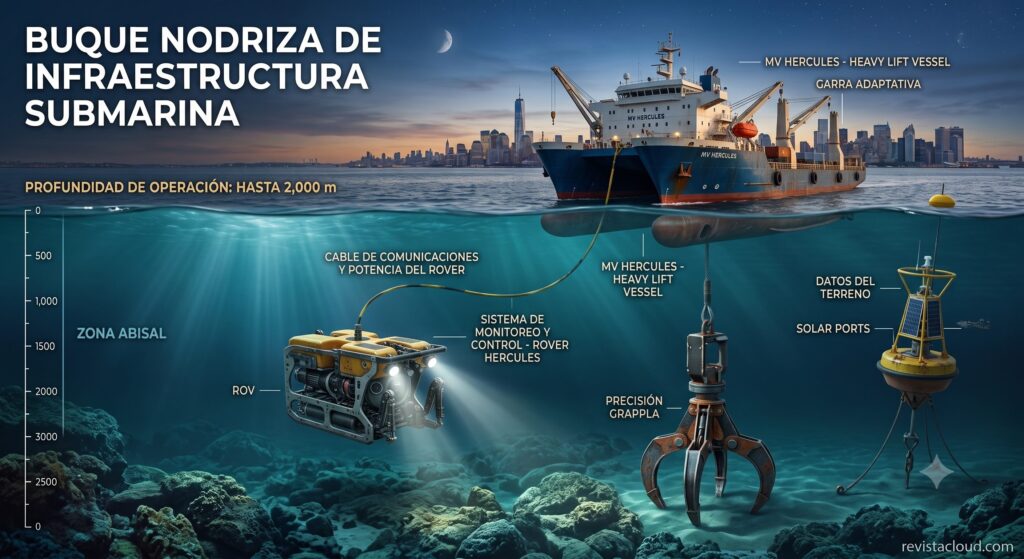
Repairing a submarine cable requires a very different process than fiber optic repairs on land. It involves precisely locating the fault, mobilizing a cable-laying vessel, obtaining permits, operating under suitable maritime conditions, retrieving the cable, splicing, testing, and reactivating the line. It’s not an immediate intervention.
Gabriel Salas noted on LinkedIn that, according to estimates from specialists in this type of repair, the work could take about 15 days once the vessel reaches the fault site—though the necessary permits may not yet be fully obtained at the time of his comment. This window explains why international recovery can lag behind local restoration.
In the meantime, a progressive but uneven improvement is to be expected. Some operators may perform better than others depending on their exposure to Cirion, their backup capacity, agreements with carriers, connectivity to Colombia, or the use of temporary satellite solutions. User experience will likely vary.
The lesson: internet also needs emergency planning
The connectivity crisis in Caracas offers a clear lesson for any country: internet isn’t an abstract cloud. It depends on energy, fiber, submarine cables, terrestrial routes, permits, data centers, trade agreements, towers, equipment, technical staff, and response capacity.
When multiple layers fail simultaneously, resilience is measured in decisions made before the emergency: how many routes exist, what backup capacity was contracted, which operators have true diversity, where the interconnection points are, what energy autonomy nodes have, and what regulatory procedures enable activation of alternative solutions without days of delay.
Caracas appears to have made significant progress in restoring local and national connectivity. The weak point remains international exit and some operators’ ability to absorb the temporary loss of a key route. Restoring Cirion’s submarine cable will be a central part of normalization, but the deeper issue extends beyond a single incident.
The key question isn’t just when everything will return to normal, but how redundant normalcy was before the earthquake.
Frequently Asked Questions
Is internet already restored in Caracas?
Local and national connectivity has notably improved, according to technical analyses shared by operators and sector professionals. International exit remains the most fragile part.
What caused the initial connectivity outage?
A combination of power outages, damages to telecom infrastructure, and the rupture of a Cirion submarine cable following the June 24 earthquakes.
Does the Cirion cable rupture affect the entire country equally?
Not necessarily. It impacts more those operators relying solely on that route without sufficient redundancy. Venezuela has other cable landings and alternative routes.
Why does repairing a submarine cable take so long?
Because it requires permits, a specialized vessel, precise fault location, cable retrieval, splicing, testing, and operational conditions.
What temporary solutions are being used?
Alternative routes have been activated, satellite links deployed in critical zones, and expedited procedures established for terrestrial connections with Colombian operators.
via: LinkedIn
