
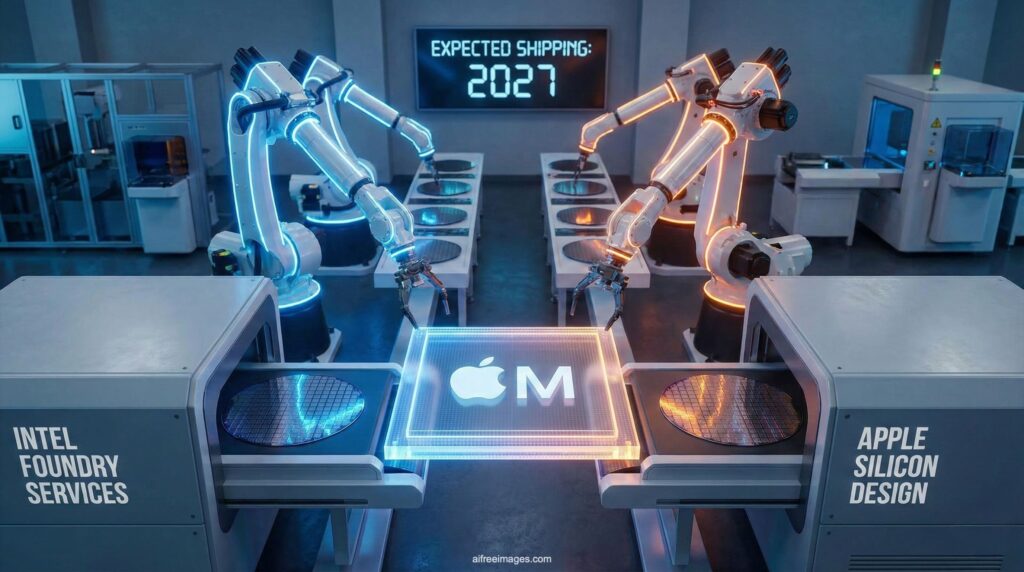
Intel could finally become Apple’s second major provider of advanced chips. According to the latest industry surveys, the Santa Clara-based company is increasingly close to beginning manufacturing Apple’s lower-tier M processor—currently powering mainly MacBook Airs and some iPad Pro models—using its advanced 18AP node, with a tentative schedule between the second and third quarter of 2027.
This isn’t just a recurring rumor. Apple has reportedly already signed an NDA with Intel and has in its possession the 0.9.1GA PDK (Process Design Kit) for the 18AP node. Initial simulation exercises and PPA (performance, power, area) testing are meeting Cupertino’s expectations, which now expects the release of PDK versions 1.0/1.1, scheduled for the first quarter of 2026. From that point, the final design and validation phase would be unlocked.
What chip would Intel manufacture… and in what volume
The affected processor would be the entry-level Apple M, meaning the chip used in:
- MacBook Air
- Basic range iPad Pro (depending on the generation in use at the time)
For 2025, joint shipment estimates for these devices total around 20 million units. However, it is expected that in 2026, part of that demand will shift to a more affordable new MacBook based on a “iPhone-class” SoC, which would keep the low-end M sales in the range of 15–20 million units annually for both 2026 and 2027.
In absolute terms, these volumes are not massive compared to TSMC’s overall business, which will continue to produce the vast majority of Apple’s chips. For the Taiwanese foundry, the direct financial impact is limited and does not alter its short-term technological leadership. But the move sends several important signals.
What Apple gains: a second source and a “Made in USA” gesture
For Apple, working with Intel Foundry Services on advanced nodes has two key implications:
- Real second source for cutting-edge processes
While TSMC remains the main pillar for Apple chips (A-series for iPhone and high/mid-range M-series), the company needs to reduce geopolitical and operational risks. Having a second foundry capable of manufacturing on an advanced node:- Adds resilience to the supply chain.
- Provides more flexibility in timing and capacity negotiations.
- Reduces dependence on a single region (Taiwan) in an increasingly tense geopolitical environment.
- Alignment with the US manufacturing agenda
The agreement fits with political pressure to bring more advanced manufacturing stateside and reinforce technological sovereignty. Having part of Apple’s chips manufactured in the US is a powerful message, both to Washington and to global markets.
In summary, Apple would continue to be a “key customer” for TSMC but would begin genuinely diversifying the most sensitive part of its supply chain.
What Intel gains: much more than just revenue
For Intel, securing Apple’s trust to produce an M family chip on an advanced node is a huge boost for its foundry business:
- Prestigious technical validation
Apple is among the world’s most demanding semiconductor design clients. If they choose to hybridize part of their M line at Intel, it indicates that the 18AP node is competitive in PPA for that segment. - Reputational boost for Intel Foundry Services (IFS)
Although the direct volume won’t rival TSMC’s, the visibility effect is significant. This contract could open doors to other top-tier clients who may have doubted Intel’s future as a foundry. - Pathway to future nodes (14A and beyond)
If the basic M experiment proves successful, nothing prevents Intel from targeting:- Other Apple chips on future nodes like 14A.
- Custom designs for major cloud and AI customers seeking alternatives to TSMC and Samsung.
The underlying takeaway: the worst for Intel’s foundry business may be passing, and this contract signals a cycle shift.
Is this a problem for TSMC?
Short term, not really.
- The entry-level M chip is just a fraction of Apple’s portfolio.
- The majority of high-margin products (iPhone SoCs, M Pro/Max/Ultra, AR/VR chips, etc.) will remain with TSMC for years.
- The estimated volume of 15–20 million units annually is manageable and doesn’t alter the overall capacity or revenue picture for Taiwanese foundry.
However, the strategic message is important:
- Apple demonstrates willingness to diversify risk across multiple manufacturers.
- Intel gains a foothold to capture more orders as its nodes mature.
- The “TSMC as sole advanced partner” model no longer has to be an unbreakable dogma.
What could happen after 2027
If everything proceeds according to industry timelines:
- In 2026, Apple should finalize the design of the entry-level M chip on the 18AP node, using Intel’s PDK 1.0/1.1.
- Between 2nd and 3rd quarter of 2027, Intel would begin shipping the first commercial batches of that chip.
- If yield, power, and temperature performance are solid, Intel could:
- Scale volumes.
- Position itself as a real option for future Apple designs and other major clients.
Conversely, if the node doesn’t meet expectations, Apple can always continue relying on TSMC as its main supplier for this segment and keep the experiment as a more symbolic gesture.
Frequently Asked Questions
What node will Intel use to manufacture Apple’s entry-level M chip?
Current plans point to the advanced 18AP node, for which Apple already has a PDK 0.9.1 and expects versions 1.0/1.1 in 2026. The final chip design would be finalized after that.
Does this move replace TSMC as Apple’s main supplier?
No. TSMC will continue producing most of Apple’s SoCs, especially high-end and iPhone chips. Intel would serve as second source for the most basic M processor, with volumes around 15–20 million units per year.
Why does Apple want a second manufacturer for its M chips?
Primarily for risk management and supply chain resilience. Diversifying foundries reduces geopolitical exposure, improves bargaining power, and aligns with political pressures to increase advanced manufacturing in the US.
What does this mean for the future of Intel Foundry Services (IFS)?
If confirmed and executed well, this contract with Apple would be a key validation of Intel’s capabilities as an advanced foundry. It won’t solve all its challenges on its own but can attract more top-tier clients and build confidence in future nodes like 14A and beyond.