
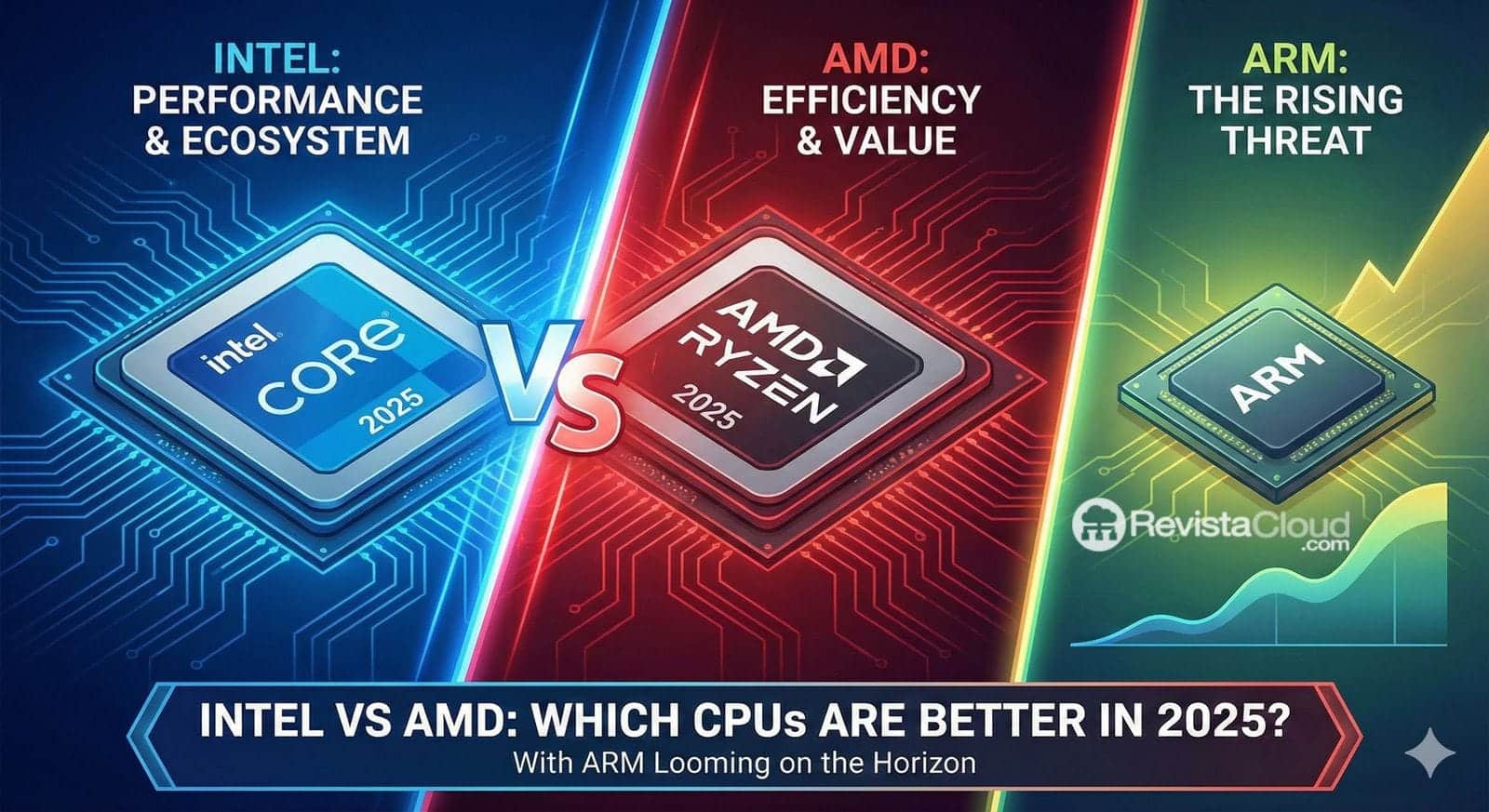
For years, the question “Intel or AMD?” was answered almost out of habit: one or the other brand, depending on the current offers and the type of PC. In 2025, that comparison remains relevant, but it has become more complex for a very specific reason: the shift in the market towards energy efficiency and “AI computing” (with integrated NPUs) is opening a huge door for ARM-based chips, both in laptops and data centers.
The result is a three-way scenario: Intel and AMD compete with x86 in desktops, laptops, and servers, while ARM gains ground where power consumption, autonomy, and cost per watt matter more than ever.
The essentials: Intel and AMD still the “safe choice” in x86
In 2025, Intel and AMD continue to dominate the traditional PC ecosystem for a practical reason: complete compatibility. If a user (or a sysadmin) needs everything to work without surprises — drivers, hypervisors, legacy utilities, professional software, anti-cheat games — x86 remains the de facto standard.
Intel has heavily pushed its transition to “Core Ultra” series and hybrid architectures (performance + efficiency cores), especially focusing on laptops and integrating acceleration for modern tasks. The company has also refined its desktop platform with updates oriented toward stability, sustained performance, and power adjustments—shifting away from merely “winning benchmarks”.
AMD, for its part, has solidified its narrative around efficiency, multi-core performance, and a familiar strategy: chiplets, good performance per watt, and ongoing evolution of Ryzen and EPYC. In gaming, its family with 3D V-Cache (X3D) has become a recurring reference when the goal is to maximize FPS with low latencies.
Quick table: what’s best based on usage (2025)
| Scenario | What weighs more | Intel (x86) | AMD (x86) | ARM (various manufacturers) |
|---|---|---|---|---|
| Desktop gaming PC | FPS, compatibility, drivers | Very competitive; solid choice | Very strong (especially X3D) | Seldom the best option |
| Workstation (editing, 3D, compilation) | Multi-core, stability, RAM | Good options; depends on software | Very competitive in cores/efficiency | Still uneven depending on apps and plugins |
| Budget laptop (office + dev) | Battery life, temperature, sustained performance | Significant efficiency gains in modern mobile lines | Good balance of performance and power | Growing the most (if software supports it) |
| Servers and cloud | Total cost, density, vatio/performance | Very present in enterprise | Very strong in density and efficiency | Growing fast (Graviton/Ampere/Grace) |
| Homelab / virtualization | IOMMU, drivers, hypervisors, support | Excellent compatibility | Excellent compatibility | Possible, but highly dependent on stack |
The 2025 shift: ARM makes a strong move (and is no longer “just mobile”)
ARM is not “a specific CPU”: it’s an architecture. And what’s changing the game is that increasingly, different designers are using ARM to build very powerful chips with a clear goal: high performance with low power consumption.
1) Laptops: Windows on ARM improves (and emulation is no longer a joke)
The historical main obstacle for ARM in PCs was compatibility. In 2025, that still matters, but the outlook is improving thanks to ecosystem maturity and advances in emulating x86/x64 applications on Windows. This improvement doesn’t make ARM “perfect,” but it does make it viable as a primary laptop for some market segments, especially if the user relies on familiar tools and up-to-date software.
2) “AI PCs”: the NPU as a selling point (and technical factor)
The explosion of “AI-ready” laptops pushes the comparison beyond CPU/GPU, including the NPU (dedicated accelerator for local AI tasks). Here, new ARM platforms have entered the market with momentum, with performance figures for NPUs becoming part of product messaging.
3) Data centers: ARM is now a strategy, not a test
In servers, ARM has been growing for years, but by 2025 there are clear signs of maturity:
- AWS continues expanding availability and deployment of Graviton4 instances, targeting everything from microservices to ML inference CPU, promising performance improvements over previous generations.
- Ampere is pushing ARM CPUs for data centers with high-core-count designs focused on density and efficiency.
- NVIDIA has strengthened its “CPU + GPU” message in AI and HPC platforms, with Grace (ARM) as part of its infrastructure strategy.
For many infrastructure teams, this boils down to a simple idea: if your workload is scalable, modern, and controlled (cloud-native, microservices, frontends, CPU inference, CI/CD, etc.), ARM can be very competitive in cost and performance. If your workload depends heavily on legacy dependencies, proprietary modules, or software with strict requirements, x86 typically remains the path of least resistance.
Comparison table: x86 vs ARM (what really changes)
| Factor | x86 (Intel/AMD) | ARM (ecosystem) |
|---|---|---|
| Robust compatibility | Very high in PC/server | Improving but variable depending on software |
| Performance per watt | Highly competitive (especially recent mobile) | Traditionally strong; key in laptops/servers |
| Platform variety | Huge (motherboards, chipsets, drivers, BIOS/UEFI) | More concentrated by manufacturer/model |
| Virtualization and homelab | 成熟、可预料的生态系统 | Can perform very well but depends heavily on stack |
| Data centers | Enterprise standard | Rapid growth (cloud and specific providers) |
| Operational risk | Low (the “known”) | Medium (depends on software and support) |
So… what’s “better” in 2025?
By 2025, the real answer is that there is no universal winner:
- Intel vs AMD remains a choice mainly driven by use case, price, and platform, with x86 as the safe bet for compatibility.
- ARM is no longer a secondary actor: in laptops (especially for battery life and efficiency) and in servers (for density and operational cost), it’s steadily gaining ground, and software support is increasing.
The sensible decision, especially for technical profiles, looks more like this:
- If you need full compatibility, surprise-free drivers, and the most mature ecosystem: x86.
- If your priority is autonomy/efficiency or a controlled, modern workload (and you can verify compatibility): ARM deserves a spot on the shortlist.