
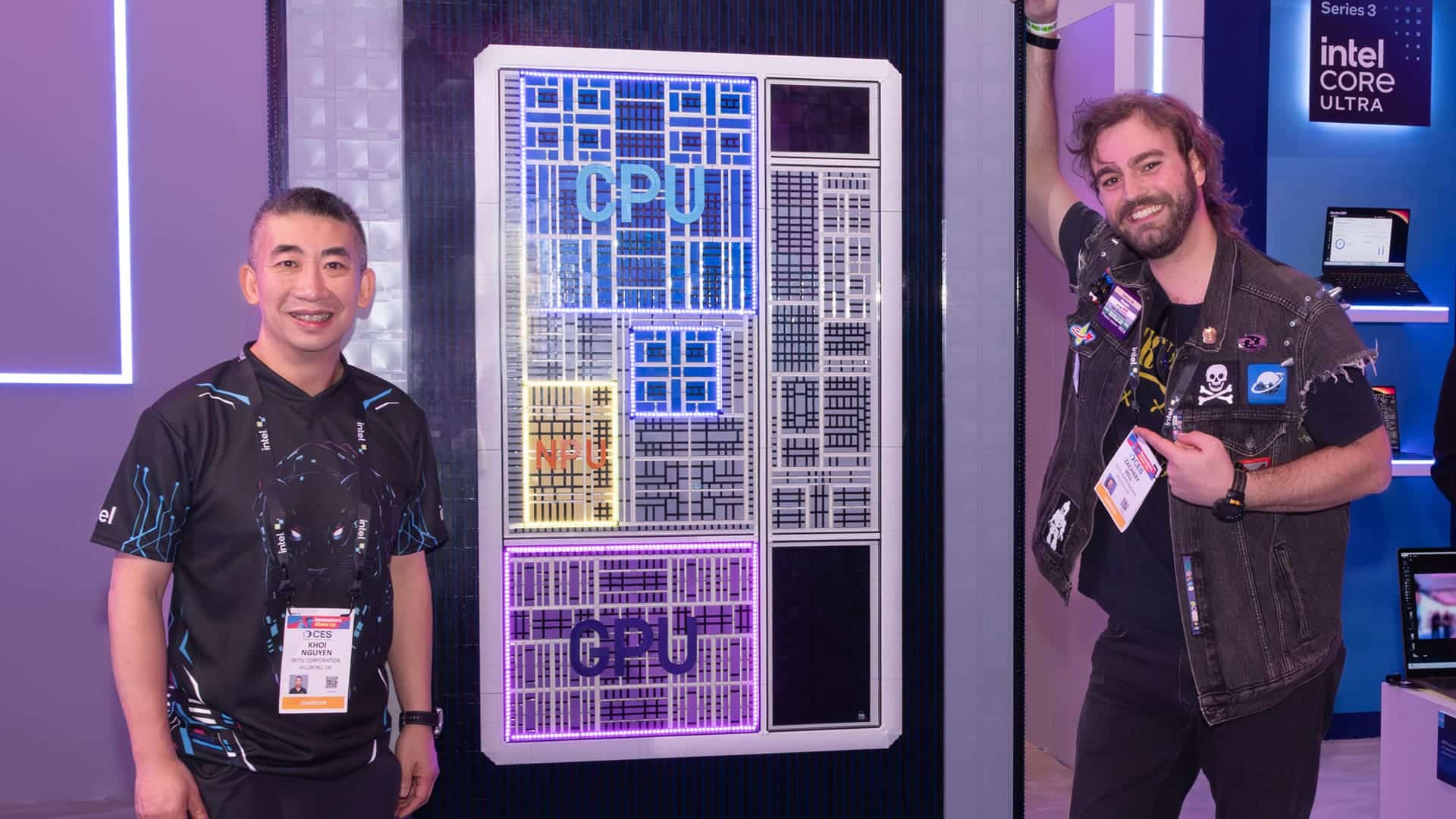
At CES 2026, dominated by the battle of “AI-infused PCs,” Intel has found an unexpected way to attract attention: not with a futuristic prototype, but with an artistic installation made of 42,000 LEGO pieces that recreates a large-scale Intel Core Ultra Series 3 (codenamed Panther Lake). The result — as gigantic as it is photogenic — has become one of those fairground magnets that draws crowds, phones held high, and the inevitable selfie.
The piece isn’t just a “decoration”: it lights up and simulates internal activity with the help of more than 600 LEDs and a hidden electronics network beneath the bricks. Intel explains that the model turns on specific areas — CPU, NPU, and GPU — based on what Windows Task Manager displays, as if the chip comes to life in real time.
A giant model that “pulses” with PC usage
The story behind the assembly has an almost handcrafted vibe. The project was led by Khoi Nguyen, who recruited Zach Hill (a former Intel intern and member of the graphics technical marketing team, as well as a LEGO enthusiast). Hill designed the 3D model using Bricklink Studio, then faced the hard part: assembling it and turning it into a functional installation.
The size explains why the work wasn’t exactly “desk-sized.” Intel details that once assembled, the model measures about 8 feet tall by 4 feet wide (2.4 m x 1.2 m), so much so that the display had to move spaces as it grew.
The final stretch was especially intense: Nguyen recounts a marathon of days integrating lighting and wiring to ensure each LED responded as intended.
The geeky detail: OpenVINO to read Task Manager
The most striking aspect isn’t just that it lights up, but how it does so. According to Intel, the software managing the installation — attributed to another team member, Michael Larsen — found a way to represent NPU usage using Intel’s OpenVINO. It analyzes the Task Manager data to extract utilization percentages, which then translate into signals for the LEDs.
In plain English: the “LEGO processor” isn’t just lighting up for show. It’s telling a story that Intel repeats at every booth and keynote: that the modern PC is no longer just about the CPU, and that the NPU (the AI acceleration unit) is starting to take a starring role alongside the GPU and traditional processor.
Why is Intel doing this now?
This display arrives at a very specific moment. At CES 2026, Intel introduced the Core Ultra Series 3 as its first platform built on Intel 18A, marking a significant step in its narrative of efficiency, integrated graphics, and AI capabilities in laptops, with a wave of devices from multiple manufacturers.
In this context, a spectacular installation functions as a visual “anchor”: it turns something abstract (silicon, nodes, IP blocks, NPU TOPS…) into a giant object that anyone can understand without semiconductor expertise. It’s less cold marketing, more tangible. And above all, designed for what rules any fair today: getting people to share it.
Not its first rodeo: from Arc A750 to Panther Lake
Hill already has a history in this arena. Intel recalls that in 2023, he designed a build inspired by the Intel Arc A750, which drew attention for including moving parts and creative solutions. PC Gamer even described that creation as a notable engineering piece, mentioning elements like “rotating” fans made from LEGO parts.
The leap from a GPU to a giant “processor” aligns with an idea Hill articulates clearly: just like LEGO bricks individually aren’t much, the chip’s components “come to life” when organized intentionally. Intel uses this as a perfect metaphor to sell complexity without confusing the audience.
Frequently Asked Questions
What is Intel 18A, and why is it so talked about at CES 2026?
It’s the name of the manufacturing process Intel is using for its Core Ultra Series 3 platform. The company considers it a strategic milestone, as it aims to boost its competitiveness in advanced manufacturing and AI-enabled products for the PC era.
What is an NPU, and what’s its role in a laptop?
An NPU is a dedicated accelerator for AI tasks (such as certain effects in video calls, productivity features, or workloads that benefit from local execution). Intel emphasizes that part of everyday AI will be handled directly on the device, not just in the cloud.
Does the model truly “react” to what the PC is doing?
According to Intel, yes: the lighting of different areas on the model is driven by metrics from Windows Task Manager, with a system that uses OpenVINO to extract data and translate it into lighting patterns.
via: newsroom.intel