
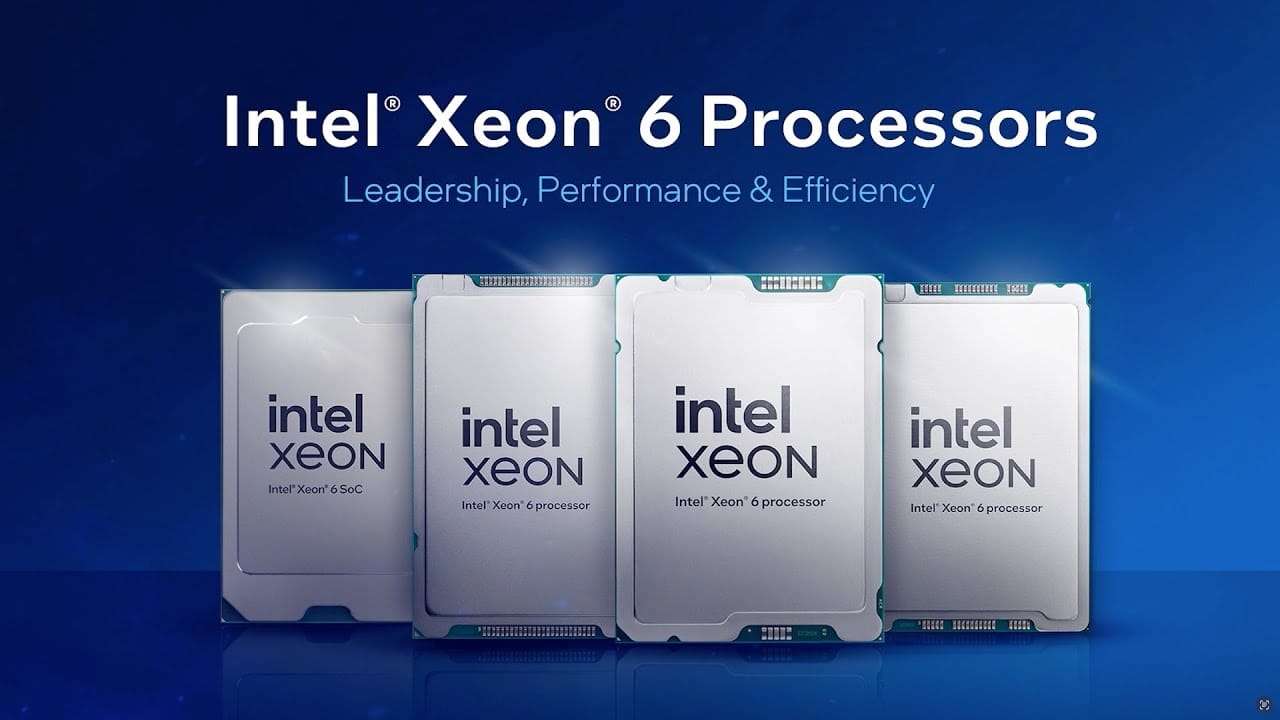
Intel has announced a new family of processors for workstations—the Intel Xeon 600 for Client Workstation— with a clear message: professional “iron” is once again growing in cores, memory bandwidth, and connectivity, precisely when workloads in data science, AI development, engineering simulation, visualization, and multimedia creation demand more resources than a conventional PC.
The launch is accompanied by a comprehensive platform update based on the Intel W890 chipset, designed for the high-end segment. The company emphasizes four key improvements: more cores, more PCIe lanes, support for faster memory, and a promise of greater energy efficiency compared to the previous generation. In terms of positioning, Intel aims to address the rise of highly parallelizable workloads (rendering, compiling, simulation) and the proliferation of configurations with multiple GPUs, accelerators, and high-performance NVMe storage.
Up to 86 “P-cores” and a connectivity leap for multi-GPU setups
The most striking detail is the ceiling of up to 86 performance cores (P-cores) with turbo speeds of up to 4.8 GHz in the Xeon 600 workstation processors. Intel complements the announcement with its typical marketing figures for this segment: internally, it claims up to 9% more single-thread performance and up to 61% more multi-threaded performance versus the previous generation, maintaining similar power consumption targets in the top-tier model (86 cores) compared to a previous one with 64 cores. The company attributes the improvements mainly to increased core count and platform enhancements. It’s important to note these metrics are measured using specific tests (Cinebench 2026) and may vary depending on configuration.
Where this offering becomes particularly attractive for professional environments is in I/O: up to 128 PCIe 5.0 lanes from the CPU, designed to support workstations with multiple graphics cards, high-performance network cards, and multiple NVMe SSDs without bottlenecks. Practically, this level of connectivity enables designing workstations that don’t run out of “lanes” when integrating AI GPUs, fast storage for datasets, and high-bandwidth networks for project transfers or render farms.
Memory: from speed to stability (and the leap to MRDIMM)
Another key aspect of the announcement is memory. Intel highlights support for up to eight channels of DDR5 RDIMM with speeds of up to 6,400 MT/s (up from 4,800 MT/s in the previous platform, according to the company). Additionally, it introduces compatibility with DDR5 MRDIMM in workstations, with speeds reaching 8,000 MT/s, offering a way to boost performance for memory-bound workloads where bandwidth and latency are critical as much as cores.
This also includes continuity of elements that are almost as important as benchmarks in professional contexts: ECC and RAS technologies for data integrity and system reliability. In sectors like engineering, finance, simulation, or audiovisual production with long projects, stability isn’t just an “extra”—it’s a necessity.
AMX with FP16: Intel’s move in AI within the CPU
Intel also aims to distinguish itself in AI directly from the processor. The Xeon 600 series for workstations adds support for FP16 in Intel AMX (Advanced Matrix Extensions), designed to accelerate training and inference in certain workflows. In its communications, Intel reports up to a 17% improvement in AI and machine learning workloads versus the previous generation, measured with SPECworkstation 4.0 AI & Machine Learning, always noting that performance depends on software, configuration, and scenario.
This is particularly relevant because not all AI tasks are exclusively GPU-based. Many companies perform parts of their workflow—preprocessing, certain inferences, prototyping, proof-of-concept tests—on the CPU, especially when aiming to keep data local for reasons of cost, latency, or privacy.
Fine-tuning and overclocking: HWBOT records as a showcase
The announcement also appeals to enthusiast-professional markets: Intel claims the platform sets “a new standard” in overclocking for workstations, with advanced tuning options (telemetry and limitations by core/chiplet, voltage protection and reporting, mesh tuning, AVX2/AVX-512, Turbo Boost, etc.).
As a highlight, Intel states that, in collaboration with ASUS, it has achieved overclocking records with a Xeon 698X mounted on an ASUS Pro WS W890E-SAGE SE motherboard, recorded in HWBOT as of 02/02/2026, performing well in benchmarks like Geekbench multi-core, multiple runs of Y-Cruncher, and CPU-focused 3DMark tests. It also mentions “global first places” in Cinebench (various versions), 7-Zip, or Geekbench 6 multi-core, among others. As always in this domain, Intel cautions that changing frequency or voltage can impact warranty, stability, and component lifespan, and recommends verifying conditions with manufacturers.
Availability: late March and “boxed” models for individual purchase
Intel has indicated that the Xeon 600 for workstations will be available through OEMs and system integrators, and also as boxed processors for individual purchase by late March 2026. In the boxed format, the company lists the following models:
- Xeon 696X (64 cores)
- Xeon 678X (48 cores)
- Xeon 676X (32 cores)
- Xeon 658X (24 cores)
- Xeon 654 (18 cores)
Overall, this move suggests a dual strategy: enabling closed configurations (OEMs/SIs) for enterprise, while also appealing again to integrators and professionals who assemble customized workstations and want direct access to the processor.
Frequently Asked Questions
What advantages does having 128 PCIe 5.0 lanes in a workstation provide?
It allows mounting multiple GPUs, high-performance NVMe SSDs, and fast network cards without sharing lanes aggressively, reducing bottlenecks in professional workflows.
What’s the difference between DDR5 RDIMM and DDR5 MRDIMM in workstations?
RDIMM prioritizes stability and capacity for professional environments. MRDIMM incorporates architecture that supports higher effective speeds (in this case, up to 8,000 MT/s), which can enhance memory-limited workloads.
What is the purpose of Intel AMX with FP16 in a workstation Xeon?
AMX is a matrix accelerator integrated into the CPU. Support for FP16 aims to boost performance in AI/ML tasks (training and inference) when the software is optimized to leverage it.
When will the Xeon 600 series for workstations be available, and which models will be sold in boxed versions?
Intel expects availability in OEM/SI channels and boxed processors by late March 2026. The boxed models listed are Xeon 696X, 678X, 676X, 658X, and 654.
via: newsroom.intel