
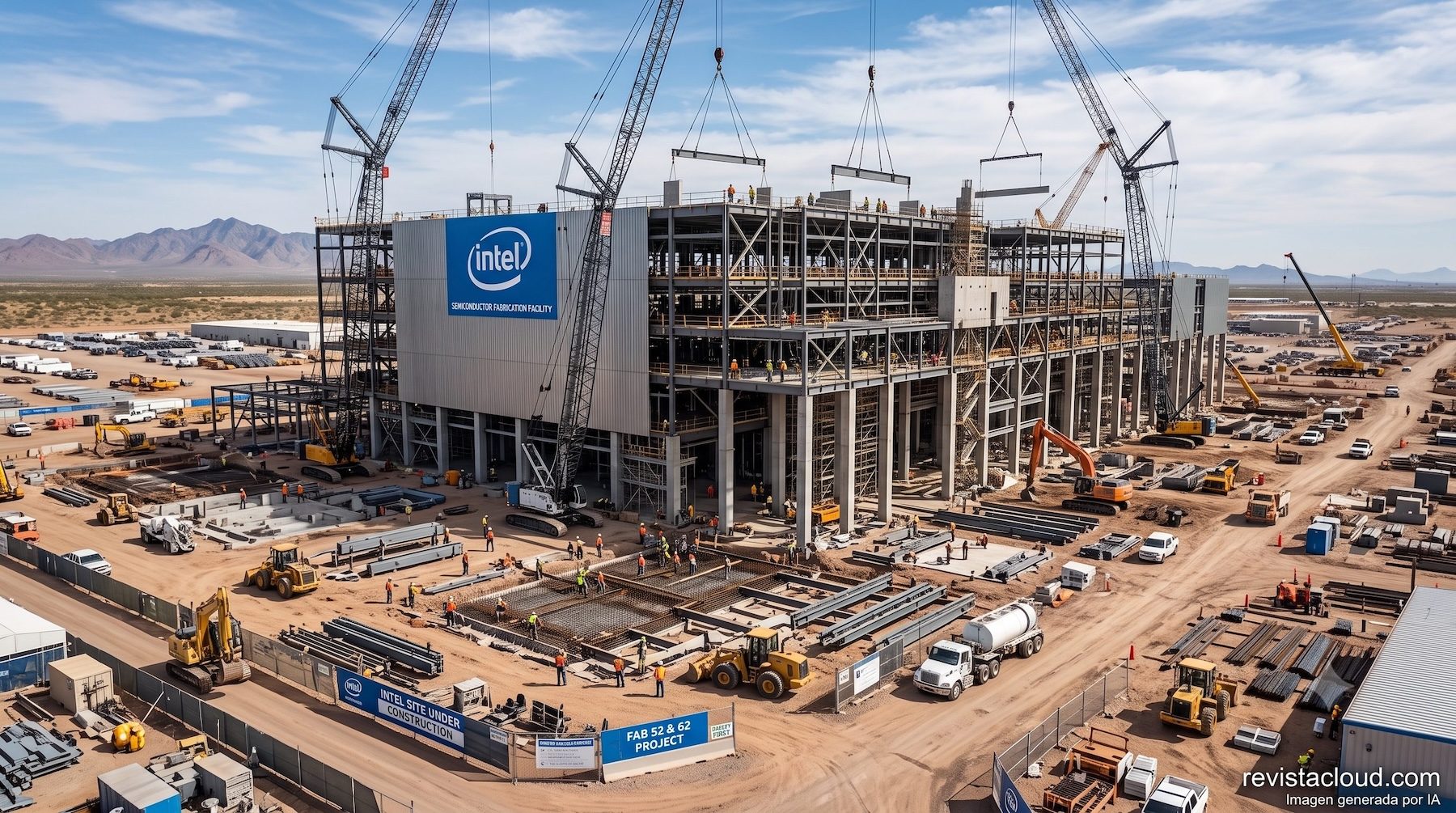
Intel may have started offering bonuses linked to overtime hours for workers involved in the construction of Ohio One, its large semiconductor manufacturing complex in New Albany. The measure, disseminated through an internal project communication and not yet publicly confirmed by the company, aims to accelerate the pace of work after several years of delays. The first module is not expected to start operations until 2030 or 2031, compared to the initial target of 2025.
The key points of Intel’s acceleration in Ohio in 30 seconds
- A document circulated from Ohio One indicates immediate incentives for those working overtime, although Intel has not publicly detailed the program.
- The campus initially includes two factories and a investment exceeding $28 billion.
- Module 1 is scheduled to finish in 2030 and begin operations between 2030 and 2031; Module 2 would start in 2032.
- The project has accumulated over 10 million hours of construction.
- Advances attributed to EMIB-T are promising but are not directly related to Ohio factories.
The information about bonuses comes from an August 1, 2026, publication by Wccftech, based on a notice allegedly distributed among project workers. The amounts, exact conditions, and duration of the incentives have not been published. Also, there is currently no statement from Intel or Bechtel, the main contractor, confirming that the program constitutes an official revision of the schedule.
The nuance matters. Paying more overtime can speed up certain phases, recover partial delays, or respond to a specific labor need, but it does not mean a chip factory could come online several years earlier. A project of this scale depends on building structure, clean rooms, machinery installation, gas and chemical systems, substations, technical validation, and the availability of specialized personnel.
Ohio One advances, but remains far from the original schedule
Intel announced Ohio One in January 2022 as the core of a future U.S. high-tech manufacturing hub. The initial land spans nearly 1,000 acres, about 405 hectares, in Licking County, northeast of Columbus. The first phase includes two manufacturing modules and an investment of over $28 billion. The space would allow for future expansion if demand and financial conditions justify new factories.
At the project’s presentation, Intel hoped to start production around 2025. The company later delayed the schedule and, in February 2025, set much more cautious dates:
- Module 1: construction completed by 2030 and operations between 2030 and 2031.
- Module 2: completed by 2031 and operational in 2032.
Intel explained that it would maintain a slower pace of work to align investments with its financial capacity and actual customer demand. It also left open the possibility of acceleration if market conditions justify it.
Bonuses for overtime hours fit with this flexibility, although they do not by themselves prove that the company has advanced the opening date. Ohio One remains a long-term investment rather than an immediate response to current AI chip demand.
In 2025, Intel invested approximately $1.4 billion in Ohio. The company states that workers from 83 out of 88 counties in the state participated in construction and that the project has surpassed 10 million hours of work. Early 2026 saw hundreds of professionals working on-site, while Bechtel continued hiring for various specialties.
The first phase is expected to create about 7,000 construction jobs, 3,000 direct positions at Intel, and approximately 10,000 indirect jobs, according to initial estimates. These figures refer to the complete deployment of the first two modules and do not include personnel currently working simultaneously.
Why Intel might want to accelerate now
Intel’s situation has changed since it decided to slow down Ohio One. The company aims to strengthen Intel Foundry, attract external clients, and demonstrate competitiveness in advanced processes and packaging against TSMC and Samsung.
Meanwhile, the U.S. seeks to boost domestic semiconductor manufacturing and reduce dependency on Asia. The Department of Commerce allocated up to $7.865 billion in direct funding to Intel through the CHIPS program, intended for projects in Arizona, New Mexico, Ohio, and Oregon. The Ohio-related portion is disbursed as construction milestones and other agreed conditions are met.
Artificial intelligence adds pressure but should not be used as the sole explanation. Demand for accelerators, data center CPUs, and advanced packaging could improve prospects for Intel Foundry, but Ohio One will still take years to become operational. By then, processes, products, and customers will likely differ from the 2022 plans.
It remains uncertain what technology the campus will ultimately produce. Ohio has been linked to future generations like Intel 14A, but the company has not publicly confirmed final product assignments for the two modules. As Intel adapts factories to demand and process node evolutions, presenting a specific, secure technology today would be premature.
EMIB-T advances but should not be confused with Ohio One
The news about construction coincides with new estimates related to EMIB-T, an evolution of Intel’s advanced packaging technology. Both pieces of information relate to Intel Foundry but describe separate projects.
EMIB, standing for Embedded Multi-die Interconnect Bridge, uses tiny silicon bridges embedded in the substrate to connect different chiplets. Unlike a large interposer placed beneath the entire assembly, this design concentrates high-density connections where needed.
EMIB-T incorporates through-silicon vias (TSVs) within the bridge. These vertical interconnects can improve power distribution and facilitate more complex designs with logic, high-bandwidth memory, and integrated components.
Analyst Ming-Chi Kuo estimated that EMIB-T’s tech validation performance is near 90%. While promising, this figure is not from an official Intel statement and does not represent the performance of a full commercial line.
Comparing this 90% to a hypothetical 98% universal target can be misleading. Acceptable performance depends on factors like size, complexity, cost, validation phase, and measurement methods. No single percentage alone determines readiness for mass production.
Kuo also highlighted that substrates associated with EMIB-T remain a challenge, with yields estimated to be much lower than the bridges themselves. No confirmation has been provided by involved manufacturers. In advanced packaging, the final outcome depends on the entire ensemble: silicon bridges, substrate, assembly, memory, testing, and materials. Good performance of one element does not guarantee large-scale, cost-effective production.
Therefore, the progress of EMIB-T does not directly explain bonuses at Ohio One. The encapsulation technology develops through Intel’s global manufacturing network, whereas Ohio One is a wafer manufacturing campus expected to open next decade.
Speeding up a factory isn’t just about working longer hours
Overtime can help complete specific phases, but building an advanced factory requires coordinating thousands of tasks. After erecting the structure, there’s the installation of clean rooms, high-purity piping, vacuum systems, gases, ultrapure water, vibration control, and lithography equipment—all of which can take months to set up and calibrate.
Commissioning doesn’t start when the building is finished. Intel must install tools, produce test wafers, validate processes, and gradually ramp up performance before shipping commercial chips. The time from completion to stable production can be substantial.
What’s happening now should be seen as a sign of activity, not as confirmation that Ohio One will recover the five-year delay compared to the original plan. Intel publicly maintains the completion of the first module between 2030 and 2031 and the second in 2032.
The key is that the company appears willing to increase effort on a project it had slowed for financial reasons. If this acceleration is sustained, the strongest indicators of progress will not be overtime hours alone but an official schedule revision, sustained staffing increases, new milestones, and installation of initial manufacturing equipment.
Frequently Asked Questions
Has Intel confirmed bonuses for overtime hours in Ohio?
Not through a public statement. The information comes from an alleged internal notice circulated within the project. The amounts and duration are unknown.
When will Ohio One start chip production?
Intel plans to complete Module 1 by 2030 and begin operations between 2030 and 2031. Module 2 should be finished in 2031 and operate in 2032.
How much will Intel invest in Ohio’s factories?
The initial phase involves over $28 billion for two factories. The land allows future expansions, but these will depend on demand and new investment decisions.
What is the relationship between EMIB-T and Ohio One?
Both are part of Intel’s industrial strategy, but they are separate projects. EMIB-T is an advanced packaging technology, while Ohio One is a semiconductor wafer fabrication campus. Intel has not publicly linked bonuses from the construction with EMIB-T advancements.
