
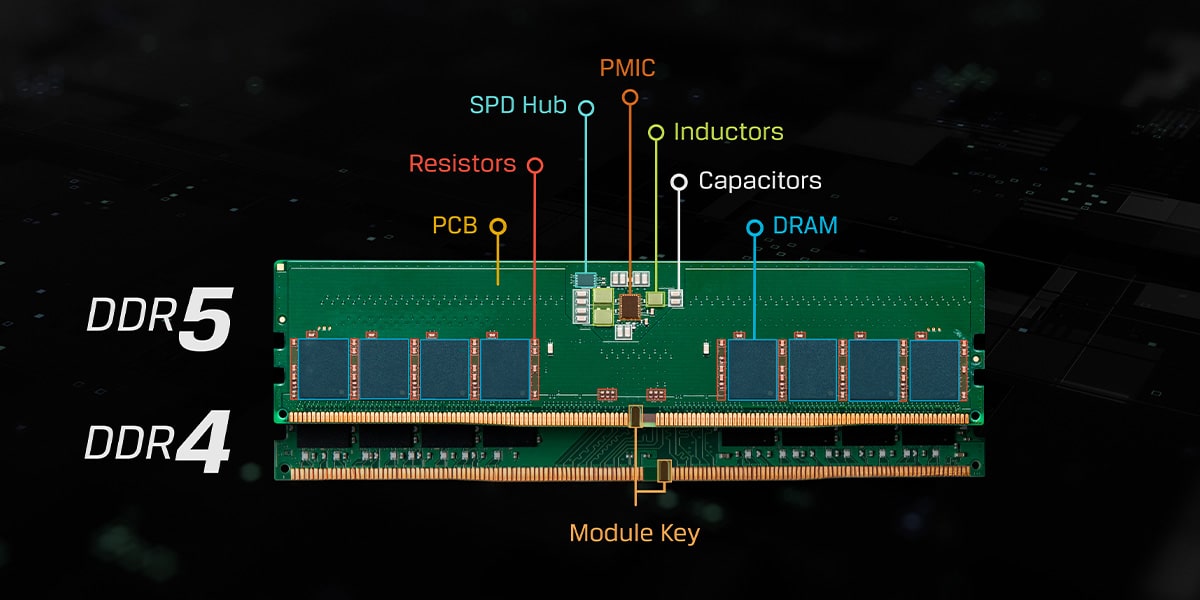
The pressure on memory is pushing the market toward solutions that until recently seemed reserved for niche technical applications. DDR5-SC1, a variant of DDR5 modules with a single active 32-bit subchannel, fits precisely into this context: it allows for the manufacturing of cheaper, lower-capacity modules, but directly cuts the available bandwidth. For some basic systems, this may make sense. For demanding gaming, integrated graphics, CPU AI, or AMD AM5 platforms, the story is quite different.
A paper authored by Chih-Hua Ke, from GIGABYTE’s Product Performance Research division, analyzes this architecture in detail and provides figures that help distinguish marketing from actual savings and performance. The concept isn’t entirely new electrically: single-subchannel configurations have been used since Alder Lake in extreme overclocking to break DDR5 frequency records. What’s new is the potential volume production of these modules to lower PC costs amidst the current DRAM price pressures.
What is DDR5-SC1 Really?
Conventional DDR5 splits each 64-bit channel into two independent 32-bit subchannels. This was a major innovation over DDR4: more internal parallelism, improved access scheduling, and finer granularity aligned with modern cache lines.
DDR5-SC1 halves this structure. Instead of populating both subchannels on the module, it uses only one. Practically, this results in a 32-bit module instead of 64 bits. Using 16 Gbit chips, it allows for 8 GB modules with four DRAM dies, whereas a standard 16 GB DDR5 UDIMM requires eight dies.
The savings come from this design. Fewer chips, less circuitry, a potentially simpler PCB, and lower material costs. According to the analysis, the bill of materials reduction compared to standard DDR5 ranges between 35% and 45%, primarily driven by fewer chips. When demand for high-bandwidth memory like HBM and server DDR5 is stressing memory manufacturing, any cost-saving measure on basic systems could be attractive to OEMs and manufacturers.
However, this comes at the expense of bandwidth. A standard DDR5-5600 module reaches a peak of 44.8 GB/s per 64-bit channel. A DDR5-SC1 at the same speed drops to 22.4 GB/s. At DDR5-4800, its peak bandwidth is 19.2 GB/s, with an estimated effective bandwidth around 16 GB/s. For comparison, DDR4-3200 offers a peak of 25.6 GB/s and approximately 21 GB/s in effective bandwidth.
| Configuration | Speed | Bus | Peak Bandwidth | Approximate Effective Bandwidth |
|---|---|---|---|---|
| Standard DDR5 | 5600 MT/s | 64 bits | 44.8 GB/s | 38 GB/s |
| DDR5-SC1 | 5600 MT/s | 32 bits | 22.4 GB/s | 19 GB/s |
| DDR5-SC1 | 6400 MT/s | 32 bits | 25.6 GB/s | 22 GB/s |
| Standard DDR4 | 3200 MT/s | 64 bits | 25.6 GB/s | 21 GB/s |
The uncomfortable fact is that a DDR5-SC1 at 4800 MT/s can perform below a DDR4-3200 in sustained bandwidth. Even at 6400 MT/s, its peak bandwidth barely matches DDR4-3200. DDR5-SC1 is not “cheaper DDR5 with the same performance.” It’s medium-bandwidth DDR5 designed for cost savings in workloads where bandwidth isn’t the primary factor.
Gaming Performance: Bottleneck-Dependent Losses
The impact on gaming will vary. In GPU-limited scenarios, especially at high resolutions and demanding graphics settings, the loss may be moderate. The paper estimates drops of 5% to 12% compared to standard DDR5-5600. In such cases, the graphics card often dominates performance, and the system memory isn’t always the main factor.
Problems arise when games rely more heavily on the CPU or when aiming for very high FPS at low resolutions. Reduced memory bandwidth can cause estimated losses of 15% to 35%. The exact impact depends on the title, but for users building a PC targeting 240 Hz, eSports, or competitive gaming, DDR5-SC1 does not seem advisable.
It’s even worse with integrated graphics. An iGPU shares system memory, so any bandwidth reduction directly affects frame rates, frametime stability, and the ability to sustain loads at 1080p. The analysis estimates losses of 35% to 55% at 1080p or higher. This is particularly relevant since many budget, educational, or entry-level laptops and desktops rely on integrated graphics.
Performance also suffers in video transcodification, CPU AI, local large language models, and scientific simulations — tasks that are very bandwidth-dependent. In these scenarios, deficits could reach 40% to 60%, as they rely heavily on memory bandwidth.
| Workload | Bandwidth Sensitivity | Estimated Deficit vs. DDR5-5600 |
|---|---|---|
| Web browsing, office, productivity | Low | 2% to 8% |
| GPU-limited gaming | Low | 5% to 12% |
| CPU-limited gaming | Medium | 15% to 35% |
| Software development | Low to medium | 8% to 15% |
| x264/x265 transcoding | High | 30% to 50% |
| 1080p or higher iGPU | High | 35% to 55% |
| CPU IA / LLM | High | 40% to 60% |
| Kiosks, embedded, POS | Very low | Less than 3% |
Note that these figures are derived from an analytical model, not from a comprehensive set of commercial benchmark tests with final modules. The paper itself acknowledges this as a limitation. Actual results will depend on the CPU, motherboard, BIOS, speeds, timings, channel configurations, and specific applications.
Why Intel Has an Edge Over AMD AM5
The key difference lies in the memory controller. Recent Intel platforms feature the integrated memory controller (IMC) that treats each 32-bit subchannel as a separate domain. This allows the system to detect which subchannel is populated, skip training on the absent subchannel, and work with the active one. In this context, DDR5-SC1 is more manageable as a reduced configuration.
In AMD AM5 (Ryzen 7000 and Ryzen 9000), the situation differs. AMD’s unified memory controller (UMC) manages DDR5 as a single 64-bit logical entity. According to the analysis, when only half the module is populated, the training sequence may fail during POST due to incomplete line detection and the coordinated calibration mode for the 64-bit channel.
The paper doesn’t present this as a simple BIOS bug fix that manufacturers can quickly resolve. It discusses a fundamental limitation related to AM5’s memory training model. Future firmware updates like modifications to AGESA or dummy load tests could attempt to circumvent the issue, but this would require coordinated platform validation. Practically, AMD AM5 is outside the natural scope for these modules.
This gives Intel a potential advantage in budget systems. If manufacturers want to launch affordable PCs with 8 GB DDR5 modules during the ongoing memory shortage, DDR5-SC1 seems more feasible on Intel platforms than AMD AM5. Not because Intel automatically outperforms in real-world performance, but because its memory controller better handles this kind of reduced topology.
For end-users, the conclusion is clear. DDR5-SC1 may make sense for office, educational, thin client, kiosk, POS, or cost-sensitive systems where performance isn’t paramount. It’s not recommended for high-end gaming PCs, laptops with demanding iGPU workloads, workstations, local CPU AI, or any scenario where memory bandwidth is a bottleneck.
Cheap memory always has obvious appeal, especially when prices are rising. But the savings aren’t free. They come from physically halving the module — and when the bus is cut in half, bandwidth drops by half too. Intel might find a commercial opportunity with DDR5-SC1; buyers, however, must carefully evaluate what kind of system they’re purchasing.
Frequently Asked Questions
What is DDR5-SC1?
DDR5-SC1 is a DDR5 memory configuration with only one active 32-bit subchannel, instead of the two 32-bit subchannels that make up the typical 64-bit channel in a standard DDR5 module.
Why might it be cheaper?
Because it requires fewer DRAM chips and may simplify parts of the module design. Using 16 Gbit chips, it allows manufacturing 8 GB modules with four dies, compared to eight dies in a standard 16 GB DDR5 module.
Does it lose performance compared to normal DDR5?
Yes. The bandwidth roughly halves. For low-memory workloads, the loss can be minimal, but for iGPU, CPU AI, transcoding, or CPU-limited gaming, it can be significant.
Will it work with AMD Ryzen 7000 and Ryzen 9000?
According to GIGABYTE’s analysis, AMD’s AM5 platform isn’t naturally compatible with single-subchannel DDR5 modules due to its memory controller design. Recent Intel platforms appear more capable of supporting this configuration.
