
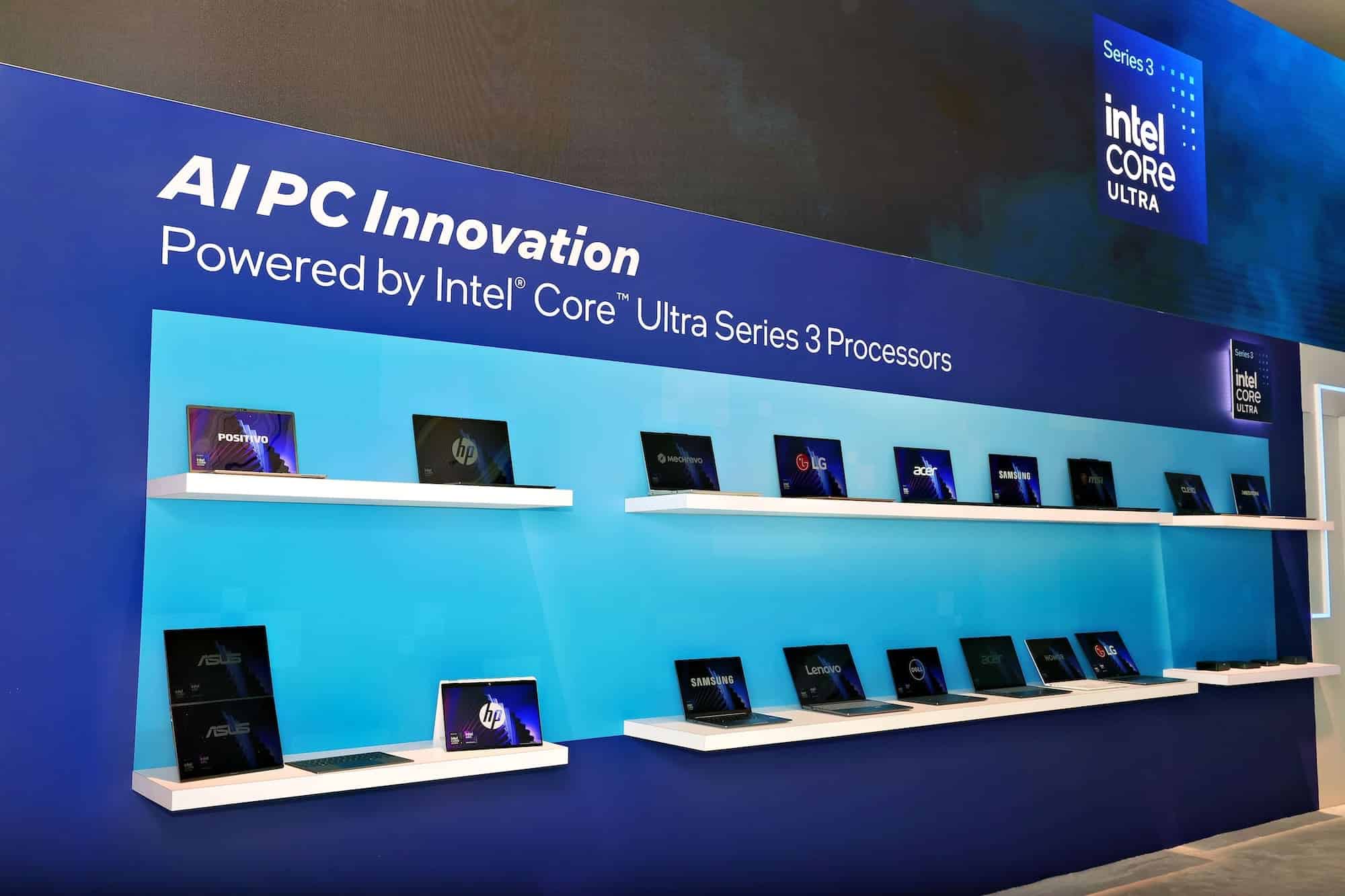
At CES 2026 in Las Vegas, Intel unveiled one of its most symbolic bets in recent years: the new Intel Core Ultra Series 3, introduced as the first computing platform built on Intel 18A, the most advanced manufacturing node the company claims to have developed and produced in the United States.
Beyond the headline, the move aims for something very specific: to turn the “AI PC” into a mass category, with enough autonomy for everyday use, power for content creation, and most importantly, an NPU (Neural Processing Unit) capable of handling AI tasks without always relying on the cloud. In the announcement, Intel emphasizes that the Series 3 family will drive more than 200 PC designs from global partners and that it will be, according to its own definition, their most widely adopted AI PC platform to date.
A range designed for laptops… and also for edge applications
One of the most repeated messages from Intel during this presentation is that it’s not just about personal computers. For the first time, the company claims that these processors are tested and certified for embedded and industrial edge uses, citing scenarios such as robotics, automation, smart cities, or healthcare.
This “dual life” — PCs and edge — aligns with the trend of bringing AI inference as close to the data as possible: less latency, more control, and less reliance on connectivity. Intel promotes this as a way to simplify deployments: more AI capability integrated into a single SoC, instead of combining discrete CPU and GPU in more complex architectures.
The leap from X9 and X7 models: Arc graphics and up to 50 TOPS in NPU
Within the mobile family, Intel highlights a new “class” of processors, Core Ultra X9 and X7, aimed at users who blend productivity, creation, and gaming in a single device. The brand emphasizes two main points: Intel Arc integrated graphics and a set of specifications that, in their top models, reach up to 16 CPU cores, 12 Xe-cores, and 50 TOPS in NPU.
In terms of performance, the announcement includes comparative figures (always based on Intel’s methodologies and configurations) with promises such as up to 60% higher multi-core performance, over 77% improvement for gaming, and up to 27.1 hours of battery life in Netflix playback on a reference design.
These figures are crafted for the CES showcase, but also to send a message to the market: an “AI-enabled” laptop can’t just be a label; it has to feel fast, last many hours, and handle modern workloads without overheating or becoming noisy.
The edge advantage: LLMs, video, and VLA models
Intel supports its “AI at the edge” message with comparisons focused on specific workloads. According to their estimates, Core Ultra Series 3 can deliver up to 1.9× more performance on language models (LLMs), up to 2.3× better performance per watt per dollar in end-to-end video analytics, and up to 4.5× higher throughput in VLA (vision-language-action) models.
The key nuance here is the target customer: industrial integrators, vision solution manufacturers, in-store retailers with analytics, or medical and laboratory systems that cannot—or prefer not to—depend on constant connections to external services. For this audience, the promise isn’t just “more TOPS,” but a more practical equation: total cost, 24/7 reliability, and repeatable deployments.
Dates: imminent pre-sale and global availability in January
Regarding availability, Intel sets a very specific timeline: pre-sales of the first laptops begin on January 6, 2026 and global availability kicks off on January 27, 2026, with more designs released throughout the first half of the year. For industrial/edge applications, the company targets systems in Q2 2026.
If the key message of CES is to shape the narrative, Intel has tried to position this launch as a tipping point: a new wave of AI PCs, with 18A manufacturing as a technological hallmark, and a family that aims to extend beyond laptops into factories, streets, and critical environments.
Frequently Asked Questions
What does it mean that the Intel Core Ultra Series 3 are “built on Intel 18A”?
It means that Intel presents this generation as the first platform based on its Intel 18A process, which the company describes as its most advanced node developed and manufactured in the United States.
What does an NPU of up to 50 TOPS in a laptop mean for real-world use?
It enables local execution and acceleration of AI tasks (such as productivity functions, effects in video calls, or creative workflows), reducing dependence on the cloud and improving latency and privacy depending on the use case.
Why does it matter that the Series 3 is certified for industrial edge applications?
Because it opens the door to deploying the same chip (and part of the software ecosystem) in embedded and industrial environments that require 24/7 reliability and specific operational conditions.
When will the first laptops with Intel Core Ultra Series 3 be available?
Intel anticipates pre-sales starting on January 6, 2026, with global availability beginning on January 27, 2026.
via: newsroom.intel