
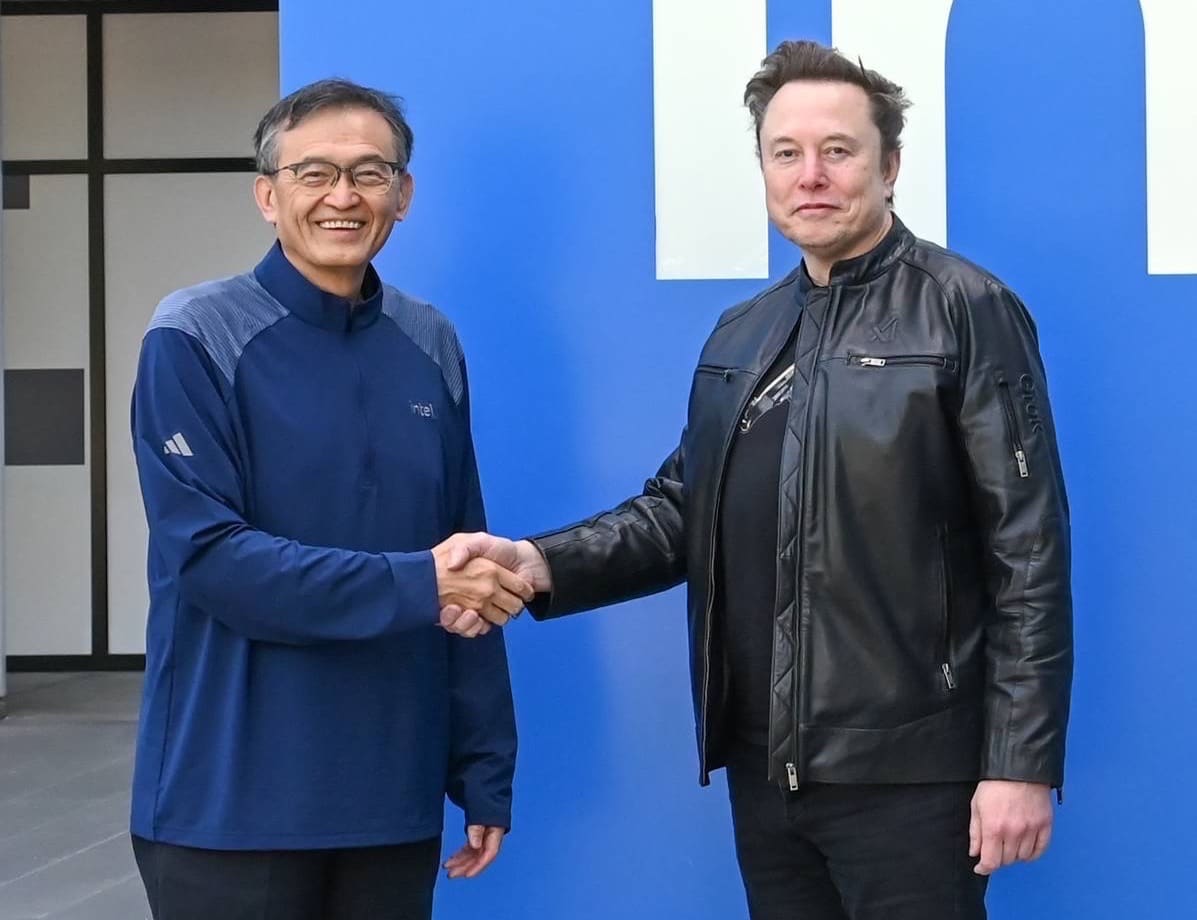
Intel has formalized its entry into Terafab, the ambitious chip manufacturing project driven by Elon Musk’s ecosystem and connected to Tesla, SpaceX, and xAI. Intel announced this on its official X account, stating that it joined Terafab to “refactor” semiconductor manufacturing technology and help accelerate the project’s goal: producing 1 TW of compute capacity annually for future artificial intelligence and robotics applications. Reuters later confirmed that Intel would participate in Musk’s AI chip complex alongside SpaceX and Tesla, with the announcement accompanied by a photograph of Lip-Bu Tan and Musk after the entrepreneur’s visit to Intel facilities.
This move is significant for two reasons. The first is industrial: Musk had been warning for months that external chip supply would not suffice for Tesla’s and his other projects’ future needs. The second is strategic: Intel sees Terafab as a high-visibility anchor client at a time when its foundry business needs to demonstrate its ability to attract major contracts and better leverage its advanced manufacturing technology.
Terafab is born to address the silicon bottleneck
The idea of Terafab didn’t emerge out of nowhere. In November 2025, Musk already stated that Tesla would likely need to build “a gigantic chip factory” because, even extrapolating the best-case scenario from its suppliers, supply was still insufficient. During that speech, he even suggested that Intel could be a possible option, though no agreement had been signed at that point. On March 14, 2026, Reuters reported that Musk announced Terafab would start in a week, recalling that he was still collaborating with TSMC and Samsung while insisting supply still hadn’t reached the needed scale.
One week later, on March 22, Reuters reported that SpaceX and Tesla would build two advanced chip factories in Austin, Texas, within the same complex. According to the information, one facility would focus on chips for vehicles and humanoid robots, while the other would serve AI data centers in space. Musk’s declared goal was enormous: 1 teravalue of compute capacity annually, making Terafab a much larger industrial bet than a conventional supply expansion.
With Intel’s announcement, that project gains a piece Musk didn’t have internally: direct experience in industrializable design, wafer fabrication, and large-scale advanced packaging. Intel highlighted these three capabilities in its public message, and Reuters added that its contribution would help accelerate the 1 TW/year target. This doesn’t mean Intel will immediately replace all of Musk’s current suppliers, but it does strengthen the industrial credibility of an initiative that until now might have seemed overly dependent on Tesla founder narratives.
Intel gains a prominent partner amid its foundry reconstruction
For Intel, the move also has strategic implications. The company is still working to rebuild credibility for Intel Foundry, a division that continues to record significant losses. Reuters highlighted this week that Intel Foundry closed 2025 with a $10.32 billion operating loss and only a 3% revenue growth. Concurrently, the company is trying to convince the market that its turnaround under Lip-Bu Tan is beginning to bear fruit, supported by cost cuts, asset sales, and a renewed focus on processes like 18A.
This is where Terafab fits as a top-tier opportunity. Reuters reported on March 4 that Intel was reconsidering opening up 18A to external customers after reserving much of it for internal use. CFO David Zinsner mentioned that, after seeing “real progress,” the company was considering 18A as a suitable node for third parties as well. A project as large as Terafab doesn’t guarantee Intel Foundry’s success by itself, but it provides what it needs to change the narrative: huge potential demand, global media exposure, and a sign that Intel can still engage in major advanced silicon projects in the U.S.
This perspective is reinforced by Tesla’s context. The company isn’t starting from scratch in semiconductors. Reuters reported in July 2025 that Tesla signed a $16.5 billion deal with Samsung for chips, and that the Taylor, Texas plant would manufacture the future AI6. Additionally, the same outlet noted that Samsung currently produces Tesla’s AI4 chip, while TSMC is scheduled to produce AI5, initially in Taiwan and later in Arizona. In March 2026, Samsung also announced it expected to begin volume production of Tesla chips in late 2027. Seen this way, Intel isn’t entering to eliminate Samsung, TSMC, or NVIDIA but to add a new layer of industrial capacity and diversify geographically and technologically.
It doesn’t replace NVIDIA or TSMC, but it shifts the game
Probably the most critical point of the announcement. Terafab doesn’t seem designed to immediately cancel Musk’s current supply chain but to create an additional, more integrated, and potentially more controllable pathway in the long term. Musk will still depend on third parties for years to sustain Tesla, Optimus, SpaceX, and their AI platforms. But with Intel involved, the initiative moves beyond just a Musk-driven vertical integration narrative and begins to resemble a more credible industrial roadmap.
For Intel, the benefit is significant. After years trailing behind TSMC and NVIDIA in AI and advanced manufacturing discussions, partnering with Musk’s most ambitious chip project allows Intel to re-enter the tech debate’s center. It doesn’t instantly solve its execution problems or ensure future profitability, but it provides something Intel desperately needs: a growth story linked to AI, cutting-edge manufacturing, and clients capable of moving massive volumes. In a market where storytelling matters, Terafab offers Intel a timely opportunity.
Frequently Asked Questions
What exactly is Terafab?
Terafab is the project announced by Elon Musk to establish a large-scale advanced chip manufacturing complex in Austin, Texas, aimed at supplying Tesla, SpaceX, and his AI and robotics ecosystem. Reuters described it as a project with two advanced factories and a target of 1 TW of annual compute capacity.
What does Intel bring to the Terafab project?
Intel states it will contribute its ability to design, manufacture, and package ultra-high-performance chips at scale. Essentially, this positions Intel as a key industrial partner to make a significant part of the project viable.
Will Intel replace Samsung, TSMC, or NVIDIA for Tesla’s chips?
There’s no confirmation of that. Public sources indicate Tesla maintains relationships with Samsung and TSMC for different generations of chips, and Intel’s involvement seems more aimed at strategic diversification and capacity expansion rather than immediate replacement of those partners.
Why is this agreement so important for Intel?
Because Intel Foundry continues to incur high losses and needs to demonstrate it can attract major external clients. Terafab offers visibility, potential future volume, and a recovery narrative in advanced semiconductors and AI manufacturing.