
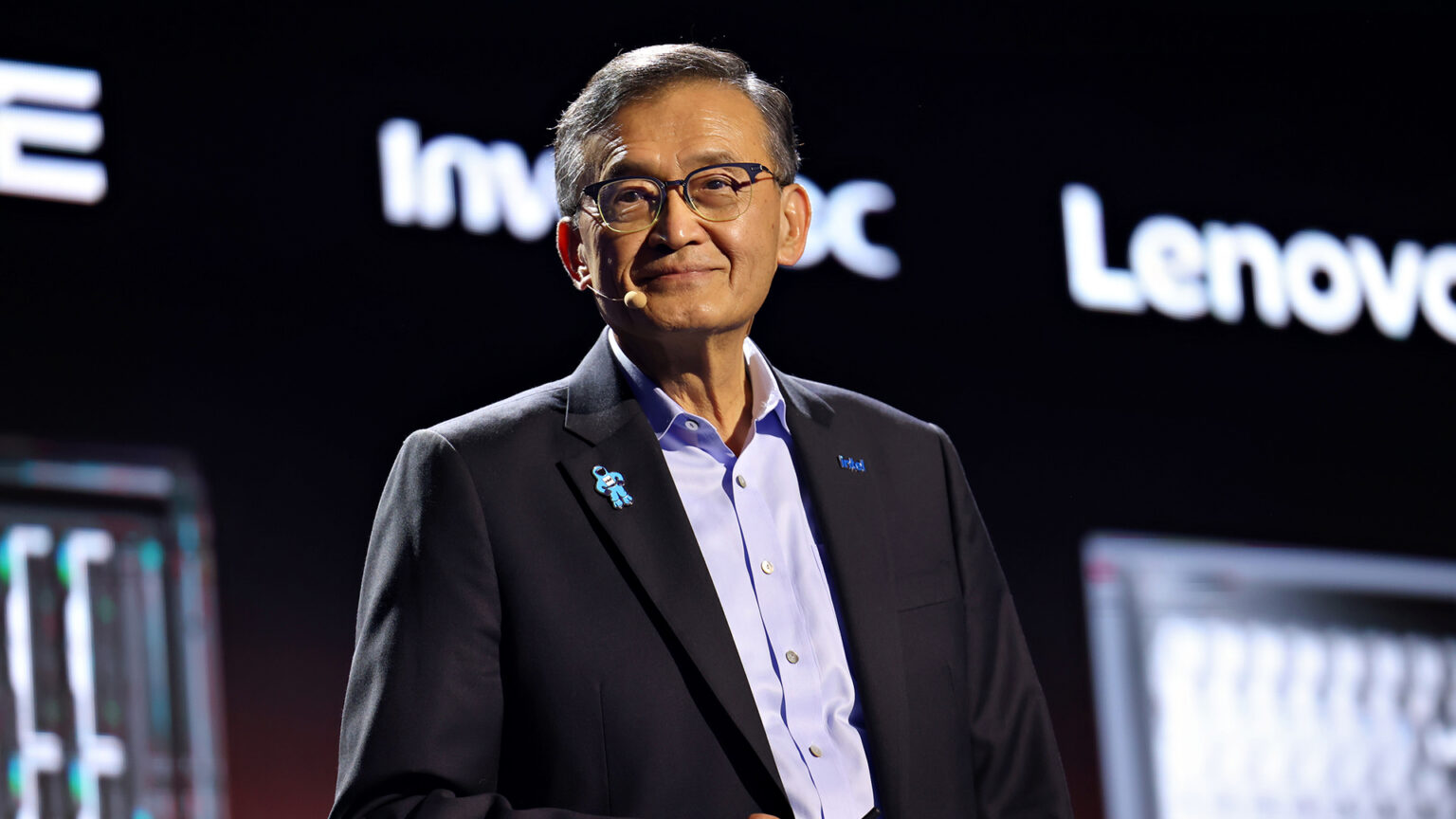
Intel took advantage of Computex 2026 to unveil a roadmap that aims to answer an uncomfortable question for the company: what role does it want to play in an AI industry dominated by NVIDIA in acceleration, TSMC in advanced manufacturing, and large hyperscalers in infrastructure deployment? Lip-Bu Tan, Intel’s CEO, responded not with a single bet but with a strategy spread across PC, edge, physical AI, data centers, inference, and custom silicon.
The Taipei presentation carried a very clear underlying message. Intel wants to remind everyone that x86 remains a massive foundation of global computing but also demonstrate that it’s not stuck in traditional servers. The company discussed processors built on Intel 18A, new designs for laptops and portable gaming, hybrid AI alongside Perplexity, Xeon 6+ for data centers, and collaborations with Foxconn, SambaNova, Google, Ericsson, Hitachi, and Siemens.
Intel 18A, new PCs, and the edge opportunity
The first part of the presentation focused on PCs and the edge. Alex Katouzian, responsible for Client Computing and Physical AI at Intel, covered the Core Ultra Series 3, the first product built on Intel 18A. The company presents it as a comprehensive XPU platform with CPU, GPU, and NPU working together to deliver performance, graphics, and battery life in premium devices.
Intel affirms that Core Ultra Series 3 is already present in over 325 consumer and business designs. They also reintroduced the Intel Core Series 3, a more generalist PC family that reuses the same IP as Core Ultra but with a broader focus: thin laptops, all-day battery, sufficient connectivity, and a premium experience in higher-volume devices.
The most notable client announcement was Intel Arc G3, designed for portable consoles and mobile gaming devices. The idea is to bring the architecture of Core Ultra Series 3 into a form factor where sustained performance, power consumption, and thermal experience are as important as maximum graphics power. This segment is growing, competing with AMD, Qualcomm, and custom designs, where Intel needs to prove it can deliver real efficiency beyond just x86 compatibility.
On the edge, Intel emphasized a broad installed base. The company reports over 130 edge designs based on 18A, more than 4,000 partners in its ecosystem, and over 100,000 deployments across manufacturing, robotics, retail, and other sectors. This highlights why Intel is so committed to “physical AI”: robots, autonomous machines, industrial devices, and systems running AI close to where data is generated.
Opportunities exist. Not all AI will reside in massive data centers; many workloads will need to operate in factories, stores, hospitals, vehicles, cameras, robots, or local devices due to latency, cost, privacy, or availability. Intel aims to fill that layer with CPUs, NPUs, integrated GPUs, and platforms tailored for specific sectors.
Hybrid AI: between device and cloud
One of the most interesting moments came with Aravind Srinivas, CEO of Perplexity. Intel and Perplexity championed the need for hybrid AI, where part of inference runs locally on the device and part in the cloud, depending on privacy, compliance, cost, available context, and computational capacity.
The approach is practical. Running everything in the cloud can be expensive and problematic for sensitive data. Running everything locally may fall short for tasks requiring large models, broad context, or external sources. The hybrid architecture allows deciding where each load executes: on the laptop, a local server, at the edge, or in the cloud.
Perplexity discussed a hybrid local inference orchestration server capable of moving loads dynamically between local and cloud environments based on device capabilities and task characteristics. For Intel, this fits with its historical positioning: millions of x86 devices already deployed and an enterprise base that doesn’t always want to send all data to external services.
This approach also ties into digital sovereignty and privacy. Regulated companies, governments, and industrial sectors may need models that work with sensitive information without leaving controlled environments. If Intel’s local and edge platforms can perform inference effectively and affordably, it could carve out a space against the dominance of large cloud-hosted models.
Xeon 6+ and the changing CPU-GPU ratio in autonomous AI
In data centers, Intel introduced Xeon 6+, built on Intel 18A with 288 e-cores and 576 MB of L3 cache. It’s positioned as a high-density, efficient solution for organizations preparing their infrastructure for AI without abandoning traditional critical workloads.
The key message wasn’t just the chip launch but Intel’s interpretation of autonomous AI. The company projects that inference workloads could account for nearly 40% of the data center’s power demand by 2030. Furthermore, it argues that autonomous agents are reshaping compute architectures because they don’t just respond once and finish; they think, plan, act, consult tools, and review results.
This behavior increases CPU demand. In frontier model training, a typical ratio is about one CPU per eight GPUs. Intel claims that in autonomous AI workloads, this ratio can shift toward 1:1 or even higher CPU density, because the processor coordinates reasoning, manages tools, orchestrates data, and governs workflows.
This is important for Intel. If AI is measured solely by accelerators, NVIDIA dominates. But if autonomous AI inference needs more CPU, coordination, rack-scale systems, and deeper integration with business workloads, Intel regains a competitive edge. It’s not enough to have GPUs; you need to feed agents, move data, run business logic, enforce policies, manage security, and coordinate workflows.
That’s where the partnership with Foxconn for rack-scale AI infrastructure comes in. Jerry Hsiao, Foxconn’s product director, explained that the Taiwanese manufacturer works with Intel and its partners to provide system integration capabilities for inference-optimized, rack-scale infrastructure. Foxconn already plays a key role in manufacturing AI servers and racks, so collaborating with Intel makes sense if the goal is complete solutions rather than just standalone processors.
Intel also highlighted collaborations with SambaNova, Vista Equity Partners, and Cambium Equity to develop more energy- and cost-efficient inference solutions. The Vector Core Compute project, described as a disaggregated cloud inference offering, will combine Intel rack-scale infrastructure with NVIDIA and SambaNova technologies. NVIDIA’s involvement shows a pragmatic approach: Intel can’t ignore GPU leadership, so it’s positioning itself in hybrid and disaggregated architectures where CPU and other accelerators also matter.
Customized silicon for Google, Ericsson, and vertical sectors
The final part of the presentation focused on custom silicon. Intel noted that many companies are now viewing their workloads as strategic assets and are seeking chips tailored to specific needs. Srini Iyengar, senior VP at Intel, explained that the company collaborates with Google on IPUs to optimize cloud provider performance and with Ericsson on chips for global wireless infrastructure.
This approach reflects market fragmentation. Large clients no longer necessarily want generic processors for everything. Hyperscalers design their own accelerators, telecom operators seek specific chips for networks, industrial firms need solutions for machinery and sensors, and AI introduces workloads with very distinct requirements depending on the sector.
Intel also mentioned partnerships with Hitachi, Siemens, Echo Neurotechnologies, and Greenstone Biosciences across areas like energy, industrial automation, biomedical engineering, and drug development. This showcases Intel Foundry and its design capabilities as a platform for vertical solutions, though the company will need to prove it can turn these alliances into sustainable revenue and competitive products.
Overall, Computex paints a picture of Intel in transition. The company seeks to leverage its x86 legacy but recognizes that’s no longer enough. It needs to successfully execute on Intel 18A, regain confidence in manufacturing, compete at the edge and in client markets, find a profitable role in inference, and produce custom silicon for large clients.
The opportunity is present. AI won’t just be training large models on GPU clusters. Inference, agents, local devices, robots, factories, enterprise servers, and specialized chips will all play roles. Intel aims to be positioned at these layers. Their challenge is not just to present a convincing strategy but to execute swiftly in a market that won’t wait.
FAQs
What did Intel present at Computex 2026?
New products and collaborations across PC, edge, physical AI, data centers, and inference, including Core Ultra Series 3, Intel Arc G3, Xeon 6+, and rack-scale AI infrastructure partnerships.
What is Intel Xeon 6+?
A new data center processor based on Intel 18A, with 288 e-cores and 576 MB of L3 cache, designed for high-density and efficient AI workloads.
Why does Intel focus so much on autonomous AI?
Because autonomous AI agents consume more tokens, coordinate multiple steps, and require more CPU for orchestration of data, tools, and procedures. Intel sees this as an opportunity to strengthen x86’s role in data centers.
What is Foxconn’s role in Intel’s strategy?
Foxconn will collaborate with Intel and partners to provide system integration for rack-scale inference infrastructure tailored for autonomous AI workloads.
via: newsroom.intel
