
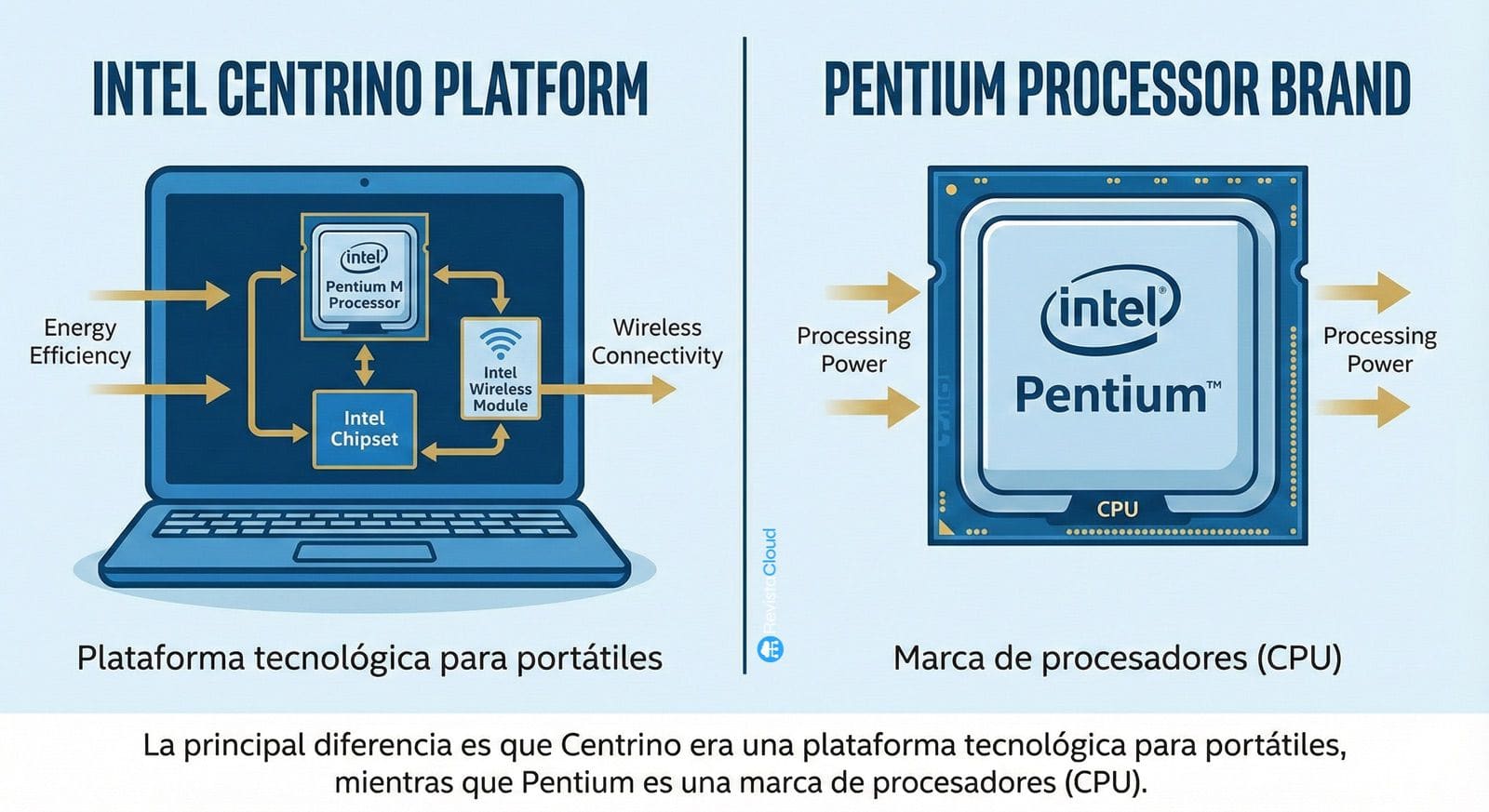
For years, many users have wondered which was better, Intel Centrino or Intel Pentium, as if they were two rival processors. In reality, the story is more nuanced: Centrino was not a CPU, but a complete mobile platform, while Pentium is a family of processors covering various generations for desktops and laptops.
Understanding this difference helps put into context a key era: the shift from bulky, hot, low-battery laptops to lightweight devices with integrated Wi-Fi and reasonable battery life.
Centrino: the platform that made “normal” Wi-Fi in laptops
Intel introduced Centrino in 2003 as a technology platform for laptops, not as a single chip. For a device to carry the Centrino logo, it had to meet three very specific requirements, all of which were Intel standards:
- An Intel mobile processor optimized for low power consumption
- Initially: Intel Pentium M (mobile architecture, different from Pentium 4).
- Later: processors like Core Duo and Core 2 Duo in the Centrino Duo and Centrino 2 evolutions.
- A specific Intel mobile chipset
- Designed to efficiently handle memory, bus, and power management functions.
- An Intel PRO/Wireless Wi-Fi module
- To ensure integrated and certified wireless connectivity.
The goal was clear:
Lighter laptops, better battery life, and factory-installed Wi-Fi, without relying on PCMCIA cards or external adapters.
Practically, buying a laptop with the “Intel Centrino” sticker meant that the device was optimized for mobile use: good battery life for its time, reasonable performance, and ready-to-use wireless connectivity.
Pentium: the CPU brand that started it all (and then declined)
On the other hand, Pentium is a processor brand that Intel launched in the early 1990s to replace the 486. For more than a decade, it was synonymous with “powerful computer.”
Over time, the Pentium family diversified:
- Pentium (classic), Pentium II, Pentium III
Desktop and laptop processors in the pre-Wi-Fi boom, focused on increasing performance. - Pentium 4
Designed for high clock speeds (over 3.0 GHz), especially desktops.
Its main weakness: high power consumption and heat, making it less suitable for slim, good-battery laptops. - Pentium M
This is where history intersects with Centrino.- It was a mobile processor designed from scratch for energy efficiency, not just a “capped” version of Pentium 4.
- It served as the main CPU for the original Centrino platform.
- From this line, architectures that inspired the first Intel Core processors would later emerge.
- Modern Pentiums (Pentium Gold, Pentium Silver, etc.)
Today, Pentium is used as a budget brand for entry-level processors, below the Core i3, i5, i7, and i9 families. It no longer represents the high-performance flagship, but an affordable basic option.
Comparison table: Centrino vs Pentium
Although they are not equivalent concepts, their main approaches can be compared:
| Feature | Intel Centrino (mobile platform) | Intel Pentium (processors) |
|---|---|---|
| Nature | Technology platform for laptops (CPU + chipset + Wi-Fi by Intel) | Processor brand (individual CPUs) |
| Scope | Only certified laptops meeting all three Intel components | Desktops and laptops, multiple generations and architectures |
| Main goal | Mobility: battery life, low power, and integrated Wi-Fi | Overall performance; today entry/mid-range |
| Energy efficiency | High, optimized for 24/7 mobile use | Very variable (from high-demand Pentium 4 to efficient Pentium M) |
| Wi-Fi connectivity | Required (Intel PRO/Wireless module) | Not part of the Pentium brand itself |
| Associated processor | Pentium M, then Core Duo / Core 2 Duo depending on the Centrino generation | Classic Pentium, Pentium II/III/4, Pentium M, Pentium Gold, etc. |
| Message to consumers | “Laptop designed for mobility and Wi-Fi” | “Intel processor in this performance/price segment” |
Basic timeline: from Pentium to Centrino and beyond
To better understand the evolution, a simplified timeline helps:
| Approximate Year | Intel Milestone | Key Comment |
|---|---|---|
| 1993 | Launch of the Pentium brand | Replaces the 486 as the main lineup |
| Late 90s | Pentium II / Pentium III | Growth of desktop PCs and first mass laptops |
| 2000–2001 | Pentium 4 | High speeds, but high power consumption and heat |
| 2003 | Launch of Intel Centrino | Mobile platform with Pentium M and integrated Wi-Fi |
| 2005–2006 | Centrino Duo / Centrino Pro / Centrino 2 | Era of Core Duo and Core 2 Duo in laptops |
| Since 2006 | Intel Core series (Core i3/i5/i7…) | Core replaces Pentium as the main performance line |
| Current era | Pentium Gold/Silver in low-end models | Pentium moves to the entry segment |
Examples of typical models and configurations
Typical “Centrino” laptop from the mid-2000s
- CPU: Intel Pentium M (e.g., 1.6–1.8 GHz, efficient architecture).
- Chipset: Optimized Intel mobile chipset for power management.
- Connectivity: Intel PRO/Wireless with Wi-Fi 802.11b or 802.11g.
- Advantages over earlier laptops:
- Significantly longer battery life.
- Less heat and quieter fans.
- Integrated Wi-Fi as a standard feature, not an “extra”.
Desktop PC with Pentium 4 from the same era
- CPU: Intel Pentium 4 at speeds like 2.8–3.2 GHz.
- Focus:
- Prioritizes raw performance and high MHz.
- Generates much more heat.
- Designed for desktop towers, without battery restrictions.
These examples clearly illustrate the different philosophies: Centrino targeted the portable device meant to accompany users outside the home, while many desktop Pentiums prioritized brute force without the same concern for power consumption.
Can we say that Centrino was “better” than Pentium?
The short answer is: it doesn’t make sense to compare Centrino and Pentium as if it were a direct duel. They didn’t exactly play in the same league.
- Centrino was a badge that guaranteed a specific combination of CPU + chipset + Wi-Fi, always focused on laptops.
- Pentium was (and is) a processor brand that can be found in desktops and laptops, with very different models.
The correct way to understand it is:
- A Centrino laptop always had an Intel processor (such as Pentium M or later Core).
- A machine with a Pentium processor could be part of a Centrino platform (if it met all the requirements), or not.
In other words:
Centrino encompassed Pentium M and other mobile CPUs in a platform; Pentium was a component within the set.
Legacy of Centrino and Pentium in today’s laptops
Although today users mainly see labels like Intel Core i3, i5, i7, or i9, the legacy of Centrino and Pentium evolution is reflected in several points:
- The idea that a laptop should have good battery life and integrated Wi-Fi directly comes from the Centrino era.
- Many energy-saving and performance-per-watt optimizations introduced with Pentium M laid the groundwork for early generations of Intel Core.
- Pentium, as a brand, shifted roles: from a symbol of top performance to a label for basic and affordable processors, while Core took over the mid and high-end segments.
For those encountering an old laptop with a Centrino sticker or Pentium M processor today, you are looking at a key transitional piece: the moment when laptops ceased to be simply “cut-down desktops” and started to be devices truly designed for portability.
Frequently Asked Questions about Intel Centrino and Pentium
1. Was Centrino a processor or something different?
Centrino was not a processor, but a mobile platform. To use the brand, laptops had to integrate an Intel mobile processor (like Pentium M), an Intel mobile chipset, and an Intel Wi-Fi module. Only then could they carry the Centrino logo.
2. What role did Pentium play within Centrino?
In the first generation, the main processor of the platform was Pentium M, a CPU specifically designed for laptops with low power consumption. Later, Centrino incorporated Core Duo and Core 2 Duo processors, but the core concept remained: unifying CPU, chipset, and Wi-Fi under one brand.
3. Why were Pentium 4 chips poorly suited for thin laptops?
Pentium 4 was designed for very high clock speeds, which resulted in higher power consumption and heat. In laptops, this meant shorter battery life and noisier cooling systems. Pentium M, used in Centrino, focused on the opposite: lower power, better performance per watt, and more portable designs.
4. What do Pentium processors mean today compared to Intel Core?
Currently, Pentium processors are in the entry-level segment, aimed at basic and budget-friendly devices. Above them are the Intel Core series (i3, i5, i7, i9), delivering higher performance and advanced features. The Pentium brand no longer signifies the top of performance but is a more affordable option for simple tasks.